
Fujian Tulou in Yongding: earthen fortresses of communal life
Published on 08/22/2026 at 14:46 | Editorial responsibility: Rafael Müller, Editor-in-Chief AD HOC NEWS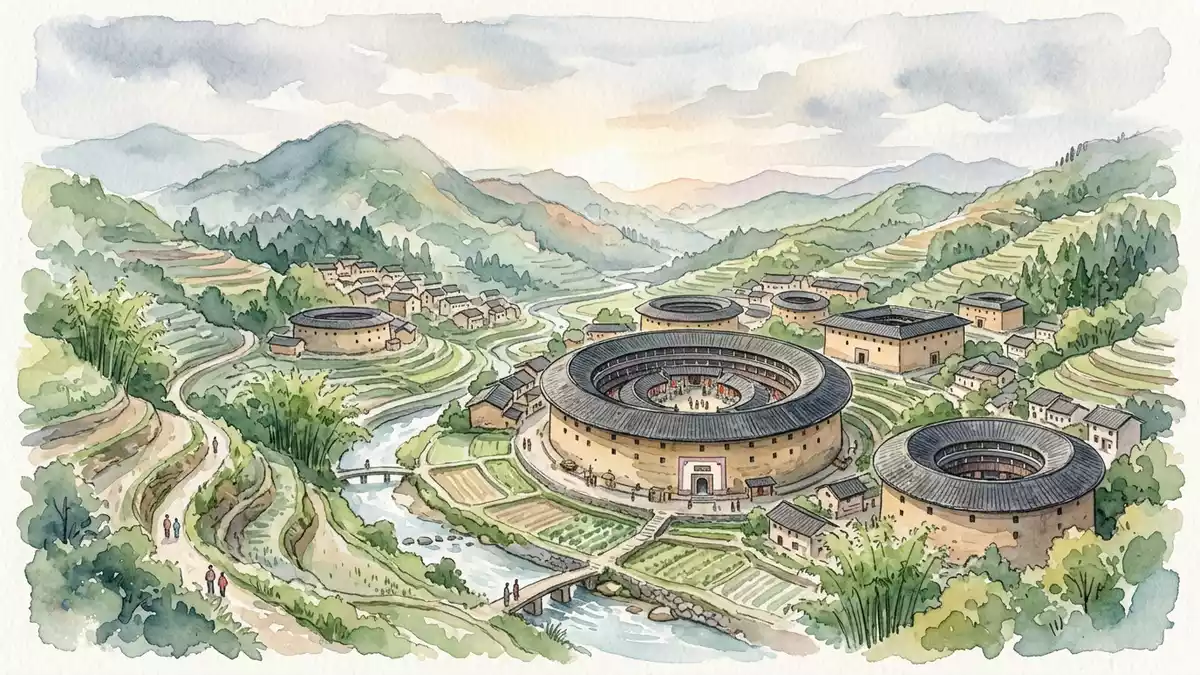
Fujian Tulou in Yongding are monumental earthen dwellings where entire clans have lived behind thick rammed earth walls in the hills of south-western China. Built between the fifteenth and twentieth centuries, these fortified residences turn everyday rural life into something architecturally grand.
Earthen fortresses in Fujian’s mountains
The term “tulou” literally combines “earth” and “multi-storey building”, and it describes large enclosed houses constructed from rammed earth and timber in the inland valleys of Fujian province. Fujian Tulou as a World Heritage property comprises 46 earthen residential buildings spread across Yongding, Nanjing and Hua'an counties in south-western Fujian, inland from the Taiwan Strait.46 earthen residential buildings Within Yongding, clusters such as Chuxi village bring together several tulou around terraced fields and wooded slopes, so that the architecture and the landscape read as one.Chuxi Tulou cluster in Yongding County
These buildings rise as multi-storey defensive shells around a large central courtyard, with foundations made from stone laid on compacted ground, above which the tall earthen walls stand. The core structural idea uses rammed earth strengthened with wooden beams and columns, creating an outer ring that is both monumental and practical.rammed earth walls and wooden beams Inside, timber galleries, staircases and small roofs divide the vertical living units, while the main courtyard remains open as the shared heart of the building.
Architecture of communal living
A typical Fujian Tulou combines outer rammed earth walls with internal wooden construction, creating stacked housing units that belong to different branches of the same clan. The exterior wall has only a single monumental entrance and openings high on the upper levels, while inside a regular grid of dwellings lines the courtyard.identical serial housing units Floors, galleries and stairways are of wood, and hip-and-gable roofs with tiled surfaces cover both the outer ring and the inner buildings.
Many tulou take a rounded plan, while others are square or follow more complex outlines, yet they share a clear emphasis on enclosure and a generous common space in the centre. Built between the fifteenth and twentieth centuries in fertile mountain valleys, they express a long tradition of collective residential architecture tied to Hakka communities and other local groups.built between the thirteenth and twentieth centuries Thick earthen walls, ancestral halls, granaries and shared facilities make each building a self-contained settlement as well as a single architectural object.
From rural strongholds to World Heritage
In 2008, Fujian Tulou was inscribed on the UNESCO World Heritage List as an outstanding example of communal living and defensive organisation in harmony with its environment.inscribed on the UNESCO World Heritage List in 2008 The inscription covers earthen buildings across Yongding, Nanjing and Hua'an, but Yongding’s tulou clusters, including those around Chuxi, are central to the story of how these structures developed in Fujian’s uplands.Fujian province is home to five UNESCO World Heritage sites, including Fujian Tulou
The communal architecture visible in Yongding’s tulou reflects long-settled rural society arranged around extended families, ancestral worship and shared cultivation of surrounding fields. UNESCO highlights the way these large fortified residences demonstrate a particular type of settlement pattern and defensive structure intertwined with the mountain landscape.exceptional examples of a building tradition and function Standing on the packed earth of a courtyard, with the encircling wall and tiers of wooden galleries above, it is clear that the architecture and social life were conceived together.
Visiting Fujian Tulou: what travellers from Western Europe should know
- Fujian Tulou clusters in Yongding lie in the inland hills of south-western Fujian province, reached from larger cities in the region by road and regional buses.
- The tulou dwellings in Yongding stand on uneven ground among fields and slopes, with internal stairways and wooden galleries that require steady footing on steps.
- The surrounding terrain combines narrow rural roads, village lanes and paths across terraced land, so visiting often involves short walks on packed earth and stone surfaces.
- The official language is Chinese and the currency is the renminbi.
- Entry requirements depend on your nationality; UK travellers can check the FCDO travel advice at gov.uk/foreign-travel-advice, Irish travellers the Department of Foreign Affairs at ireland.ie.
Searching for Fujian Tulou on social platforms
These links open searches for Fujian Tulou on each platform.
Frequently asked questions about Fujian Tulou
Where are Fujian Tulou located?
Fujian Tulou are scattered across the inland counties of Yongding, Nanjing and Hua'an in Fujian province in south-eastern China, with notable clusters in Yongding.
What should visitors expect inside a tulou?
Visitors encounter an enclosed earthen ring with a large courtyard, timber galleries and stacked housing units, together forming a complete residential community in a single building.
What makes Fujian Tulou distinctive among rural dwellings?
The combination of tall rammed earth walls, defensive layout, shared central spaces and multi-storey clan housing makes Fujian Tulou distinctive as both architecture and rural settlement pattern.


