
Fushimi Inari Taisha and Kyoto's vermilion mountain
Published on 09/09/2026 at 08:53 | Editorial responsibility: Rafael Müller, Editor-in-Chief AD HOC NEWS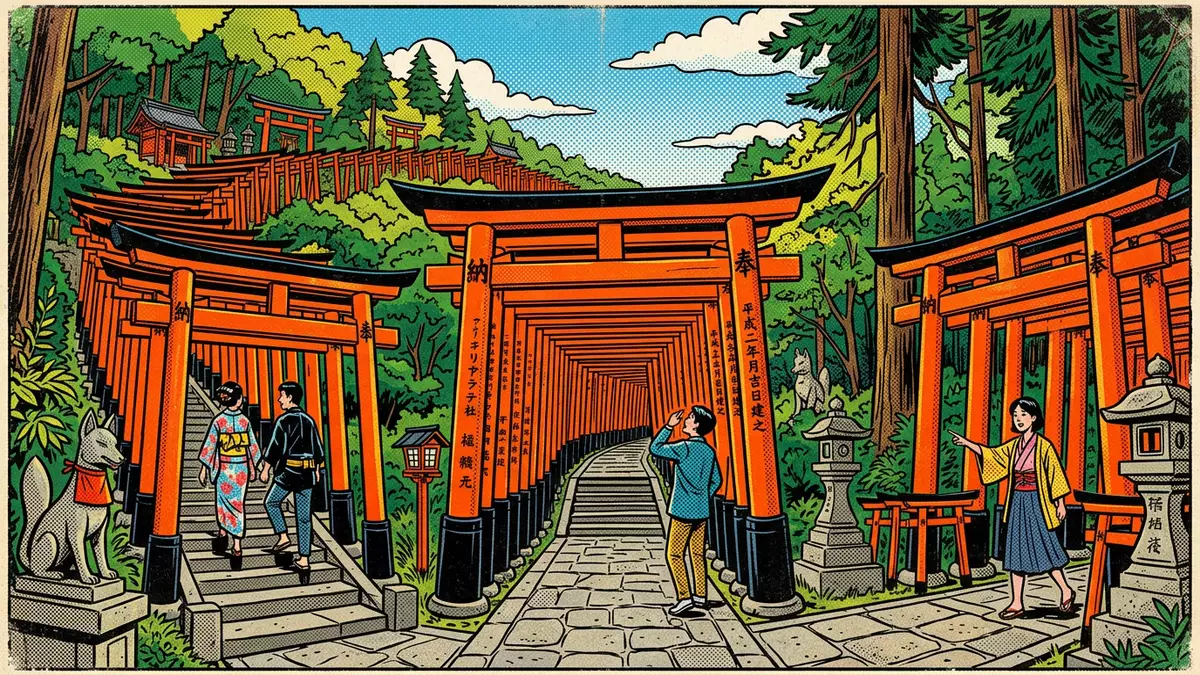
Fushimi Inari Taisha in Kyoto spreads across Inariyama, where vermilion gates, shrine buildings and wooded slopes form a single religious landscape. Its origin is traditionally dated to 711, and it remains the head shrine of Japan’s Inari shrines.
A shrine on Inariyama
The shrine’s setting on Inariyama gives it an unusually broad footprint for a shrine precinct. The mountain is part of the sacred ground, and small shrines, stones and torii appear along the routes through the hill.
That hillside setting shapes the visitor’s first impression more than any single building. The place reads as a sequence of thresholds, with the approach moving between open spaces, gates and halls.
711, 1499 and the rebuilt core
The shrine’s history reaches back to the Nara period, with its enshrinement linked to 711 and the Hata clan. In later centuries, the precinct was rebuilt after damage, and the main shrine building dates in its present form to 14991499.
The romon gate was added in 1589 with support from Toyotomi HideyoshiToyotomi Hideyoshi, and the main shrine building was designated an Important Cultural Property in 19091909. The complex therefore brings together medieval rebuilding and early modern patronage within one surviving shrine landscape.
Torii, halls and shrine compounds
What distinguishes the place most visibly is the long sequence of torii that climbs the mountain. The gates create a dense red corridor in places, but the shrine is not only about that famous path; the halls, auxiliary shrines and stone markers remain important parts of the compoundauxiliary shrines.
The main shrine building contains five shrines together: a lower shrine, a middle shrine, an upper shrine and the Tanaka and Shino-Okami shrinesfive shrines together. That arrangement makes the core sanctuary more layered than a single hall viewed in isolation.
Visiting Fushimi Inari Taisha: what travellers from Western Europe should know
- The shrine lies in Fushimi-ku, Kyoto, and the approach is tied to the mountain rather than a single courtyard. Kyoto’s JR and Keihan rail networks both serve the wider area.
- The ground rises onto Inariyama, and the precinct includes slopes, steps and mountain paths. Some routes continue into wooded terrain beyond the main halls.
- The official language is Japanese and the currency is the yen.
- Conditions on the mountain change with the seasons; the local cable-car operators and alpine clubs provide information.
Searching for Fushimi Inari Taisha on social platforms
These links open searches for Fushimi Inari Taisha on each platform.
Frequently asked questions about Fushimi Inari Taisha
Where is Fushimi Inari Taisha?
It stands in Fushimi-ku in southern Kyoto, on and around Inariyama. The shrine precinct extends up the mountain rather than ending at a single gate or hall.
What does a visit involve?
The place combines shrine buildings, torii and mountain paths. The ground becomes steeper away from the main sanctuary, and the precinct continues into wooded slopes.
What makes it distinctive?
Its vermilion gates and mountain setting define the site, along with the long history tied to 711, the Hata clan and later rebuilding in 1499. The main shrine building, the romon gate and the layered sanctuary give the place a complex architectural core.


