
Gallerie degli Uffizi and the long rooms of Renaissance art
Published on 09/24/2026 at 11:52 | Editorial responsibility: Rafael Müller, Editor-in-Chief AD HOC NEWS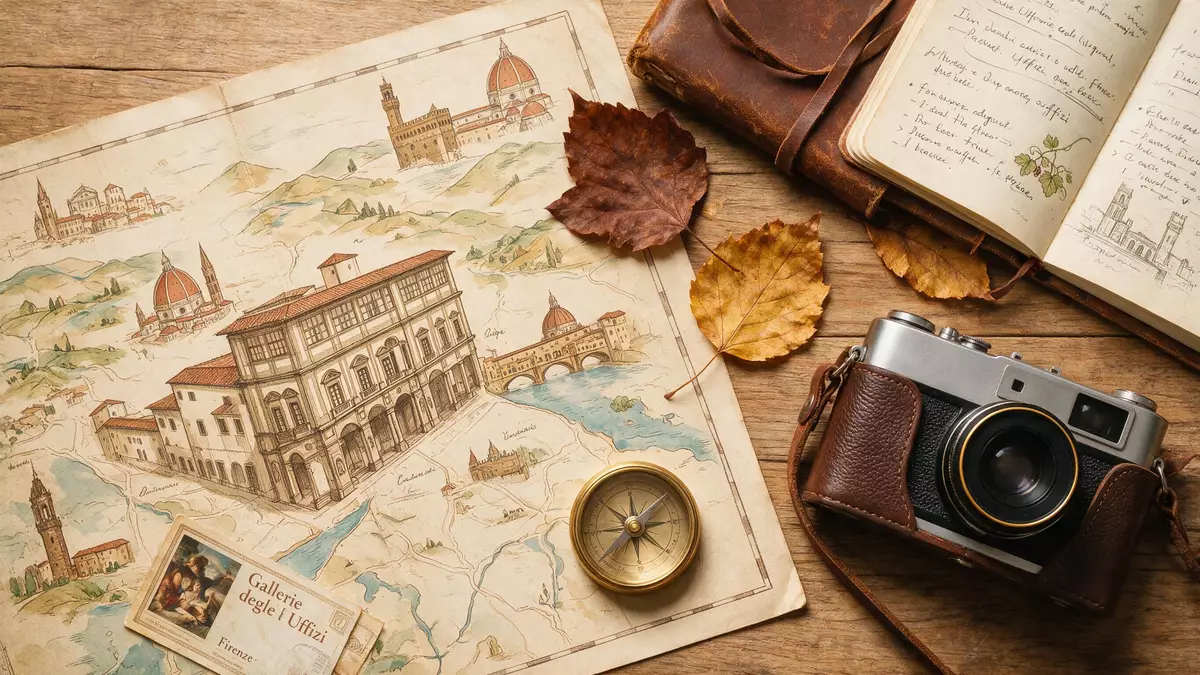
Gallerie degli Uffizi occupies a long sixteenth-century palace beside the Arno in Florenz. Its corridors and rooms hold paintings, ancient sculpture, drawings and prints, with the building itself forming part of the visit.
The gallery fills the first and second floors of the palace designed by Giorgio Vasari between 1560 and 1580. That combination of ordered architecture and concentrated Renaissance art gives Gallerie degli Uffizi its distinctive character.
Giorgio Vasari’s palace beside the Arno
Cosimo I de’ Medici commissioned Giorgio Vasari to design the building in 1559. Construction began in 1560, and the palace was completed in 1580. Its original function was administrative: the name Uffizi comes from the Italian word for offices.
The building is a major example of sixteenth-century Italian Mannerist architecture. Its long wings define the Uffizi courtyard, while the upper levels contain the museum galleries. The palace’s Mannerist design remains closely associated with Vasari’s name.
From Medici collections to a public museum
The art collection grew from the holdings of the Medici family. After Cosimo I died in 1574, Francesco I de’ Medici commissioned Bernardo Buontalenti to adapt the top floor for works gathered by the dynasty.
The gallery opened to the public in the eighteenth century, and its collections remained in Florenz through a pact connected with the transfer of Medici property to the Lorraine family. The museum’s history therefore joins dynastic collecting with the civic identity of Tuscany.
Gallerie degli Uffizi became part of the Gallerie degli Uffizi museum complex in 2014, alongside Palazzo Pitti and the Boboli Gardens. The three sites contain art, craft objects, books and botanical collections connected with the Medici, Habsburg-Lorraine and Savoy families.
Paintings, sculpture and the Renaissance rooms
The collection spans Western art from the Middle Ages to the modern period. Florentine painting forms its central thread, with works associated with Giotto, Simone Martini, Piero della Francesca, Fra Angelico, Filippo Lippi, Botticelli, Leonardo, Raphael, Michelangelo and Caravaggio.
Sandro Botticelli’s paintings occupy a particularly important place in the gallery’s Renaissance sequence. The collection also includes European works, especially from German, Dutch and Flemish traditions. The Uffizi painting collection is accompanied by ancient Roman copies of lost Greek sculptures, Medici busts and other antiquities.
Drawings and prints add another dimension to the museum. They record preparation, study and artistic invention alongside finished paintings. The corridors, sculpture displays and framed works create a continuous relationship between architecture and collection.
Visiting Gallerie degli Uffizi: what travellers from Western Europe should know
- Gallerie degli Uffizi stands beside Piazza della Signoria in central Florenz, near the Arno and the Palazzo Vecchio. The historic centre is served by city buses and reached on foot from Florenz railway station.
- The museum occupies the first and second floors of a historic palace. The visit includes corridors, staircases and large gallery sequences, while lifts provide an alternative route between levels.
- The Uffizi complex is connected culturally with Palazzo Pitti and the Boboli Gardens. The Vasari Corridor links the Uffizi area with Palazzo Pitti across the Arno.
- The official language is Italian and the currency is the euro.
Searching for Gallerie degli Uffizi on social platforms
These links open searches for Gallerie degli Uffizi on each platform.
Frequently asked questions about Gallerie degli Uffizi
Where is Gallerie degli Uffizi?
Gallerie degli Uffizi is in central Florenz, beside Piazza della Signoria and close to the Arno, Palazzo Vecchio and the historic centre.
What can visitors expect inside?
The museum presents Renaissance and later paintings, ancient sculpture, Medici busts, drawings and prints across the first and second floors of Vasari’s palace.
What makes the museum distinctive?
Its identity rests on the meeting of a sixteenth-century Mannerist building with major Florentine works by Botticelli, Leonardo, Raphael and Michelangelo.


