
Gamcheon Munhwa Maeul and Busan’s stepped hillside homes
Published on 09/23/2026 at 00:55 | Editorial responsibility: Rafael Müller, Editor-in-Chief AD HOC NEWS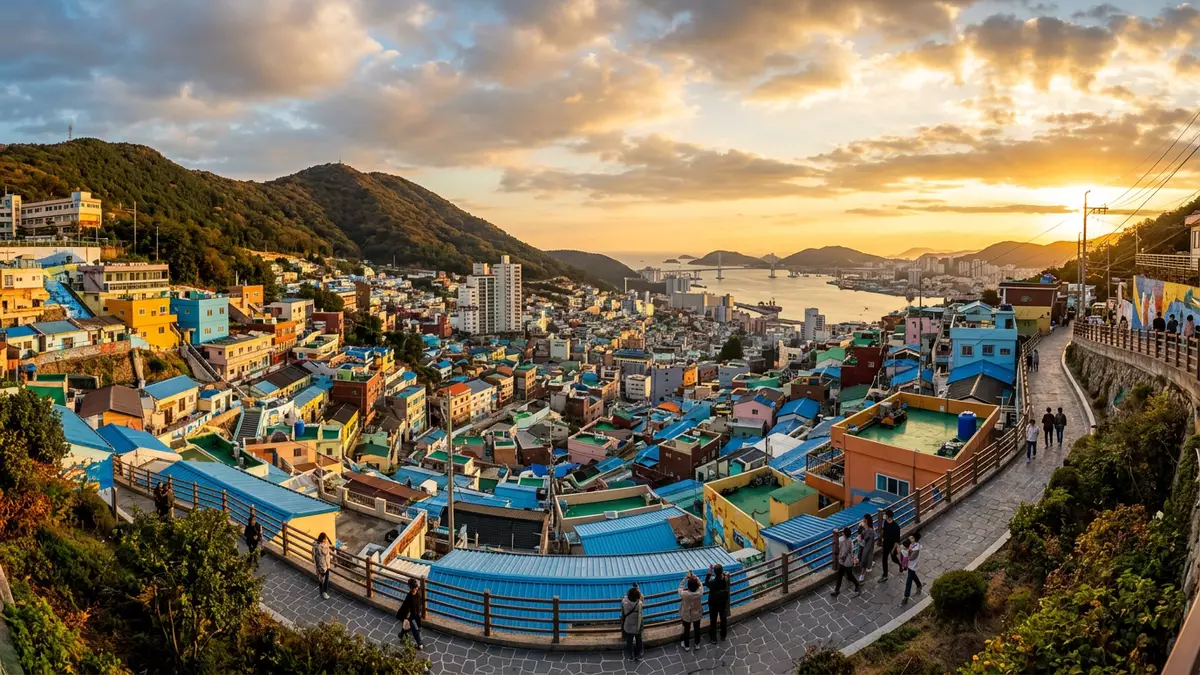
Gamcheon Munhwa Maeul is a hillside neighbourhood in Saha District, Busan, where painted homes rise in stepped rows above the city. Its layered streets, bright façades and public artworks form a visible record of a settlement shaped during the Korean War era.
Gamcheon Munhwa Maeul rises in painted terraces
Viewed across the slope, the neighbourhood appears as a dense field of small houses arranged on successive levels. Roofs, walls, stairways and retaining surfaces create a compact urban landscape rather than a single enclosed attraction.
The terrain is closely tied to the character of the place. Narrow passages connect homes at different elevations, while stairways link lanes that climb through the settlement. Colourful façades appear beside unpainted walls, tiled roofs, concrete steps and open views towards Busan.
Public art occupies many parts of the neighbourhood. Murals, sculptures, galleries and painted surfaces sit among ordinary homes, cafés and local businesses. The result is a lived-in district where art and residential architecture share the same hillside.
From Korean War settlement to cultural district
Gamcheon Munhwa Maeul developed during the 1950s, when Busan received people displaced by the Korean War of 1950–1953. The settlement’s history is also connected with Taegeukdo, a Korean religious movement whose community lived on the hillside.
In 1955, around 800 Taegeukdo families moved to the area during the post-war reconstruction period. The date and the community remain central to the neighbourhood’s historical identity. Gamcheon’s 1950s history is visible in the compact arrangement of homes and lanes.
The district’s cultural role took shape through an art-led regeneration project in 2009. Murals, installations and small creative spaces were added across the residential area, while the older hillside layout remained part of the setting.
Art, lanes and the geography of Busan
Gamcheon Munhwa Maeul occupies Gamcheon-dong in western Busan, within Saha District. The settlement lies above the harbour-facing parts of the city, with houses following the contours of a steep urban slope.
Its visual character comes from relationships between elements that are easy to see on foot: a painted wall beside a domestic doorway, a sculpture at the edge of a stairway, or a roofline continuing across several levels.
The village’s name is commonly associated with its cultural identity, while its Korean name is ??????. It is a neighbourhood rather than a reconstructed historical monument, and daily residential life remains part of its character.
The Taegeukdo connection adds a specific historical layer to the colourful streets. The 1955 relocation links the present hillside community with Busan’s post-war history.
The district also belongs to a wider story of twentieth-century Korean urban development. Refugee settlement, religious community life, modest housing and public art appear together within a small area of western Busan.
Visiting Gamcheon Munhwa Maeul: what travellers from Western Europe should know
- Gamcheon Munhwa Maeul is in Gamcheon-dong, Saha District, in western Busan. The Busan Subway reaches Toseong Station, followed by a local bus or taxi towards the hillside neighbourhood.
- The settlement occupies steep ground. Visits involve stairways, sloping lanes and uneven changes between residential levels.
- Gamcheon Munhwa Maeul is a living neighbourhood. Homes, small businesses, galleries, murals and sculptures stand together along the same passages.
- The official language is Korean and the currency is the South Korean won.
- Entry requirements depend on your nationality; UK travellers can check the FCDO travel advice at gov.uk/foreign-travel-advice, Irish travellers the Department of Foreign Affairs at ireland.ie.
Searching for Gamcheon Munhwa Maeul on social platforms
These links open searches for Gamcheon Munhwa Maeul on each platform.Frequently asked questions about Gamcheon Munhwa Maeul
Where is Gamcheon Munhwa Maeul?
Gamcheon Munhwa Maeul is in Gamcheon-dong, Saha District, in western Busan, South Korea. It occupies a steep hillside above the harbour-facing parts of the city.
What can visitors expect there?
Visitors encounter narrow lanes, stairways, painted homes, murals, sculptures, galleries and local businesses. The neighbourhood remains a residential district rather than a single museum complex.
What makes the neighbourhood distinctive?
Its distinctive character comes from the combination of stepped hillside housing, bright façades, public art and a history linked to the Korean War era and Taegeukdo.


