
Gateway of India and the sweep of Mumbai’s harbour
Published on 08/23/2026 at 13:39 | Editorial responsibility: Rafael Müller, Editor-in-Chief AD HOC NEWS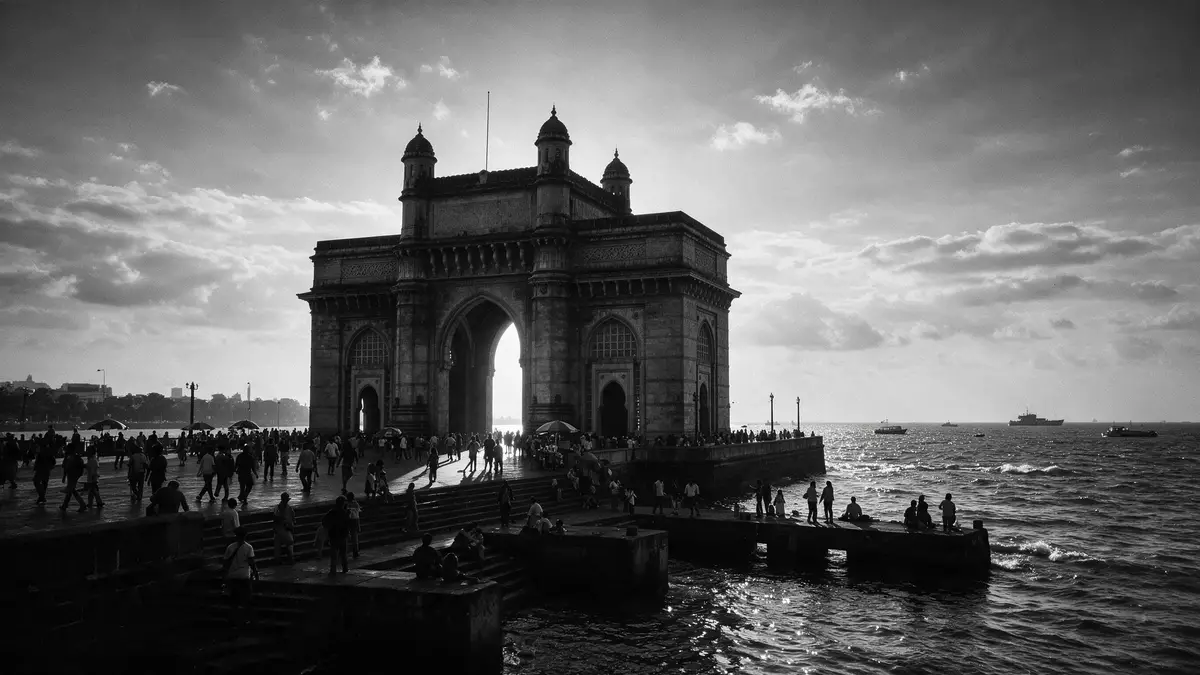
Gateway of India rises from Mumbai’s waterfront as a basalt arch by George Wittet, completed in 1924. Its scale and harbour setting make the monument easy to read from the promenade and the sea approach.
A basalt arch on the harbour edge
The monument stands on Apollo Bunder, facing the Arabian Sea and the busy edge of Colaba. Yellow basalt and reinforced concrete give the arch its solid, pale surface, while the central opening lifts above a broad ceremonial base.
The design belongs to the Indo-Saracenic current associated with late colonial Bombay, and Wittet’s name remains central to its identity. Gateway of India was completed in 1924 and opened on 4 December 1924 by the Earl of Reading, the Viceroy of India.George Wittet’s design completed in 1924
Empire, ceremony and public memory
The Gateway was associated with imperial arrivals and departures, and the site later acquired a second historical layer through independence-era memory. The arch is linked with the departure of the last British troops from India in 1948, a date that sits beside its earlier ceremonial role.
That combination of dates matters because the building is read as both a colonial monument and a civic landmark in present-day Mumbai. The structure’s life in public space has long outlasted the political order that produced it.last British troops 1948
Indo-Saracenic detail in public view
The arch combines elements associated with Hindu and Muslim traditions within a colonial composition, a mixture that is visible in the profile and ornament rather than in any single detail. That formal blend is part of what gives the monument its recognisable presence on the waterfront.
The site is also linked with the wider architectural career of Wittet, who worked in Bombay and is associated with several major civic buildings in the city. Gateway of India remains the most publicly visible of his Bombay commissions and the easiest to encounter from the harbour front.Indo-Saracenic current George Wittet
Visiting Gateway of India: what travellers from Western Europe should know
- The monument stands at Apollo Bunder in Colaba, near the city’s harbour edge and the shoreline promenades. Public ferries and local traffic serve the area.
- The approach is level, but the site is exposed and open to the harbour air. The arch itself is raised above a broad paved forecourt.
- The setting includes views across the water towards the harbour, with boats moving close by the monument. That gives the place a strong maritime character.
- The official language is Marathi and the currency is the Indian rupee.
Searching for Gateway of India on social platforms
These links open searches for Gateway of India on each platform.
Frequently asked questions about Gateway of India
Where is Gateway of India?
Gateway of India stands at Apollo Bunder in Colaba, on Mumbai’s harbour-facing waterfront. The monument sits close to the sea edge and the city’s promenade area.
What does a visit involve?
The place is an open-air monument rather than an enclosed building. A visit involves walking around the arch, the forecourt and the waterfront setting.
What makes it distinctive?
The monument is distinctive for its basalt mass, its Indo-Saracenic language and its place in Mumbai’s imperial and civic history. George Wittet’s name is part of that identity.


