
Gaztelugatxe and its stone stairway above the Bay of Biscay
Published on 09/23/2026 at 09:08 | Editorial responsibility: Rafael Müller, Editor-in-Chief AD HOC NEWS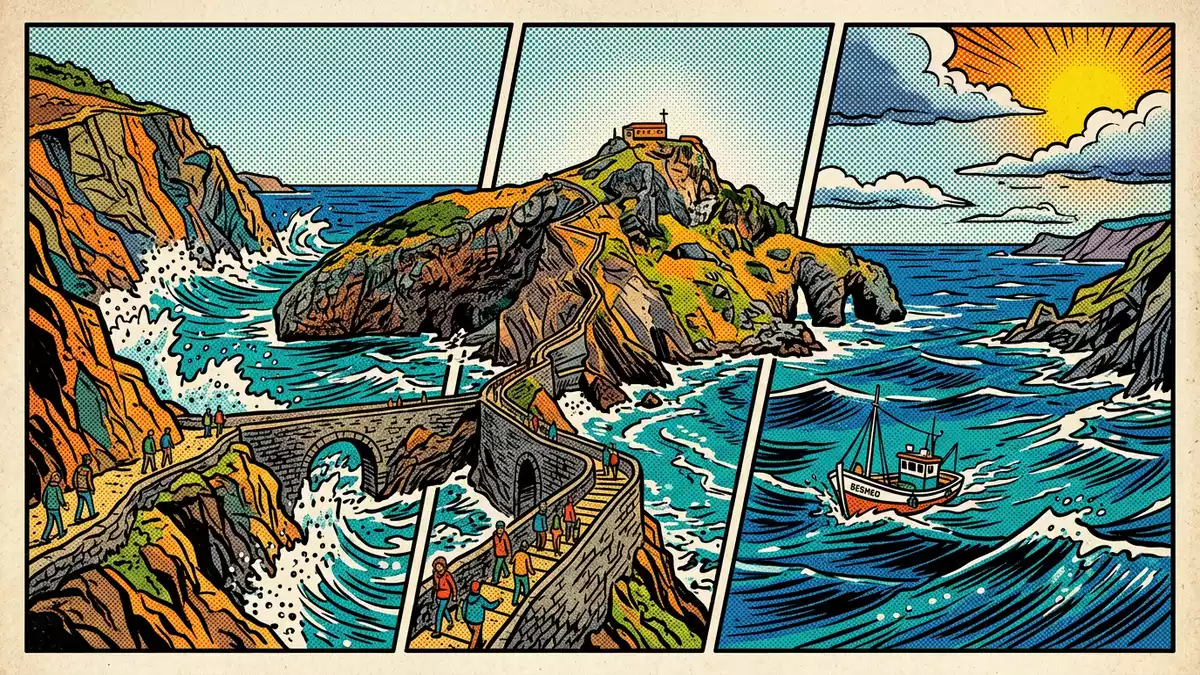
Gaztelugatxe rises from the Biscay coast near Bermeo as a rocky islet joined to the mainland by a narrow bridge and a long stone stairway. The path climbs towards the hermitage of San Juan, where the built landscape meets open sea, cliffs and dark coastal rock.
The site combines a visible architectural journey with a documented history reaching back to the ninth century. Its small chapel, defensive past and protected coastal setting belong to different layers of the same compact landscape.
The stone stairway between land and sea
The approach begins on the mainland before narrowing towards the bridge. From there, the steps zigzag across the rock, rising above the water before reaching the chapel dedicated to John the Baptist. The route contains 241 steps, a precise count that gives the island its physical character.
Gaztelugatxe is not a level monument viewed from a distance. Its defining feature is the connection between coast, bridge, stairway and summit. The stone route remains visible as a continuous line across the rugged profile, with the sea occupying the spaces around it.
The chapel stands at the top of the rocky outcrop. Its present form belongs to a long sequence of rebuilding, after fires and attacks affected earlier structures. The building is small beside the surrounding cliffs, yet its position makes it the final element of the ascent.
From ninth-century hermitage to coastal stronghold
The first hermitage is traditionally dated to the ninth century. In the twelfth century, the site became a convent, adding a religious community to its role as a coastal landmark. A medieval reference from 1053 records the chapel under the name Sancti Johannis de Castiello.
Gaztelugatxe also formed part of the military history of the Lordship of Biscay. In the fourteenth century, supporters of Juan Núñez de Lara used the rocky site during conflict with Alfonso XI of Castile. The fortress-like setting and narrow approach belong to this defensive chapter.
In 1596, Francis Drake and his privateers attacked the site. Fires and battles damaged the chapel during later centuries, and the building visible on the summit is not the earliest structure. Its history is therefore read through successive religious and defensive uses rather than through one preserved medieval building.
The chapel was rebuilt after a fire in 1978, and restoration completed in 1983 gave the shrine another phase in its long architectural history. San Juan remains the name attached to the summit, while Gaztelugatxe identifies the wider rock, bridge and coastal setting.
Rock, water and the protected Biscay coast
Gaztelugatxe forms part of a protected biotope on the Biscay coast. The protected area extends between the coast near Bakio and Cape Matxitxako near Bermeo, covering coastal rock, sea and surrounding habitats.
The islet sits beside a coast shaped by exposed rock and Atlantic water. From the stairway, the relationship between the chapel and the sea is direct: the building occupies the summit, while the bridge and path remain attached to the mainland below.
The wider landscape includes the coast around Bermeo, Cape Matxitxako and the approach towards Bakio. The site belongs to the Basque coastal landscape rather than to an isolated inland monument, and its historical layers remain inseparable from that position beside the Bay of Biscay.
Gaztelugatxe also carries local religious traditions connected with John the Baptist. The chapel, the summit bell and the ascent preserve a devotional identity alongside the rock formations and sea views. The result is a place where a narrow stone route remains as important as the small building at its end.
Visiting Gaztelugatxe: what travellers from Western Europe should know
- Gaztelugatxe lies on the Biscay coast near Bermeo, between Bermeo and Bakio. The approach is made by road and continues on foot towards the bridge and stairway.
- The route includes 241 stone steps across a rocky coastal setting. The approach combines a bridge, uneven ground and a sustained climb to the hilltop hermitage.
- The surrounding protected biotope covers coastal land and water between the Bakio area and Cape Matxitxako. The landscape includes exposed rock, cliffs and the Bay of Biscay.
- The official language is Spanish and Basque, and the currency is the euro.
- Entry requirements depend on your nationality; UK travellers can check the FCDO travel advice at gov.uk/foreign-travel-advice, Irish travellers the Department of Foreign Affairs at ireland.ie.
Searching for Gaztelugatxe on social platforms
These links open searches for Gaztelugatxe on each platform.Frequently asked questions about Gaztelugatxe
Where is Gaztelugatxe?
Gaztelugatxe is on the Biscay coast near Bermeo in the Basque Country, between the coast around Bakio and Cape Matxitxako.
What does a visit involve?
The approach continues on foot across a bridge and up a stone stairway of 241 steps to the hermitage of San Juan.
What makes Gaztelugatxe distinctive?
The site joins a hilltop chapel, a rocky islet, a narrow bridge and a long stairway within a protected coastal landscape.


