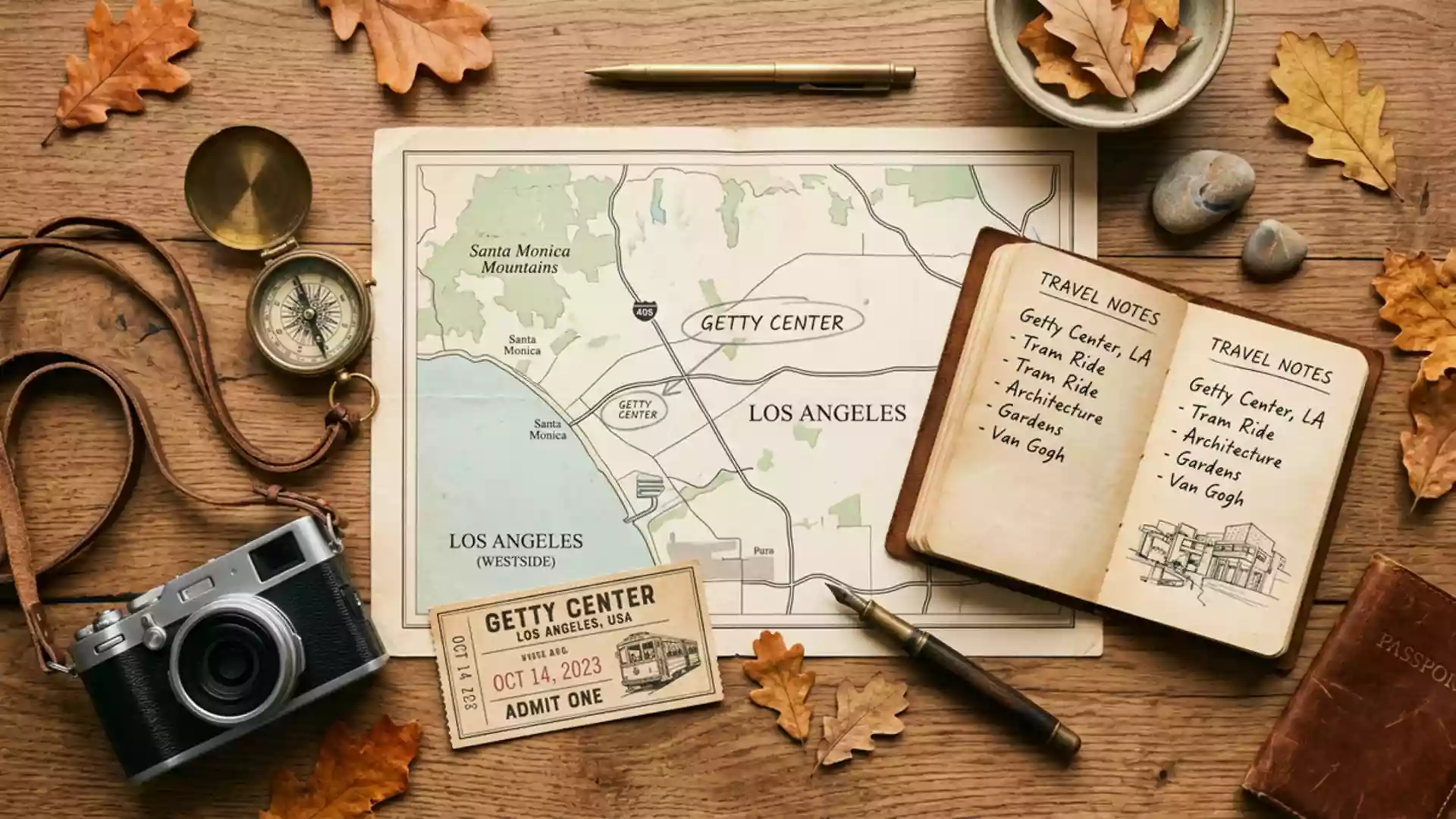
Getty Center, Los Angeles: a hilltop campus of travertine and light
Published on 08/17/2026 at 14:08 | Editorial responsibility: Rafael Müller, Editor-in-Chief AD HOC NEWS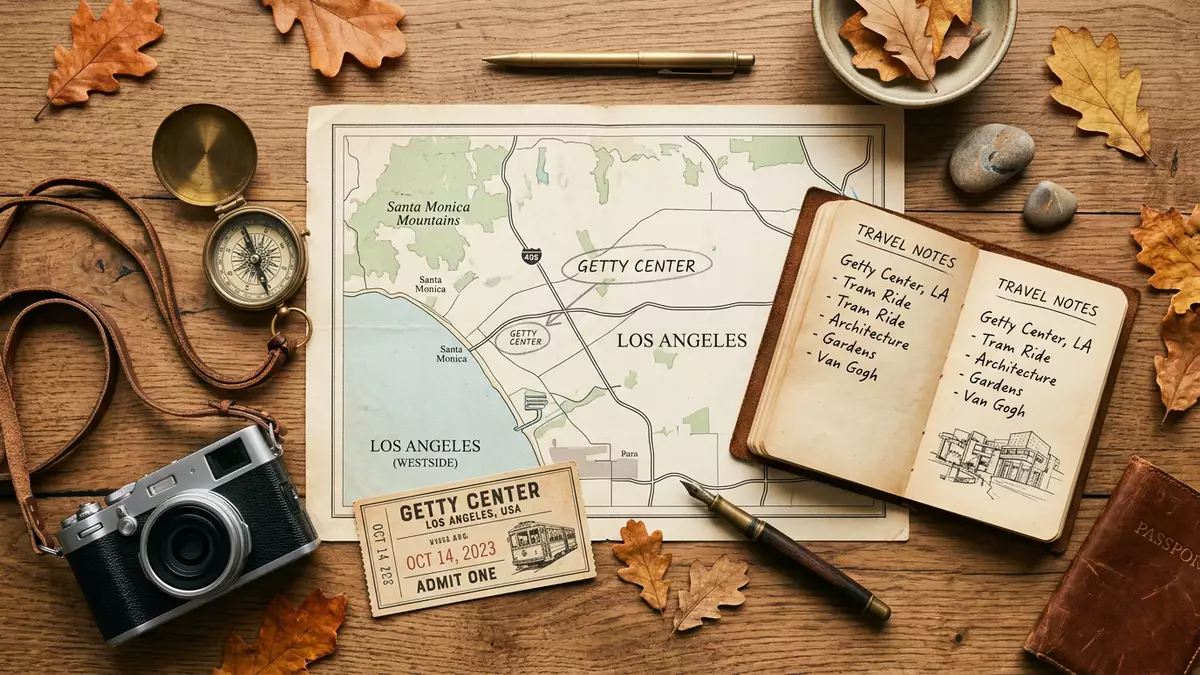
High above the street grid of Los Angeles, Getty Center gathers art, architecture and landscape into a single hilltop campus clad in pale travertine and metal. Conceived for the J. Paul Getty Trust in the 1980s and opened in 1997, the ensemble by architect Richard Meier forms a modern acropolis in the Santa Monica Mountains with long terraces, pavilions and gardens oriented toward the city and the Pacific.
A modern acropolis in the Santa Monica Mountains
Getty Center occupies a 110-acre site on a ridge at 1200 Getty Center Drive in west Los Angeles, on the slopes of the Santa Monica Mountains where the urban basin meets canyon and chaparral.The 110-acre hilltop gives the campus a clear sense of separation from the city below, while still keeping the downtown skyline, the Pacific Ocean and the San Gabriel Mountains within view.Panoramic views over Los Angeles become part of any visit, framed by arcades, railings and planted slopes.
The commission for Getty Center was awarded to Richard Meier in 1984 after an extensive selection process by the trust, giving the American architect the task of bringing several cultural programmes and a new museum together on one site.Richard Meier’s appointment in 1984 Meier responded with a campus of low-rise buildings arranged along two ridges, rather than a single dominant block, with many service areas and connections located below ground to reduce the apparent bulk against the hillside.A campus of low buildings
Travertine, grid and curves: the architecture of Getty Center
The most immediately recognisable material at Getty Center is Italian travertine stone, cut into rectangular blocks and panels that cover facades, retaining walls and outdoor seating.Travertine stone cladding The stone is paired with white metal cladding and large expanses of glass, creating a light-toned palette against the green slopes and blue Californian sky. On close inspection, the travertine carries fossil traces and subtle surface variations, a deliberate counterpoint to the precise geometry of the architecture.
Richard Meier organises the campus around a strict modular grid, yet offsets it with curving terraces and pavilions that follow the contours of the site and the angle of the nearby freeway.Grid and curvilinear forms Squares and rectangles define plaza surfaces, window groups and balcony edges, while cylindrical forms and sweeping walls soften the transitions between buildings and gardens. The arrival plaza, museum pavilions, research buildings and conservation facilities each have their own architectural expression, yet share proportions and materials that make the complex feel coherent rather than repetitive.
Art, research and gardens across the hilltop campus
Beyond its architecture, Getty Center is home to a number of institutions of the J. Paul Getty Trust, including the J. Paul Getty Museum, the Getty Research Institute, the Getty Conservation Institute and the Getty Foundation.Operating entities of the trust The museum galleries occupy several pavilions arranged around courtyards, displaying European paintings, drawings, sculpture and decorative arts alongside photography and antiquities. Research libraries and study rooms are housed in separate wings, while conservation laboratories and administrative offices occupy their own parts of the campus, linked by passageways and service corridors.
Landscape plays an equally visible role. A central garden designed as a living artwork anchors one side of the campus, with planted slopes, water features and paths leading down from the museum terrace. Elsewhere, smaller gardens, groves and planted courtyards sit between the pavilions, and broad viewing terraces open towards the Pacific and the city. Together with the architecture, these outdoor spaces make Getty Center feel less like a single museum building and more like a small district of cultural and academic facilities arranged on a hillside.
Visiting Getty Center: what travellers from Western Europe should know
- Getty Center stands above the Brentwood neighbourhood of Los Angeles, reached from the base by an electric tram that climbs from the parking area to the hilltop arrival plaza.
- The campus sits on a ridge in the Santa Monica Mountains, and getting around involves walking between pavilions on outdoor terraces and negotiating flights of steps and gentle ramps.
- The site lies close to major freeways on the west side of Los Angeles, and organised streets and signposted access roads lead to the lower entrance complex at Getty Center Drive.
- The official language is English and the currency is the United States dollar.
Searching for Getty Center on social platforms
These links open searches for Getty Center on each platform.
Frequently asked questions about Getty Center
Where is Getty Center located?
Getty Center is on a hilltop site at 1200 Getty Center Drive in west Los Angeles, on the slopes of the Santa Monica Mountains above the Brentwood area.
What can visitors expect on a visit to Getty Center?
Visitors encounter a campus of travertine-clad buildings, museum galleries, research and conservation facilities, gardens and wide terraces with expansive views over Los Angeles.
What makes Getty Center distinctive among museums?
Its combination of Richard Meier’s grid-and-curve architecture, extensive travertine stone, integrated gardens and a hilltop position overlooking the city gives Getty Center a character unlike a single urban museum block.