
Gosudarstvennyi Ermitazh and the Winter Palace on the Neva
Published on 08/16/2026 at 13:55 | Editorial responsibility: Rafael Müller, Editor-in-Chief AD HOC NEWS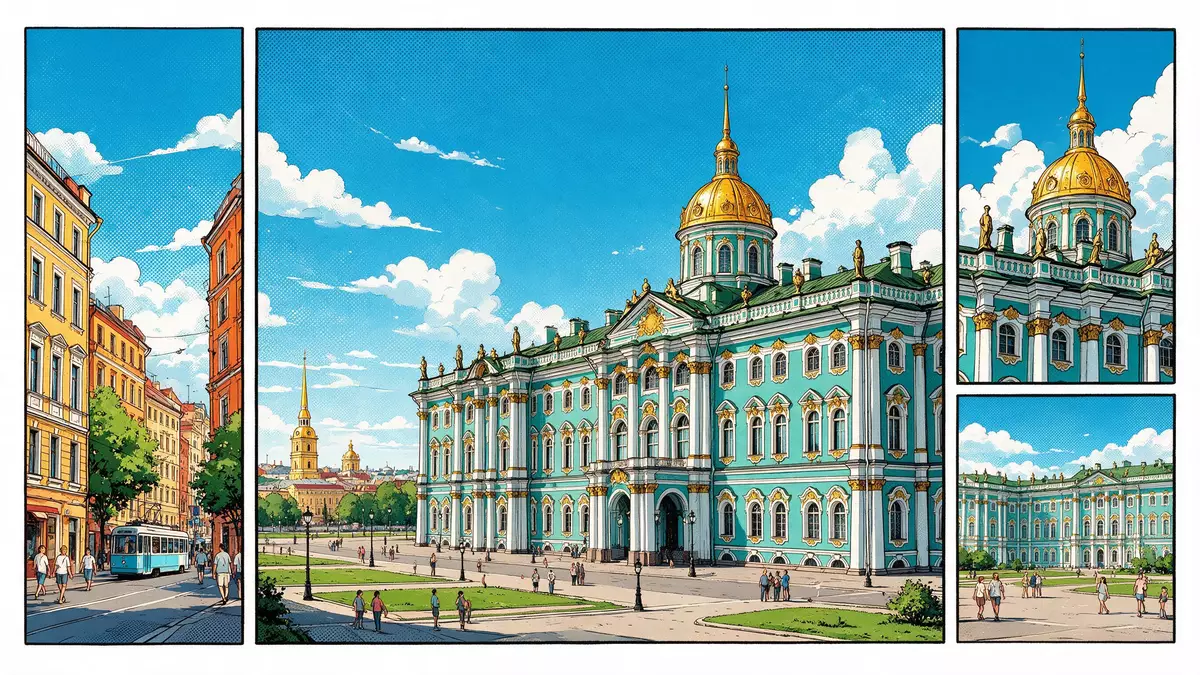
Gosudarstvennyi Ermitazh, known internationally as the State Hermitage Museum, forms a continuous museum complex along the Neva River in Sankt Petersburg, with the Baroque Winter Palace at its core.State Hermitage Museum Founded in 1764 under Empress Catherine the Great and later opened to the public in 1852, it grew from a private imperial collection into one of Russia’s major museums of art and culture.Founded in 1764
The riverside palace that became a museum
The main building of Gosudarstvennyi Ermitazh is the former Winter Palace, a large Baroque residence laid out along the Palace Embankment on the southern bank of the Neva River.Winter Palace on the Neva It was built between 1754 and 1762 for Empress Elizabeth, daughter of Peter the Great, with the design attributed to the Italian architect Bartolomeo Rastrelli.built for Empress Elizabeth The palace’s green-and-white façades, high roofs and long elevations form a continuous frontage onto the river and Palace Square, and became the principal residence of the Russian emperors for roughly 150 years.main residence of the Tsars
The Hermitage complex extends beyond the Winter Palace to include neighbouring buildings added in the later eighteenth and nineteenth centuries. Catherine the Great commissioned the Small and Large Hermitage beside the palace to house paintings, library rooms and a reproduction of the Raphael Loggias from the Vatican.Small and Large Hermitage Further east, the New Hermitage of the mid-nineteenth century introduced purpose-built galleries, while the Hermitage Theatre and other structures along the river completed an ensemble of imperial buildings that are now part of the museum’s architectural identity.New Hermitage galleries
An imperial collection turned public institution
The story of Gosudarstvennyi Ermitazh begins with Catherine the Great’s acquisition of a group of paintings from Berlin in 1764, a purchase that formed the nucleus of her private art collection in the Small Hermitage.Catherine’s paintings from Berlin Over subsequent decades, the collection expanded to include European Old Masters, antiquities, decorative arts and artefacts from different cultures, filling rooms in the palace and adjoining buildings.imperial collection expanded In 1852, the New Hermitage opened to the public as the Imperial Museum, marking the transition from a private court space to a museum accessed by visitors outside the royal circle.opened as Imperial Museum
Today Gosudarstvennyi Ermitazh is recognised as one of Russia’s major art and cultural museums, with a vast collection extending across many historical periods and regions.major art and cultural museum The holdings encompass paintings, sculptures, applied arts and archaeological material, presented in galleries that follow the sequence of the historical palace interiors. Visitors move through state rooms, enfilades and staircases that retain elements of eighteenth- and nineteenth-century décor, encountering displays of European, Russian and wider world art in spaces that were once central to imperial life.galleries within palace rooms
A museum complex on Palace Square
Gosudarstvennyi Ermitazh is anchored between Palace Embankment and Palace Square, forming one side of a major urban space in central Sankt Petersburg.Palace Embankment address Facing the square is the General Staff Building, a long, crescent-shaped neoclassical block with a prominent triumphal arch that connects Nevsky Prospekt to Palace Square.General Staff Building Constructed between 1819 and 1829 to designs by architect Carlo Rossi, it originally housed military and ministerial offices; the museum later took over the eastern wing to display nineteenth- and twentieth-century art.east wing for modern art
The Winter Palace itself has a long façade running along the river, with multiple storeys, lavish exterior ornament and entrances both to the embankment and to Palace Square.riverfront Baroque façade Within, a network of grand staircases, galleries and halls connects to neighbouring Hermitage buildings beside the Winter Canal and towards the Neoclassical Hermitage Theatre, forming a continuous architectural sequence of imperial-era structures.ensemble of Hermitage buildings This complex makes Gosudarstvennyi Ermitazh a place where the architecture, urban setting and collections are closely intertwined, with views towards the Neva and Palace Square appearing from many parts of the museum.
Visiting Gosudarstvennyi Ermitazh: what travellers from Western Europe should know
- Gosudarstvennyi Ermitazh’s main complex stands on Palace Embankment and Palace Square in central Sankt Petersburg, with entrances near the Neva River and the Alexander Column.
- Inside the Winter Palace, movement between floors involves broad ceremonial staircases and corridors through historical rooms, so a visit includes walking through long interior sequences.
- The museum complex also occupies part of the General Staff Building on Dvortsovaya Ploshchad, where galleries dedicated to nineteenth- and twentieth-century art are reached from Palace Square.
- The official language is Russian and the currency is the Russian rouble.
- Entry requirements depend on your nationality; UK travellers can check the FCDO travel advice at gov.uk/foreign-travel-advice, Irish travellers the Department of Foreign Affairs at ireland.ie.
Searching for Gosudarstvennyi Ermitazh on social platforms
These links open searches for Gosudarstvennyi Ermitazh on each platform.
Frequently asked questions about Gosudarstvennyi Ermitazh
Where is Gosudarstvennyi Ermitazh located within Sankt Petersburg?
Gosudarstvennyi Ermitazh occupies the former Winter Palace and adjacent Hermitage buildings on Palace Embankment and Palace Square, beside the Neva River in central Sankt Petersburg.
What can visitors expect when exploring the museum complex?
Visitors walk through historical palace interiors and purpose-built galleries containing paintings, sculptures and decorative arts, moving between the Winter Palace and adjoining Hermitage buildings, including part of the General Staff Building.
What makes Gosudarstvennyi Ermitazh distinctive among museums?
It combines an eighteenth-century imperial residence, later extensions such as the New Hermitage and Hermitage Theatre, and a large art collection within a single riverside ensemble on the Neva.


