
Granada in Nicaragua, where a colonial city meets a vast lake
Published on 08/22/2026 at 15:15 | Editorial responsibility: Rafael Müller, Editor-in-Chief AD HOC NEWS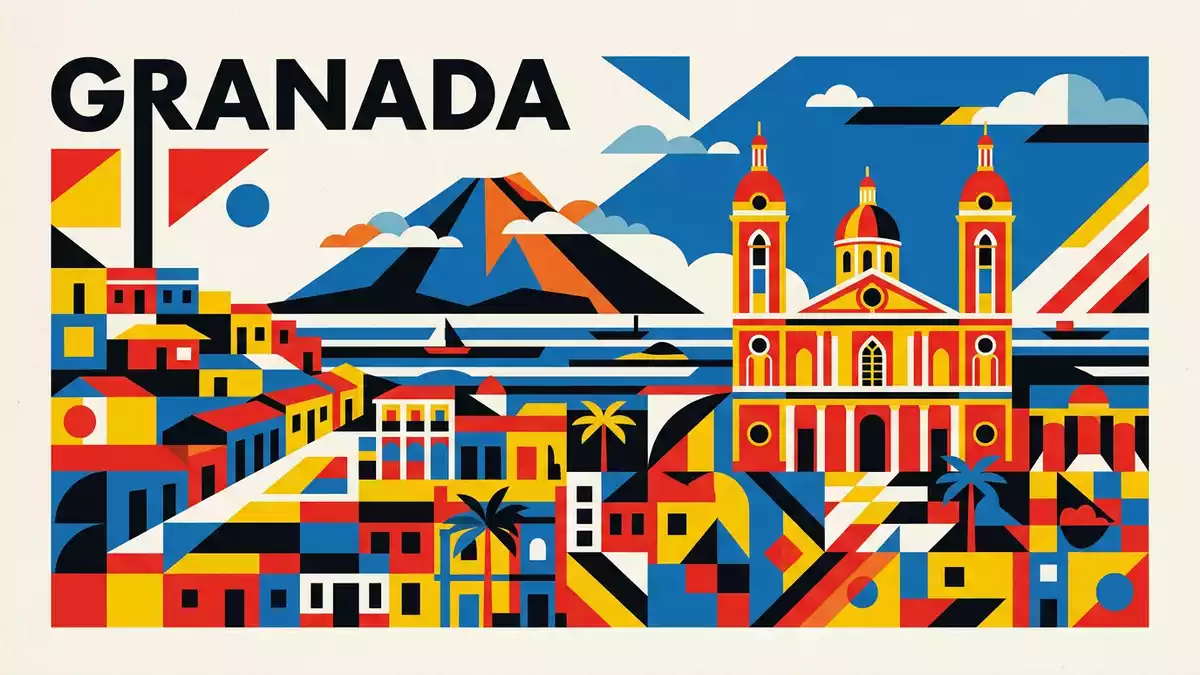
Granada in Nicaragua is a Spanish colonial city laid out beside Lake Cocibolca, with the low cone of Mombacho volcano rising behind its coloured façades and church towers. Founded in the early sixteenth century, it remains closely tied to the freshwater lake on whose shore it grew.
A sixteenth-century city on Lake Cocibolca
Granada stands in western Nicaragua as the capital of the Granada Department, on the north-western shore of Lake Nicaragua, also known as Lake Cocibolca.capital of the Granada Department The city was founded in 1524 by the Spanish conquistador Francisco Hernández de Córdoba, giving it an early position among colonial towns in Central America.founded in 1524 Its official name “Santiago de Granada” recalls the Andalusian city that inspired the choice of name.Santiago de Granada
The lake beside the city is one of the largest freshwater bodies in the Americas, a broad expanse historically known to the Spanish as “Mar Dulce”, the sweet sea.Great Lake of Nicaragua Lake Cocibolca has been given several names over the centuries, including Gran Lago de Nicaragua and Lago de Granada, and it provides Granada with a long waterfront of piers, promenades and views across to scattered low islets. The presence of the lake made Granada a point of contact between the Pacific side of Central America and routes leading towards the Caribbean through the San Juan River.lake drains via the San Juan River
Volcano, grid and churches: the city’s layout
Granada’s streets follow a rectilinear colonial grid, running inland from the lakeside and arranged around plazas and church fronts.grid of streets Low houses with tiled roofs and courtyards line these streets, their walls painted in strong colours that emphasise doorways and window openings. At several points, the silhouette of Mombacho volcano appears at the end of an axis, forming a steady backdrop to the urban fabric.volcano Mombacho
The city contains a number of churches whose towers and domes rise above the surrounding single-storey houses. The cathedral on the main square presents a large façade facing the plaza, while other churches stand at street corners or near former convents.Granada architecture Many of these religious buildings have been rebuilt or repaired after fires and conflicts, yet their forms still follow colonial patterns, with naves, side chapels and bell towers marking their presence in the skyline. Between them, civic buildings and private houses create sequences of arcades, balconies and shaded doorways along the main streets.
Lake, islets and waterfront
From the lakeside edge of Granada, the water of Lake Cocibolca stretches to the horizon, forming what looks like an inland sea. The lake is recognised as the largest in Central America and among the largest freshwater lakes worldwide.largest lake in Central America It contains hundreds of small islets, as well as larger islands and volcanic forms, and has long been described as a habitat for freshwater species such as sharks and sawfish.freshwater sharks and sawfish
The waterfront near Granada includes embarkation points for small boats heading towards nearby islets, where houses, trees and piers meet the water. Along this stretch, paths and open spaces give views back to the city’s towers and over the lake’s expanse.western shores of Lake Nicaragua On clear days, the outlines of distant islands and the gentle slopes of Mombacho can be picked out against the sky, reinforcing the relationship between water, city and volcano.
Visiting Granada: what travellers from Western Europe should know
- Granada lies in western Nicaragua on the north-west shore of Lake Cocibolca, to the south-east of Managua, and is reached by road links from the capital.northwestern shore of Lake Cocibolca
- The city centre is largely flat, with streets laid out in a grid and pavements leading from the main square to the lakeside; routes to viewpoints on Mombacho involve steeper terrain.
- Lake Cocibolca lies directly beside the urban area, so walks from central streets to the waterfront involve only a short approach across level ground.
- The official language is Spanish and the currency is the Nicaraguan córdoba.
- Entry requirements depend on your nationality; UK travellers can check the FCDO travel advice at gov.uk/foreign-travel-advice, Irish travellers the Department of Foreign Affairs at ireland.ie.
Searching for Granada on social platforms
These links open searches for Granada on each platform.
Frequently asked questions about Granada
Where is Granada in Nicaragua located?
Granada is in western Nicaragua on the north-western shore of Lake Nicaragua, also called Lake Cocibolca, and serves as the capital of the Granada Department.
What should visitors expect when exploring Granada?
Visitors encounter a colonial grid of streets with coloured houses, prominent churches, plazas and a lakeside waterfront, all set against the volcanic outline of Mombacho.
What makes Granada distinctive among Central American cities?
Granada is distinctive for its early foundation in 1524, its direct relationship with Lake Cocibolca, and the way its colonial layout interacts with the nearby volcano and freshwater lake.


