
Grande Mosquee de Djenne and the art of earthen architecture
Published on 08/22/2026 at 10:10 | Editorial responsibility: Rafael Müller, Editor-in-Chief AD HOC NEWS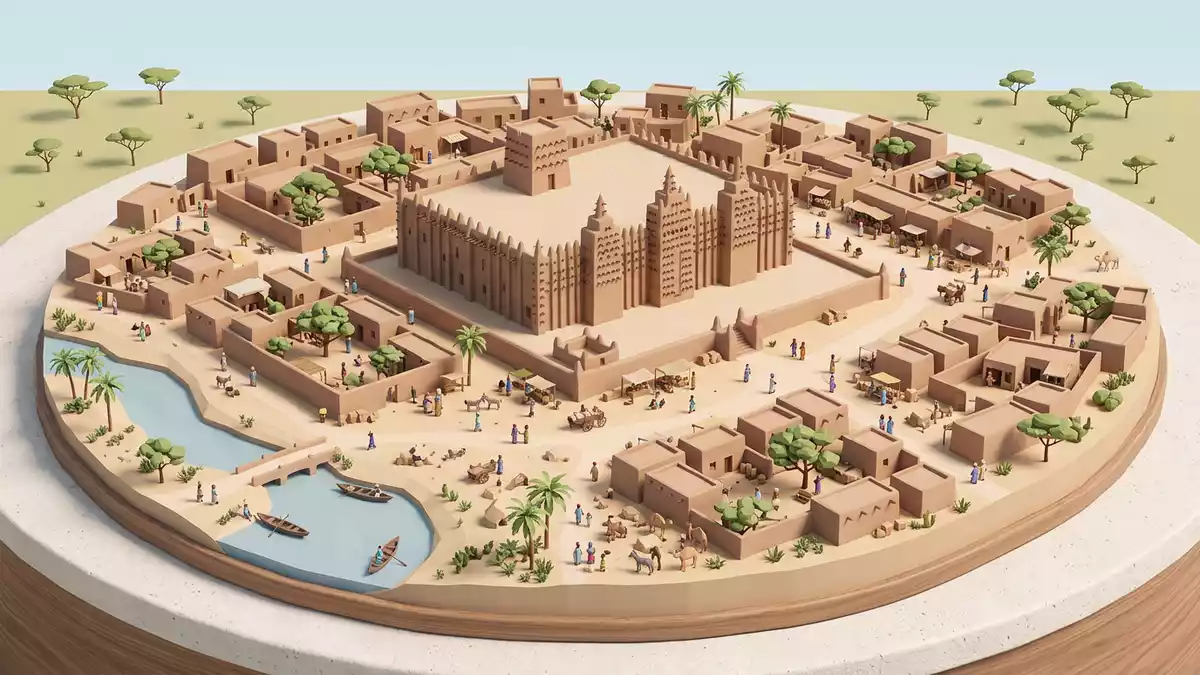
Grande Mosquee de Djenne, known in English as the Great Mosque of Djenné, stands in the old trading town of Djenne in central Mali, its vast earthen walls rising above a floodplain of the Bani River. Built in the Sudano?Sahelian style and completed in 1907, it brings together a long local tradition of mud architecture and a monumental congregational mosque in one striking structure.
An earthen giant on a raised platform
Seen from the edge of Djenne’s market square, Grande Mosquee de Djenne appears as a continuous mass of earth, lifted on a high platform that keeps the building above the seasonal waters of the surrounding plain. The present mosque was completed in 1907 on the site of earlier mosques that are dated to the thirteenth century, and it stands as the most prominent religious building in the town.The building seen today dates from 1907
The mosque is built almost entirely from sun?dried mud bricks set in mud mortar and covered in a smooth mud plaster known locally as banco, creating thick walls with a warm, earthy colour.The mud brick walls are rendered in banco The whole structure stands on a roughly square platform whose sides measure around 75 m, giving it a broad footprint that dominates the centre of Djenne.The mosque occupies a 75 by 75 metre platform
Sudano?Sahelian architecture in sculpted mud
Grande Mosquee de Djenne is one of the clearest expressions of Sudano?Sahelian architecture, a regional style that uses thick earthen walls, timber elements and projecting supports to create monumental forms in mud.It is regarded as a pre?eminent Sudano?Sahelian monument Three prominent towers rise from the main facade, each tapering towards a finial at the top, and the outer walls are punctuated by rows of wooden beams that project from the surface like a permanent scaffolding pattern.
The projecting beams, carved from local timber, form a visible lattice along the walls and towers and provide handholds for masons when the mud plaster is renewed. Inside, the mosque contains a large prayer hall supported by rows of pillars and covered by a flat roof carried on timber elements, with small openings in the ceiling that admit shafts of daylight.The mosque’s interior relies on dense earthen piers and a timber roof Together, the thick walls, towers and timber details give the building a sculpted, almost plastic quality, as if the entire mosque had been modelled from clay on a grand scale.
History, learning and a World Heritage town
The history of Grande Mosquee de Djenne reaches back to the early spread of Islam along trans?Saharan trade routes, when the first mosque on this site was established in the thirteenth century.The site has housed a congregational mosque since the 13th century The current structure was built in the early twentieth century under the leadership of the master mason Ismaila Traoré, head of the local masons’ guild, continuing an earthen building tradition that had been refined over generations.Ismaïla Traoré is credited as architect of the 1907 mosque
For centuries, Djenne functioned as a centre of Islamic scholarship, and the mosque served both as the town’s main congregational space and as a focus for Qur’anic schools clustered around its walls.The mosque serves as Djenné’s main Friday congregational mosque In 1988, Grande Mosquee de Djenne and the surrounding “Old Towns of Djenné” were inscribed together on the UNESCO World Heritage List, recognising both the mosque itself and the wider ensemble of earthen houses, tombs and archaeological sites that define the town’s historic character.The mosque and Old Towns were inscribed as World Heritage in 1988
Visiting Grande Mosquee de Djenne: what travellers from Western Europe should know
- Grande Mosquee de Djenne stands in the town of Djenne in central Mali, on a floodplain linked to the Bani River, and lies within the inland Niger delta region.
- The mosque rises on a raised earthen platform above the surrounding streets, and approaching its outer walls from the market square involves crossing uneven, compacted earth rather than paved surfaces.
- Djenne is reached by road connections that link the inland Niger delta to other towns in Mali, and local transport brings visitors into the market area directly beside the mosque’s platform.
- Arabic and French are widely used around Djenne alongside local languages, and the currency in Mali is the West African CFA franc.
- Entry requirements depend on your nationality; UK travellers can check the FCDO travel advice at gov.uk/foreign-travel-advice, Irish travellers the Department of Foreign Affairs at ireland.ie.
Searching for Grande Mosquee de Djenne on social platforms
These links open searches for Grande Mosquee de Djenne on each platform.
Frequently asked questions about Grande Mosquee de Djenne
Where is Grande Mosquee de Djenne located?
Grande Mosquee de Djenne stands in the historic town of Djenne in central Mali, on a floodplain connected to the Bani River within the wider inland Niger delta.
What should a visitor expect when seeing the mosque?
Visitors encounter a vast earthen building raised on a broad platform, with tapering towers, projecting timber beams and a surrounding market square that brings everyday town life up to its walls.
What makes Grande Mosquee de Djenne distinctive among mosques?
It is built almost entirely from mud brick and banco plaster, completed in 1907 as a monumental Sudano?Sahelian congregational mosque and recognised together with the Old Towns of Djenné as a UNESCO World Heritage Site.


