
Gravensteen in Gent, a stone fortress of the Counts of Flanders
Published on 08/22/2026 at 14:02 | Editorial responsibility: Rafael Müller, Editor-in-Chief AD HOC NEWS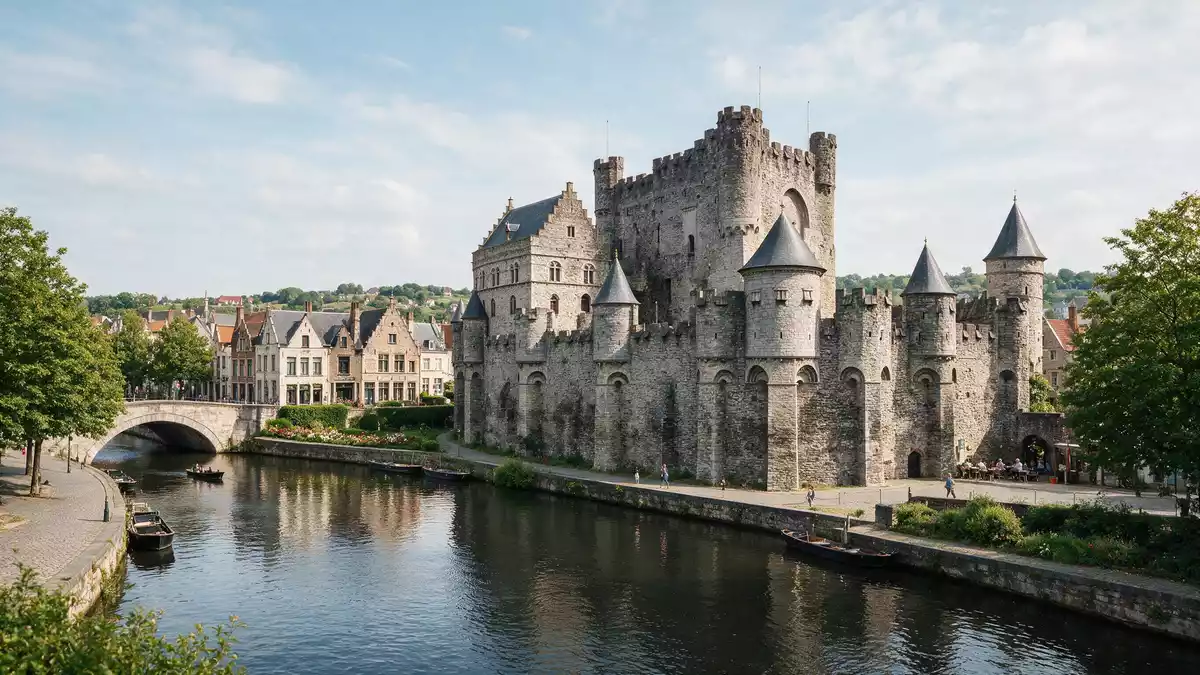
Gravensteen in Gent is a massive medieval stone fortress whose present form dates from 1180, when it became the residence of the Counts of Flanders and a symbol of comital power in Flanders. Rising above the historic centre of Gent, the castle’s towers, battlements and enclosing walls still give a clear sense of how a fortified seat of authority looked in the high Middle Ages.
A medieval fortress built for the Counts of Flanders
The name Gravensteen translates as “castle of the counts”, a literal description of its role as the stronghold of the Counts of Flanders during the twelfth and thirteenth centuries.The current castle dates from 1180 and served as their residence until the mid-fourteenth century, anchoring comital authority in a rapidly growing mercantile city.Philip of Alsace was Count of Flanders from 1168 to 1191 and is closely associated with this phase of rebuilding.
The fortress stands at a strategic point amid Gent’s waterways, with a defensive moat linked to the surrounding canals and the River Lieve mentioned in several accounts.Descriptions emphasise a stone keep enclosed by curtain walls with projecting towers and a water-filled moat, giving Gravensteen the character of a compact but heavily fortified medieval stronghold. Within the enclosure, the central keep and ranges provided living quarters, ceremonial halls and service spaces for the comital household.
Layers of use: from mint and courts to cotton mill
After the Counts of Flanders moved their residence elsewhere in the fourteenth century, Gravensteen’s role shifted but its solid stone shell remained in place. From the later Middle Ages onwards the complex housed Gent’s mint, where coinage for the city and county was produced, and it also served as a court and prison, reflecting its continued association with justice and authority.Sources describe its use as a court and prison until the eighteenth century and as a mint between the fourteenth and fifteenth centuries.
During the nineteenth century Gent became a centre of textile manufacturing, and Gravensteen was drawn into that industrial transformation.Accounts note that the castle was converted into a cotton mill in the 1800s, with factory structures and workers’ facilities built into and around the medieval walls. This industrial phase, although far removed from the castle’s original purpose, helped ensure that the main stone fabric was retained rather than demolished, leaving a rare example of a near-complete medieval fortress embedded in an evolving urban landscape.Dutch-language descriptions highlight Gravensteen as a fortified water castle with a largely intact defensive system.
Restoration and Gravensteen as a city museum
By the late nineteenth century, romantic and historical interest in medieval architecture had grown, and Gent’s authorities moved to secure and restore Gravensteen.The main restoration campaign between 1893 and 1903 aimed to recover the fortress’s medieval appearance, removing many industrial additions while consolidating towers, walls and internal ranges. The result is the stone castle seen today, combining original fabric with reconstructed elements shaped by contemporary ideas of medieval fortification.
Gravensteen is now operated as a museum and historic monument by the city of Gent, presenting both its role as a comital residence and its grimmer functions as a site of justice and confinement.The castle at Sint-Veerleplein 11 is described as a moated stone fortress in the centre of Gent, and its exhibitions include collections of arms, armour and instruments associated with judicial punishment. Visitors encounter not only the architecture of a medieval stronghold but also material traces of how power was exercised in Flanders across several centuries.
Visiting Gravensteen: what travellers from Western Europe should know
- Gravensteen stands in the historic centre of Gent, in East Flanders in Belgium, with its entrance on Sint-Veerleplein near canal junctions and older quays.
- Exploring the castle involves climbing staircases within the towers and walking along elevated battlements, with uneven stone steps and changes in level throughout the enclosure.
- The surroundings include Gent’s medieval streets and waterfronts, so a visit to Gravensteen can be combined with walks along nearby canals and squares such as Sint-Veerleplein.
- The official language is Dutch and the currency is the euro.
Searching for Gravensteen on social platforms
These links open searches for Gravensteen on each platform.
Frequently asked questions about Gravensteen
Where is Gravensteen and what kind of place is it?
Gravensteen is a medieval stone fortress and former comital residence in Gent in East Flanders, Belgium, standing as a fortified water castle with enclosing walls and moat.
What can visitors expect when exploring Gravensteen?
Visitors move through stone halls, towers and battlements, seeing displays on arms and judicial punishment while gaining views over Gent’s historic centre from the upper levels.
What makes Gravensteen distinctive among castles in Flanders?
Gravensteen retains a largely intact medieval defensive circuit with moat, curtain walls and central keep, and its history ranges from comital residence to mint, courts, prison, cotton mill and restored museum.


