
Great Zimbabwe’s stone walls and the Shona city they frame
Published on 08/20/2026 at 12:48 | Editorial responsibility: Rafael Müller, Editor-in-Chief AD HOC NEWS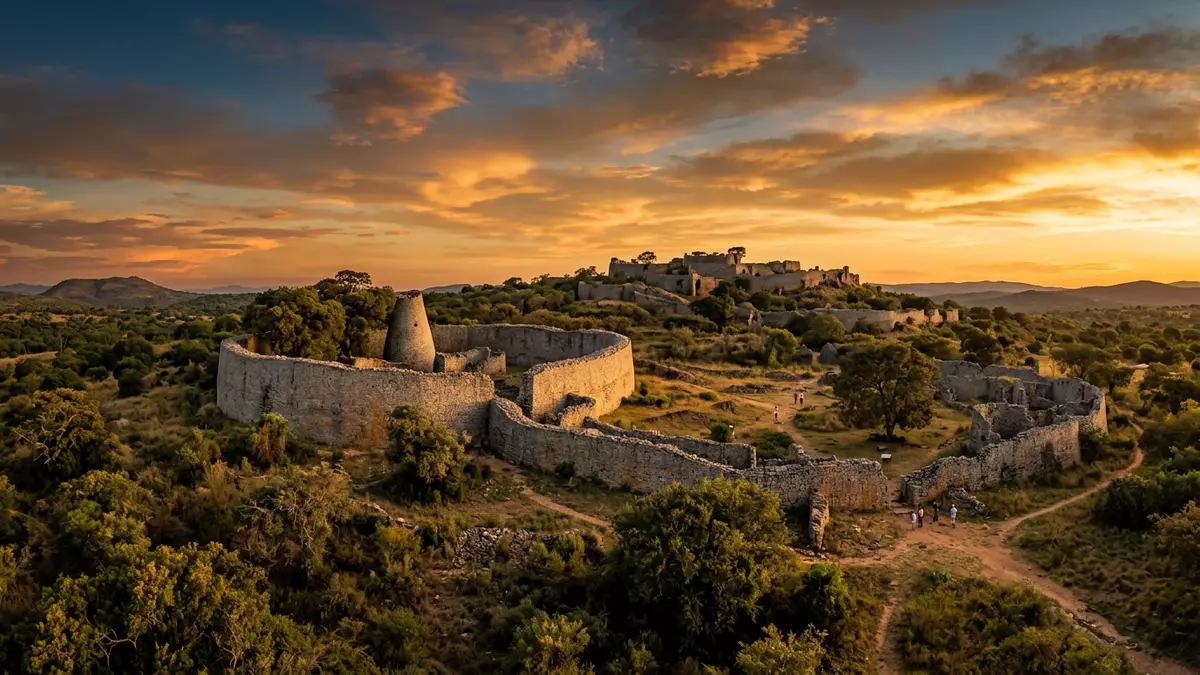
Great Zimbabwe rises from the granite hills south-east of Masvingo as a vast city of stone, its drystone walls tracing the outline of a Shona capital that flourished between the eleventh and fifteenth centuries.
Stone architecture in a Shona landscape
Great Zimbabwe stands in south-eastern Zimbabwe, in the lowveld near Masvingo, where granite outcrops punctuate a gently undulating landscape.The property lies about 30 km from Masvingo at an altitude of around 1,100 m. These granite hills provided the material for the settlement’s drystone architecture, in which stacked blocks form continuous walls without mortar.
The name Great Zimbabwe derives from a Shona term that can be translated as “stone house”, and it refers both to the city itself and to the wider tradition of stone-built settlements in the region.Archaeologists identify more than 300 related zimbabwe sites across Zimbabwe. The ruins around Masvingo form the largest and most elaborate of them, giving the modern Republic of Zimbabwe both its name and one of its national emblems, the Zimbabwe Bird.
Hill Ruins, Great Enclosure and Valley Ruins
Great Zimbabwe is organised into three main architectural groups that visitors can still distinguish on the ground: the Hill Ruins, the Great Enclosure and the Valley Ruins.The site extends over almost 800 ha of granite hills and terraces. Paths climb through tumbled boulders to the Hill Ruins, where stone walls crown the summit and frame courtyards and passageways overlooking the surrounding lowveld.
Below the hill, the Great Enclosure forms a sweeping oval of masonry, its outer wall curving around a dense interior of huts, enclosures and a famous conical tower.This Great Enclosure is one of the largest ancient structures built in sub-Saharan Africa. Beyond it, the Valley Ruins spread across the slope in a pattern of smaller stone compounds and open spaces, marking where households and workshops once filled the city with activity.
A medieval Shona capital and World Heritage site
Archaeological evidence places the main growth of Great Zimbabwe between the eleventh and fifteenth centuries, when it served as the capital of a Shona-led kingdom that controlled trade routes between the inland plateau and the Indian Ocean coast.UNESCO recognises Great Zimbabwe as an outstanding example of Bantu civilisation between the eleventh and fifteenth centuries. At its height in the fourteenth century the city housed a substantial population living within and around its walled precincts.Trade links connected Great Zimbabwe to coastal centres and to merchants from as far away as the Persian Gulf and China.
Great Zimbabwe’s cultural importance has long extended beyond archaeology. The ruins provided the name for the post-colonial state of Zimbabwe, and the stylised Zimbabwe Bird carved in soapstone, first documented on pillars within the site, now appears on national symbols.The complex has been protected as a national monument and was inscribed on the UNESCO World Heritage List in 1986. For visitors from Western Europe, a walk through its stone passages becomes a way into the history of the Shona-speaking peoples and the wider story of African state formation.
Visiting Great Zimbabwe: what travellers from Western Europe should know
- Great Zimbabwe lies south-east of Masvingo in south-eastern Zimbabwe and is reached on signposted roads that branch from the main route linking Masvingo with the border town of Beitbridge.
- The Hill Ruins section stands on a granite prominence above the surrounding plain, and reaching the summit involves a sustained uphill walk on uneven rock paths and stone steps.
- The Great Enclosure and Valley Ruins occupy lower ground, where visitors move across grass and earth paths between stone walls and open clearings within the archaeological park.
- The official language is English and the currency is the Zimbabwean dollar.
- Entry requirements depend on your nationality; UK travellers can check the FCDO travel advice at gov.uk/foreign-travel-advice, Irish travellers the Department of Foreign Affairs at ireland.ie.
Searching for Great Zimbabwe on social platforms
These links open searches for Great Zimbabwe on each platform.
Frequently asked questions about Great Zimbabwe
Where is Great Zimbabwe located?
Great Zimbabwe is in south-eastern Zimbabwe, near the city of Masvingo, in a lowveld landscape of granite hills and grassland.
What can visitors expect on a visit?
Visitors walk among extensive stone walls, climb to the Hill Ruins on a granite outcrop and explore the Great Enclosure and Valley Ruins on paths between archaeological structures.
What makes Great Zimbabwe distinctive?
Great Zimbabwe is distinctive for its large dry stone architecture, its role as a medieval Shona capital and its status as a UNESCO World Heritage site and national symbol of Zimbabwe.


