
Griffith Observatory and the science of looking up
Published on 09/23/2026 at 09:33 | Editorial responsibility: Rafael Müller, Editor-in-Chief AD HOC NEWS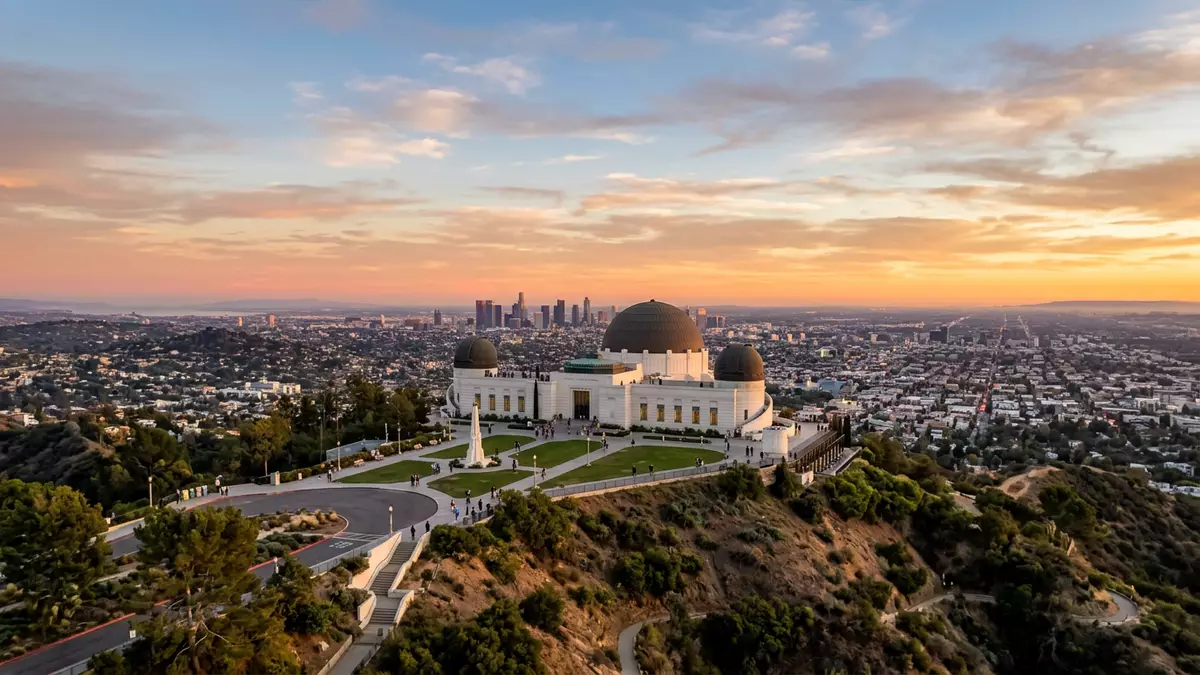
Griffith Observatory is a concrete Art Deco building on the southern slope of Mount Hollywood in Griffith Park, Los Angeles. Its domes, terraces and public instruments place astronomy inside a building that is also a carefully composed civic landmark.
John C. Austin and Frederick M. Ashley designed the observatory, which opened on 14 May 1935. The building combines exhibition halls, telescopes, a planetarium and broad outdoor terraces in one compact hilltop complex.
Griffith Observatory’s domes and concrete geometry
The observatory is built from cast-in-place concrete, with decorative details formed directly into the structure. Its architectural language is identified as Art Deco, with Moderne and Modified Greek influences and a Beaux-Arts-influenced plan.
A copper-covered planetarium dome rises from the centre of the composition. Smaller copper-clad domes house the Zeiss telescope and solar instruments, while the entrance includes bronze, glass and decorative metalwork. A Greek key pattern runs through the concrete decoration.
The front lawn contains the Astronomers Monument, a concrete sculpture funded through a public art programme. Its figures represent major figures in the history of astronomy, placing scientific history in the landscape before visitors enter the building.
The observatory’s Art Deco concrete structure belongs to the visual vocabulary of 1930s Los Angeles, but its details remain closely tied to astronomy.
From Griffith J. Griffith’s bequest to a public observatory
Griffith J. Griffith donated land for Griffith Park to the City of Los Angeles in 1896. His will provided funds for an observatory, an exhibition hall and a planetarium, linking the institution’s creation with public access to scientific knowledge.
The Griffith Trust and Los Angeles Park Commissioners selected Austin and Ashley in 1931. Astronomer Russell W. Porter worked with the architects as a consultant, while physicist Edward Kurth directed aspects of the project.
Construction began in 1933 during the Works Progress Administration era. The observatory opened on 14 May 1935, when ownership passed to the City of Los Angeles. The city’s Department of Recreation and Parks has operated the facility since that transfer.
The opening date and architectural team are recorded in the observatory’s history of the original building. In 1976, Griffith Observatory became Los Angeles Historic-Cultural Monument No. 168.
A major renovation and expansion completed in 2006 added new exhibition areas while retaining the historic exterior and principal interior spaces. The result joins a 1935 civic building with galleries that present astronomy through instruments, images, models and demonstrations.
Where telescopes meet the Hall of the Eye
The W.M. Keck Foundation Central Rotunda contains the Foucault Pendulum, a bronze ball suspended from a long cable. As the pendulum swings, pegs in its pit mark the apparent progress of Earth’s rotation.
The Wilder Hall of the Eye follows the history of human observation. Its displays examine optical tools, telescopes, lenses and mirrors, moving from direct sight towards instruments that reveal faint or distant objects.
A Tesla coil occupies the Hall of the Eye. Its electrical discharges create bright arcs inside a dedicated display area, giving the gallery a scientific object that is both functional and theatrical.
The Ahmanson Hall of the Sky includes a triple-beam solar telescope. Its instruments present views of the Sun, including sunspots, solar flares and spectra, when conditions permit observation.
The building’s domes contain a Zeiss refracting telescope and solar telescopes. These instruments connect the historic architecture with direct observation, while the public telescope exhibits continue the observatory’s scientific role.
Across the galleries, astronomy appears as a sequence of practical acts: measuring, magnifying, tracking, modelling and comparing. The building does not separate architecture from science; its halls and instruments form a single public setting for looking at the sky.
Visiting Griffith Observatory: what travellers from Western Europe should know
- Griffith Observatory is at 2800 East Observatory Road on Mount Hollywood, within Griffith Park. The LADOT DASH Observatory bus connects the site with the Vermont/Sunset Metro station and Los Feliz Village.
- The observatory stands on a hill, with terraces, sloping roads and nearby trailheads leading towards Mount Hollywood and the Greek Theatre area.
- Griffith Park surrounds the building with open landscape, while the Hollywood Sign is visible from viewpoints around the observatory.
- The official language is English and the currency is the US dollar.
Searching for Griffith Observatory on social platforms
These links open searches for Griffith Observatory on each platform.
Frequently asked questions about Griffith Observatory
Where is Griffith Observatory?
Griffith Observatory is on the southern slope of Mount Hollywood in Griffith Park, Los Angeles. Its address is 2800 East Observatory Road.
What can visitors see inside?
The galleries include the Foucault Pendulum, the Wilder Hall of the Eye, the Ahmanson Hall of the Sky, a Tesla coil and public telescopes.
What makes the building distinctive?
Its 1935 Art Deco design combines cast-in-place concrete, copper-covered domes, scientific instruments and exhibition halls on a single hilltop site.


