
Gros Morne National Park and the rocks of deep time
Published on 08/15/2026 at 14:03 | Editorial responsibility: Rafael Müller, Editor-in-Chief AD HOC NEWS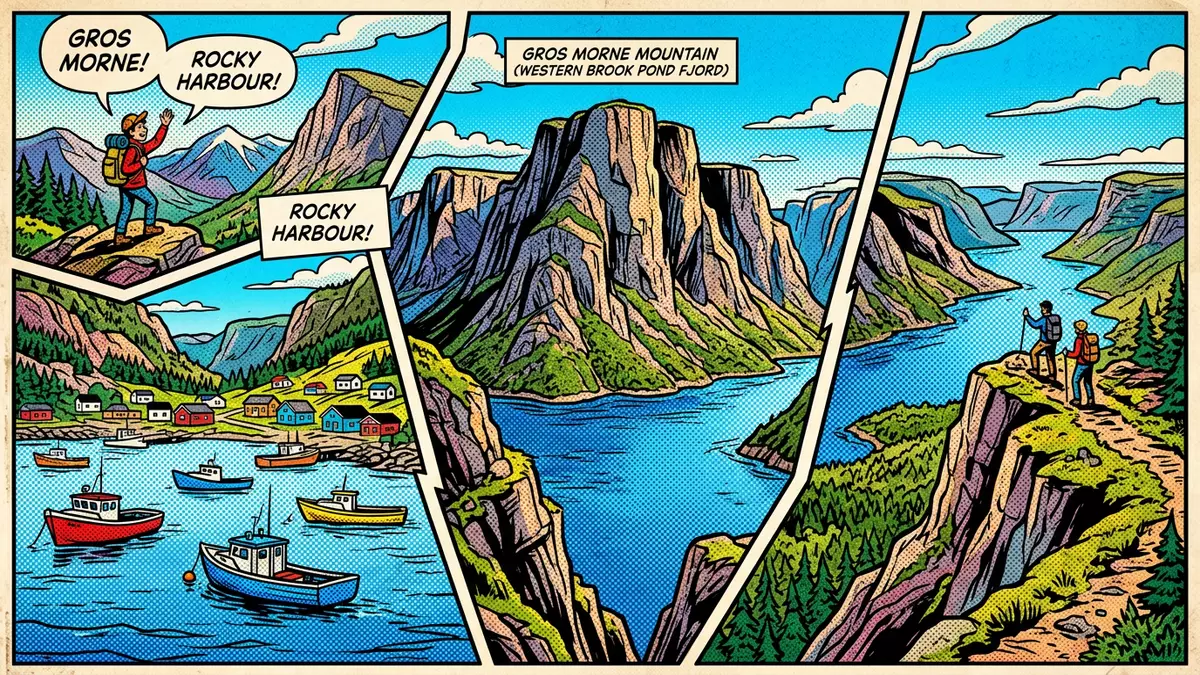
Gros Morne National Park on Newfoundland’s west coast is defined by exposed mantle rock, fjords and cliffed coasts. Near Rocky Harbour, the landscape belongs to the Long Range Mountains and carries UNESCO World Heritage status.
Man-made time in a deep geological landscape
The park’s identity rests on the contrast between sea, uplands and ancient rock. The Tablelands present an area of mantle rock at the surface, while Western Brook Pond cuts inland as a land-locked fjord.
UNESCO lists the site for its role in showing continental drift and the exposure of deep ocean crust and the earth’s mantle. Parks Canada describes the Tablelands as a rare outcrop of mantle rock pushed skyward about half a billion years ago.
Long Range Mountains, fjords and cliffs
The park reaches into the Long Range Mountains, part of Newfoundland’s rugged western uplands. Its coast includes sheer cliffs, waterfalls, lakes and alpine plateau landscapes.
That range and the coast together give Gros Morne its strongest visual character. The mountain terrain, the fjord country and the open shoreline sit close enough together to read as one connected landform.
Gros Morne National Park as a World Heritage landscape
The park was inscribed on the World Heritage List in 1987. Its geological significance lies in the way oceanic crust, mantle material and sedimentary rocks are exposed across a single protected area.
Parks Canada describes the park as a UNESCO World Heritage Site shaped by colliding continents and glaciers. That combination explains why the place matters to geologists as much as to walkers, boat passengers and travellers who come for the scenery.
Visiting Gros Morne National Park: what travellers from Western Europe should know
- The park lies on the west coast of Newfoundland, near Rocky Harbour. Access is by road within the island network, and Rocky Harbour is the main nearby settlement.
- The terrain includes steep slopes, exposed rock, fjords and upland ground. Some of the most recognisable landscapes are reached on foot or by boat.
- The official language is English and the currency is the Canadian dollar.
- Entry requirements depend on your nationality; UK travellers can check the FCDO travel advice at gov.uk/foreign-travel-advice, Irish travellers the Department of Foreign Affairs at ireland.ie.
Searching for Gros Morne National Park on social platforms
These links open searches for Gros Morne National Park on each platform.
Frequently asked questions about Gros Morne National Park
Where is Gros Morne National Park?
It is on the west coast of Newfoundland, in the Canadian province of Newfoundland and Labrador, near Rocky Harbour. The Long Range Mountains form part of the park’s setting.
What does a visit involve?
The park combines road access, coastal scenery and upland terrain. Fjords, cliffs, lakes and the Tablelands give it a broad landscape range.
What makes Gros Morne National Park distinctive?
Its rocks expose mantle material and oceanic crust in a protected landscape. UNESCO inscribed the park in 1987 for that geological significance and for its scenery.


