
Gros Morne National Park’s ancient mountains and fjords
Published on 09/16/2026 at 13:28 | Editorial responsibility: Rafael Müller, Editor-in-Chief AD HOC NEWS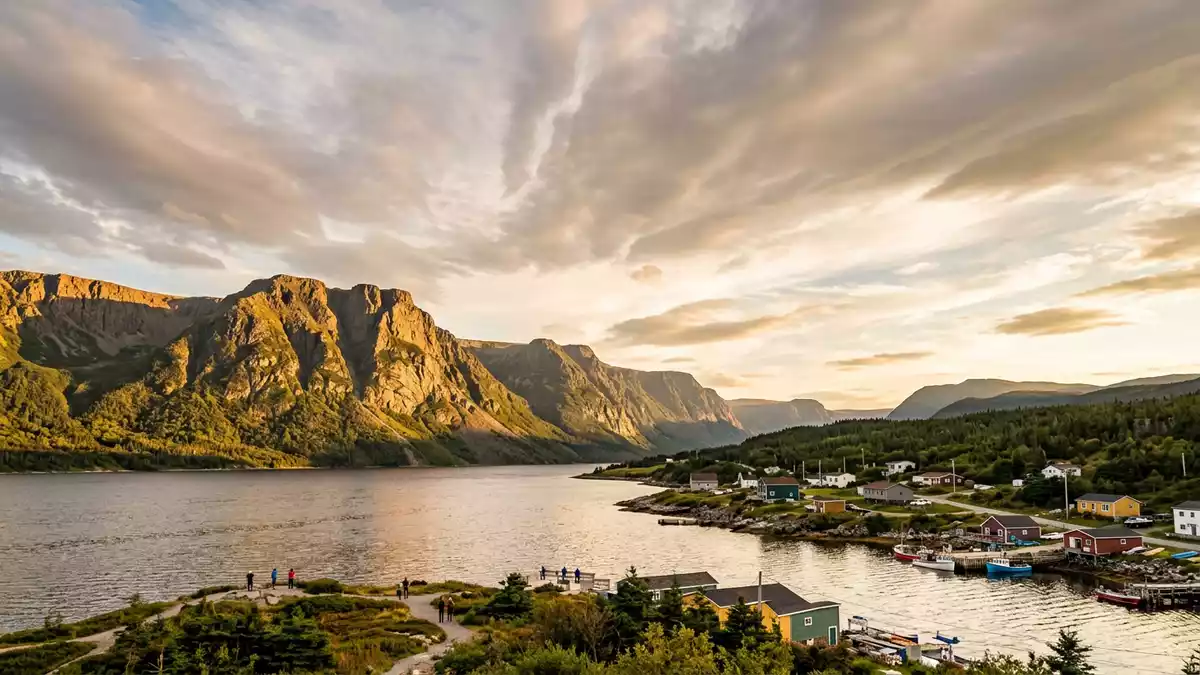
Gros Morne National Park in western Newfoundland is a landscape where deep geological time feels close at hand, with ancient mountains, landlocked fjords and rare mantle rock shaping the coastal region around Rocky Harbour. Designated a UNESCO World Heritage Site in 1987 for both its geological significance and natural beauty, it offers a concentrated view of processes that formed the Appalachian Mountains and opened and closed oceans long before human settlement.
Mountains, fjords and a coast shaped by ice
Gros Morne National Park spreads across highlands and lowlands along the west coast of Newfoundland, facing the Gulf of St Lawrence and forming part of the island’s Great Northern Peninsula.Great Northern Peninsula The park covers an area of 1,805 square kilometres (697 sq mi), a scale that allows broad sweeps of wilderness between small coastal communities and inland valleys.1,805 square kilometres of wilderness Glacier-scoured uplands rise above forested slopes, while long inlets cut inland from the coast, their cliffs showing layered rock shaped by erosion.
One of the most striking landforms is Western Brook Pond, a freshwater fjord enclosed by steep walls and reached from the park’s coastal lowlands.glacier-carved landlocked fjord Its water fills a former glacial valley cut into ancient rocks of the Long Range Mountains, where cliffs and plateaus show how ice carved deep troughs into an already uplifted terrain. Elsewhere in the park, smaller valleys and lakes nestle between ridges, and rivers flow towards sandy estuaries and coves along the Gulf of St Lawrence.
Plate tectonics written into the rocks
The defining feature of Gros Morne National Park is its geology, which presents an internationally significant illustration of continental drift and plate tectonics.UNESCO World Heritage Site designation In several parts of the park, rocks that formed as oceanic crust and mantle now lie exposed at the surface, having been transported and uplifted during the closure of an ancient ocean. This combination of deep marine rocks, continental crust and sedimentary layers gives the area a textbook cross-section of processes that shaped the eastern margin of North America.
The Tablelands, a prominent plateau near the coast, are the most famous example of mantle material visible above ground.rare outcrop of the Earth’s mantle Here, ultramafic rock from the Earth’s mantle was pushed upward hundreds of millions of years ago, creating slopes with a distinctive barren appearance compared with the surrounding forested hills. Nearby, sedimentary formations from the Ordovician period contain fossils that helped define benchmarks in global geological time, while Precambrian basement rocks in the Long Range Inlier record much older stages of mountain building.Ordovician sedimentary strata and Precambrian basement
Rocky Harbour and the human scale of a vast park
Rocky Harbour sits near the centre of Gros Morne National Park’s coastal section, acting as a practical base for exploring the surrounding fjords, headlands and interior plateaus.Location in Rocky Harbour The community lies close to several trailheads and viewpoints, and a visitor centre has been established there to interpret the park’s geology and ecology for travellers arriving from elsewhere in Newfoundland and beyond.visitor centre in Rocky Harbour
Within the park boundaries, boreal forest, wetlands, coastal barrens and alpine plateaus create varied habitats for wildlife. Caribou, moose and smaller mammals move between valley forests and open uplands, while seabirds use the cliffs and offshore shallows along the Gulf of St Lawrence. Lakes and rivers cutting through glacial deposits and bedrock complete the picture of a northern landscape where the human footprint remains comparatively light away from the coastal settlements.
Visiting Gros Morne National Park: what travellers from Western Europe should know
- Gros Morne National Park lies on the west coast of Newfoundland, in the Canadian province of Newfoundland and Labrador, with Rocky Harbour providing an access point by road from the island’s main transport routes.
- The terrain in the park ranges from coastal paths and boardwalks to steep mountain trails; upland routes involve significant ascents on rocky ground and exposed plateaus.
- In winter, snow can cover both the highlands and lower valleys, and conditions in the backcountry reflect the maritime climate of Newfoundland’s west coast.
- The official language is English and the currency is the Canadian dollar.
- Entry requirements depend on your nationality; UK travellers can check the FCDO travel advice at gov.uk/foreign-travel-advice, Irish travellers the Department of Foreign Affairs at ireland.ie.
Searching for Gros Morne National Park on social platforms
These links open searches for Gros Morne National Park on each platform.Frequently asked questions about Gros Morne National Park
Where is Gros Morne National Park located?
Gros Morne National Park is on the west coast of Newfoundland, in the province of Newfoundland and Labrador, with Rocky Harbour near its central coastal section.
What can travellers expect when visiting Gros Morne National Park?
Travellers encounter glacier-carved fjords, mountain plateaus, boreal forest and coastal landscapes, along with interpretation of plate tectonics and geological history at visitor facilities.
What makes Gros Morne National Park distinctive among Canadian parks?
Its exposed oceanic crust and mantle rock, combined with fjords and highlands shaped by glaciation, give Gros Morne an exceptional role in illustrating Earth’s geological evolution.


