
Grosser Aletschgletscher and the long curve of ice above Fiesch
Published on 09/09/2026 at 17:32 | Editorial responsibility: Rafael Müller, Editor-in-Chief AD HOC NEWS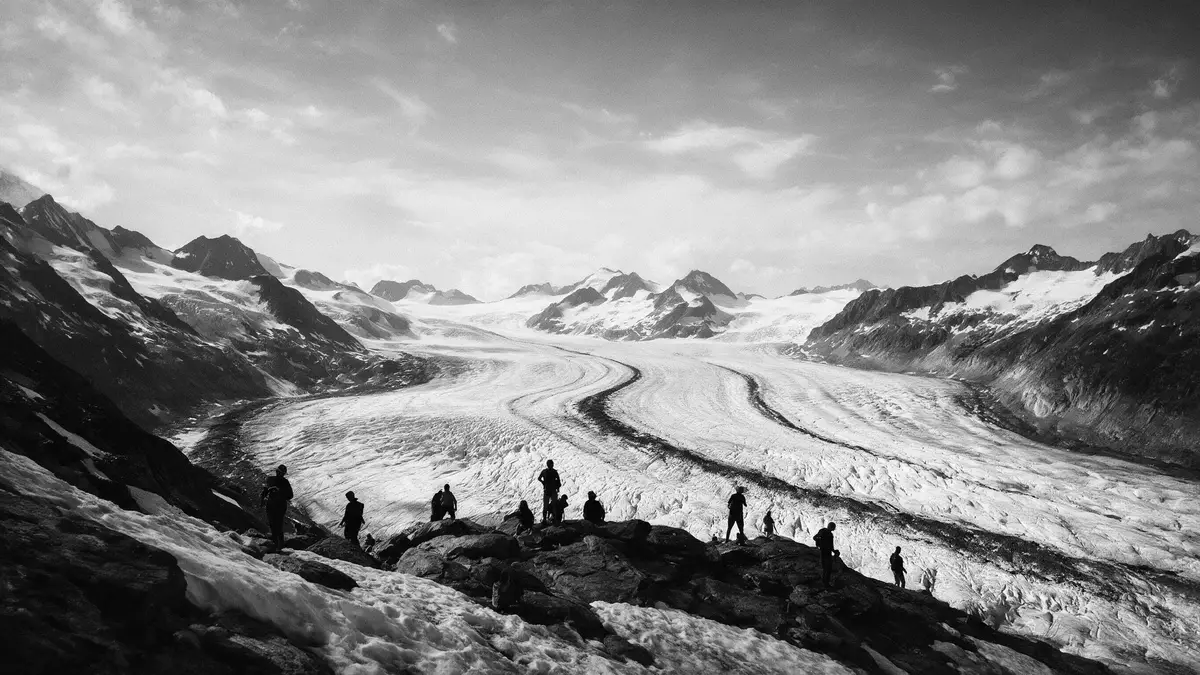
Grosser Aletschgletscher is the great ice stream above Fiesch, spreading through the Bernese Alps in Valais. It is the largest glacier in the Alps and part of the Swiss Alps Jungfrau-Aletsch World Heritage landscape.
A broad river of ice in Valais
The glacier forms a long, curving band of ice between high rock walls and hanging snowfields. Its main body gathers near Konkordiaplatz, where several firn basins meet before the ice flows southwards through the mountain landscape.
That scale is the first thing the eye reads. The glacier stretches for around 20 km and occupies a valley setting that drops towards the Rhône valley near Fiesch. Valais tourism describes the glacier’s altitude range from 1,575 m to 4,160 m, a span that underlines how much vertical relief surrounds the ice.
UNESCO landscape and alpine setting
The glacier sits within the UNESCO-listed Jungfrau-Aletsch region, recognised in 2001. That protected landscape brings together ice, rock, forests and high summits on the south side of the Bernese Alps.
The name also belongs to a wider mountain geography, not a single viewpoint. From the southern side, the ice appears as a wide white sweep rather than a narrow tongue, with the upper basin and lower glacier body reading as separate parts of one system. Aletsch Arena links the glacier with the broader heritage region, while the SwissEduc material on the glacier gives a detailed profile of its form and length.
Fiesch and the southern viewpoints
Fiesch is the practical place name attached to many visits, because it lies beneath the glacier on the valley side. From there, mountain transport leads into the Aletsch Arena and towards high terraces such as Fiescheralp and Eggishorn.
Seen from those heights, the glacier’s curve and width become clearer than from the valley floor. The surroundings are all steep slopes, high passes and exposed viewing points, with the glacier’s white surface set against dark rock and alpine ridges. Fiesch access routes and the Eggishorn viewpoint are part of the same mountain circuit.
Visiting Grosser Aletschgletscher: what travellers from Western Europe should know
- The glacier is reached from Fiesch in Valais, with mountain transport towards Fiescheralp and Eggishorn. The village sits in the upper Rhône valley.
- The landscape is high alpine, with steep slopes, exposed viewpoints and long stretches of ice visible from above. The glacier itself lies far below the terraces.
- Eggishorn gives a clear view of the glacier’s broad upper sweep. Fiescheralp forms a useful intermediate plateau in the same access chain.
- The area belongs to the Bernese Alps and sits within a protected World Heritage landscape. That status shapes the character of the place more than any single building or monument.
Searching for Grosser Aletschgletscher on social platforms
These links open searches for Grosser Aletschgletscher on each platform.
Frequently asked questions about Grosser Aletschgletscher
Where is Grosser Aletschgletscher?
It lies in Valais, on the southern side of the Bernese Alps above Fiesch. The glacier forms part of the Swiss Alps Jungfrau-Aletsch World Heritage landscape.
What does a visit involve?
The usual access points are mountain routes from Fiesch towards Fiescheralp and Eggishorn. The place is defined by high altitude, broad ice views and a sharply alpine setting.
What makes it distinctive?
Its length, width and setting inside a UNESCO-listed mountain landscape give it a strong physical presence. The glacier reads as a continuous river of ice rather than a single frozen face.


