
Grote Markt and the Baroque square of Brussels
Published on 09/24/2026 at 03:29 | Editorial responsibility: Rafael Müller, Editor-in-Chief AD HOC NEWS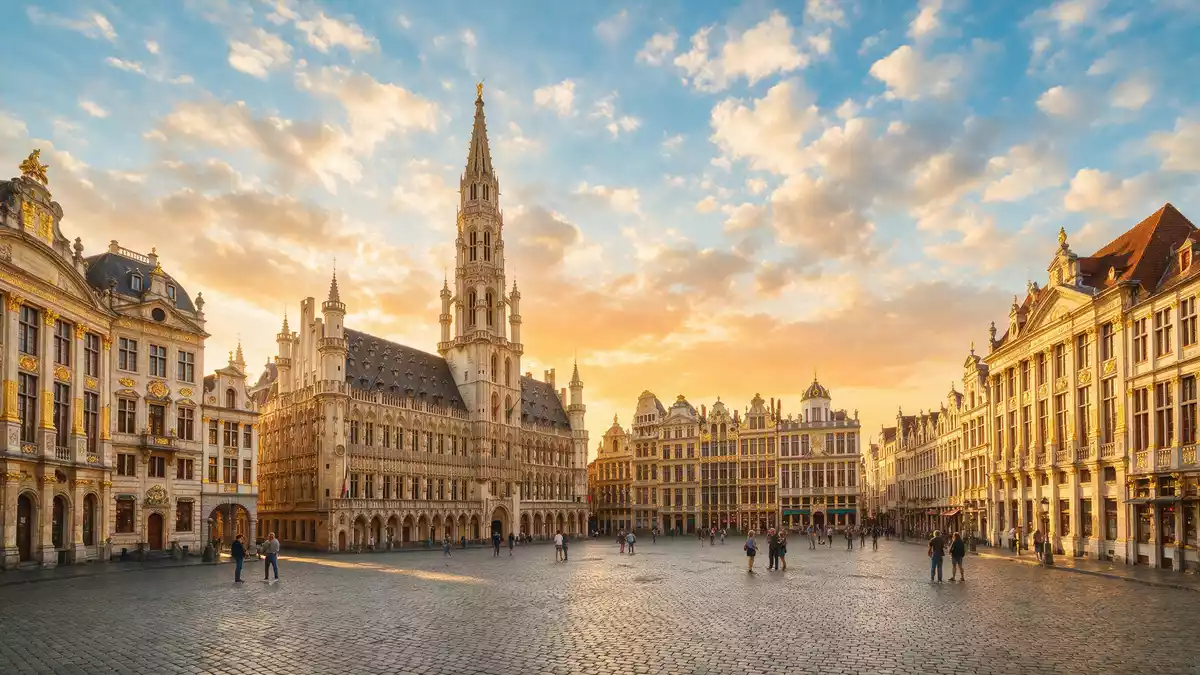
Grote Markt is a rectangular public square in Brüssel, enclosed by a closely arranged group of Gothic, Baroque and later historic buildings. Its most striking feature is the contrast between the tall Gothic Town Hall and the richly decorated guild houses around the cobbled open space.
The square has served as a market since the twelfth century. Much of its visible architectural character dates from the late seventeenth century, when the buildings were reconstructed after the bombardment of Brussels in 1695.
A medieval market framed by civic power
The earliest written reference to the square dates from 1174, when it was known as the Nedermerckt, or Lower Market. Its position beside the Senne connected commercial activity with the growing urban centre of Brussels.
Trade shaped the buildings around the square. Market halls, private houses and guild premises occupied the edges, while the open centre remained a place for commerce, public ceremony and civic life. The buildings belonged to a city whose political and commercial importance was expressed through its central urban space.
The Town Hall occupies the southern side of Grote Markt. Its Brabant Gothic architecture, built in stages during the fifteenth century, is marked by a tall tower and an elaborate façade. The building remains the square’s clearest expression of municipal authority, set against the more varied façades of the former guild houses.
1695 and the Baroque rebuilding
French troops under Louis XIV bombarded Brussels in August 1695 during the Nine Years’ War. The bombardment destroyed most of the buildings around Grote Markt, while parts of the Town Hall and other substantial masonry survived.
Reconstruction followed in the late seventeenth century. The guilds rebuilt their houses in stone, producing the compact ensemble that defines the square. Each façade has its own ornament, roofline and symbolism, yet the buildings share a close relationship in scale and materials.
Among the buildings is the Maison du Roi, also known as the Broodhuis. Its history reaches back to the sixteenth century, and its present appearance belongs to the nineteenth-century reconstruction of an older building. It houses the Brussels City Museum and faces the Town Hall across the square.
The façades combine Baroque decoration with Gothic and Renaissance elements. Gables, pilasters, sculpted details and gilded accents appear across the building line. Together they form an urban composition rather than a single monumental structure.
One square, several architectural languages
Grote Markt is recognised as a UNESCO World Heritage Site, inscribed in 1998. The designation covers the square and its surrounding public and private buildings as an architectural ensemble.
The site brings together civic, commercial and residential architecture. The Town Hall represents municipal government, the Maison du Roi recalls the administrative and commercial history of the city, and the guild houses preserve the names and identities of historic trades.
The result is a square where no single façade explains the whole place. The eye moves from the Gothic tower to the stepped and curved gables, then across rows of stone façades carrying statues, emblems and decorative metalwork.
Grote Markt also records the changing materials of Brussels. Earlier market buildings were largely wooden, while the reconstruction after 1695 produced the predominantly stone frontage visible around the square. Restoration and rebuilding in subsequent centuries added further layers without removing the basic rectangular urban form.
The square’s character therefore lies in its combination of open space and dense ornament. A visitor standing in the centre can read the history of Brussels through the buildings surrounding one paved enclosure: medieval trade, municipal power, guild organisation, wartime destruction and Baroque reconstruction.
Visiting Grote Markt: what travellers from Western Europe should know
- Grote Markt lies in central Brussels, within the historic city centre. It is reached through the surrounding pedestrian streets and public transport network.
- The square is paved, and its surrounding streets include pedestrian routes with uneven historic surfaces. Comfortable footwear suits the stone paving.
- The Town Hall stands on the southern side, while the Maison du Roi faces it across the square. The two buildings provide clear reference points within the enclosure.
- Belgium’s official languages are Dutch, French and German, and the national currency is the euro.
Searching for Grote Markt on social platforms
These links open searches for Grote Markt on each platform.
Frequently asked questions about Grote Markt
Where is Grote Markt?
Grote Markt is in the historic centre of Brussels, Belgium. It is surrounded by pedestrian streets and historic buildings.
What can visitors expect at the square?
Visitors find a paved rectangular square enclosed by the Gothic Town Hall, the Maison du Roi and former guild houses.
What makes Grote Markt distinctive?
Its distinctive character comes from the concentration of Gothic, Renaissance and Baroque architecture around one open civic and commercial space.


