
Gyeongbokgung, the axial heart of Seoul’s royal city
Published on 08/25/2026 at 06:44 | Editorial responsibility: Rafael Müller, Editor-in-Chief AD HOC NEWS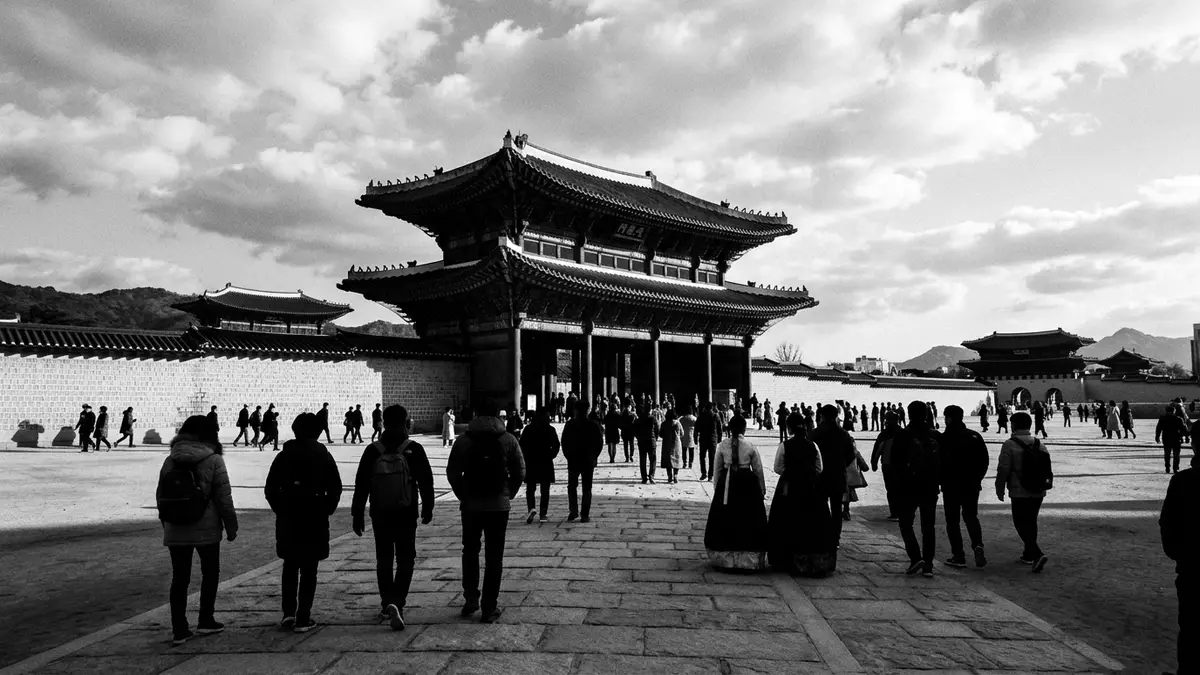
Gyeongbokgung is the former main royal palace of the Joseon dynasty in Seoul, laid out between the city’s old south–north axis and the mountain ridge of Bugaksan. Built in 1395 as the principal seat of King Taejo’s new dynasty, its ceremonial halls, courtyards and pavilions still define the historic centre of South Korea’s capital.
A palace on a mountain–river axis
Gyeongbokgung was established in 1395, three years after Yi Seong-gye founded the Joseon dynasty and took the throne as King Taejo.Built in 1395 It occupies a broad rectangle in northern Seoul, with the Bugaksan mountain slopes rising behind its inner courts and the city stretching away towards the Han River in front.Bugaksan behind the palace This mountain?behind, water?before arrangement reflects the geomantic ideals that shaped the capital’s layout.
The name “Gyeongbok” carries the hope that the new dynasty would enjoy good fortune and prosperity, and the palace soon became the setting for major state rituals and everyday administration.Meaning of the name Gyeongbok Within its walls, the early Joseon kings consolidated their rule, including Sejong the Great, under whose reign the Korean script Hangul was created for the language spoken across the kingdom.Sejong and Hangul
Rise, destruction and restoration
For much of the fifteenth and sixteenth centuries, Gyeongbokgung functioned as the main seat of royal power, housing the king, his household and the central offices of government.Main royal palace of Joseon The palace’s formal axis, running from the main gate to the throne hall, framed audiences, coronations and examinations that shaped the bureaucracy of the dynasty.
In 1592, during the Imjin War, Japanese forces invaded the Korean peninsula and Gyeongbokgung was burned, leaving the palace complex in ruins.Destruction in 1592 The site remained largely abandoned until the nineteenth century, when Regent Heungseon Daewongun oversaw a major rebuilding project during the reign of King Gojong.Restoration under Heungseon Daewongun Many of the major gates, halls and residential quarters visible today follow layouts from that rebuilding.
Gates, halls and ponds along the axis
Approaching Gyeongbokgung from central Seoul, visitors pass first through Gwanghwamun, the great south gate in the outer wall, before crossing further gates towards the palace’s main courtyard.Gwanghwamun Gate The route leads to Geunjeongjeon Hall, the central throne hall where kings held formal audiences, announced civil service examination results and received foreign envoys.Geunjeongjeon throne hall
Off the main axis sit some of Gyeongbokgung’s most atmospheric structures. Gyeonghoeru Pavilion stands on stone columns above a broad pond, used historically for banquets and major celebrations.Gyeonghoeru Pavilion and pond Further into the inner court, Hyangwonjeong Pavilion rises beside another water basin reached by a narrow bridge, marking a quieter residential corner of the palace complex.
Visiting Gyeongbokgung: what travellers from Western Europe should know
- Gyeongbokgung stands in Jongno-gu in central Seoul, with its main gate Gwanghwamun facing one of the city’s principal boulevards and near major metro stations.
- The palace grounds cover an extensive walled area with broad gravelled courtyards and long axial routes on foot between gates, halls and pavilions.
- Within the complex, several halls are reached by staircases built in stone, and some pavilions sit beside ponds that require crossing bridges or stepping up onto raised platforms.
- The official language is Korean and the currency is the South Korean won.
- Entry requirements depend on your nationality; UK travellers can check the FCDO travel advice at gov.uk/foreign-travel-advice, Irish travellers the Department of Foreign Affairs at ireland.ie.
Searching for Gyeongbokgung on social platforms
These links open searches for Gyeongbokgung on each platform.
Frequently asked questions about Gyeongbokgung
Where is Gyeongbokgung located in Seoul?
Gyeongbokgung stands in the Jongno-gu district of central Seoul, with Gwanghwamun Gate facing south towards the city’s major civic square and avenues.
What can visitors expect inside the palace grounds?
Visitors walk through a sequence of grand gates, open courtyards and wooden halls, with pavilions such as Gyeonghoeru and Hyangwonjeong set beside broad ponds within the walled complex.
What makes Gyeongbokgung distinctive among Korean palaces?
Gyeongbokgung combines its role as the first main palace of the Joseon dynasty with an axial layout aligned between Bugaksan and the city, and retains notable structures like Geunjeongjeon Hall and Gyeonghoeru Pavilion.


