
Hakone Chokoku no Mori Bijutsukan and its landscape of sculpture
Published on 08/15/2026 at 14:03 | Editorial responsibility: Rafael Müller, Editor-in-Chief AD HOC NEWS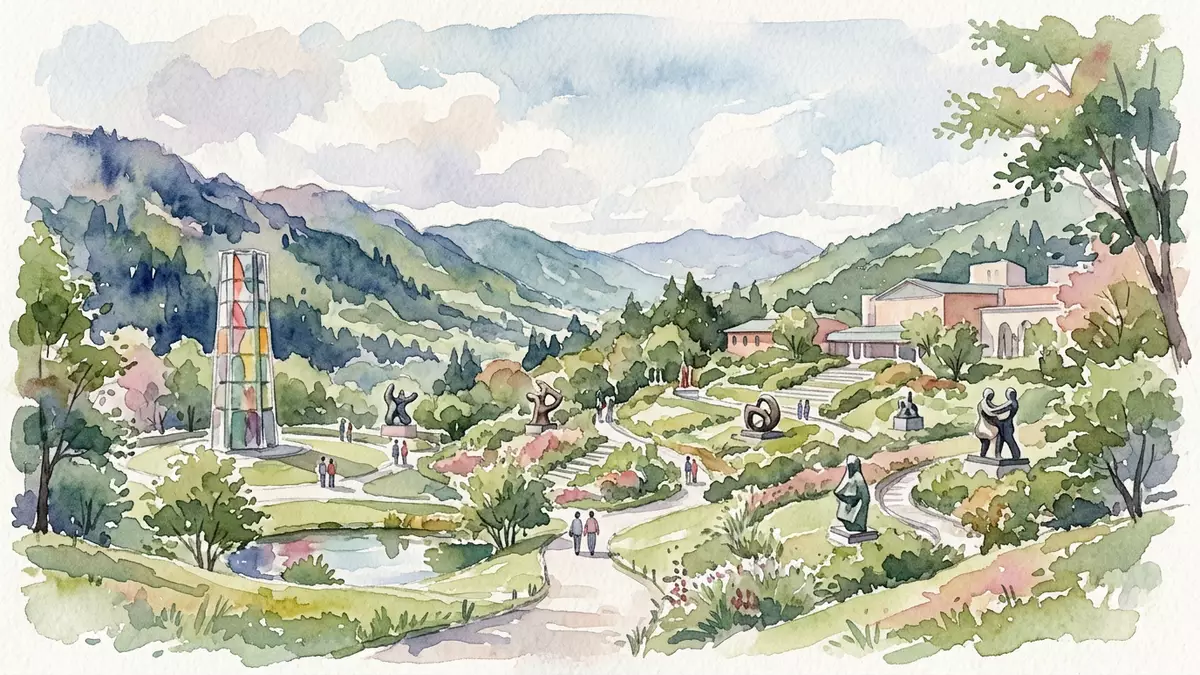
Hakone Chokoku no Mori Bijutsukan in Hakone, Japan is Japan’s first open-air art museum, opened in 1969 on a broad hillside within the Fuji-Hakone-Izu National Park. Its permanent collection of modern and contemporary sculpture is displayed across an extensive garden where works by Japanese and international artists stand against the backdrop of Hakone’s mountains.
Sculpture in an open mountain garden
The defining experience of Hakone Chokoku no Mori Bijutsukan is the way sculpture and landscape are combined in a single continuous outdoor gallery. The grounds extend over about 70,000 square metres (17.3 acres) of sloping terrain, with lawns, paths and planted terraces laid out so that visitors move from one group of works to another in the open air.70,000 square metres The site lies in Ninotaira, a district of Hakone in Kanagawa Prefecture, surrounded by hills that frame the sculptures and make the museum feel closely tied to its mountain setting.Hakone is located in Fuji-Hakone-Izu National Park
Across these grounds, around 120 works are installed permanently, representing sculptors from the modern and contemporary periods.approximately 120 masterpieces Names such as Auguste Rodin, Henry Moore and Joan Miró appear alongside Japanese artists, and the pieces range from figurative bronzes to abstract forms in metal, stone and other materials.world masters of modern and contemporary art The museum’s outdoor layout creates multiple vantage points where sculptures are seen with the surrounding valley and peaks behind them, under changing light and weather.
From Japan’s first open-air museum to a multi-layered art site
Hakone Chokoku no Mori Bijutsukan opened in 1969 as Japan’s first open-air art museum, established by the Fujisankei Communications Group in the late 1960s.opened in 1969 The founding idea was to create an institution that focuses on modern and contemporary sculpture and presents it in direct relationship with the surrounding landscape of Hakone. Over time the museum foundation has assembled an art collection that encompasses thousands of works, including sculptures and paintings chiefly from the twentieth century.over 2,000 works
Alongside the open-air displays, Hakone Chokoku no Mori Bijutsukan includes indoor pavilions that add further layers to a visit. One of the best-known is the Picasso Pavilion, which houses more than 300 works attributed to Pablo Picasso, including paintings, ceramics and prints.Picasso Pavilion with 300+ works Another striking feature is “Happiness in Symphonic Sculpture”, a tower-like structure whose interior surfaces are lined entirely with stained glass, creating colourful patterns of light over its stairways and platforms.Happiness in Symphonic Sculpture These enclosed spaces complement the outdoor gardens and give the museum a mix of open and sheltered viewing areas.
The layout, terrain and facilities of Hakone Chokoku no Mori Bijutsukan
The museum’s grounds occupy a hillside plot, so paths and sculpture lawns follow the natural gradients of the terrain rather than a flat grid. Visitors move along paved walkways and gentle slopes, with occasional stairways connecting different levels, and the artworks are set both close to the paths and further out on grass or among planting. This layout allows the pieces to be seen against different backdrops, including trees and distant mountains, and makes the garden feel more like a continuous landscape than a series of separate courtyards.outdoor displays as greatest attraction
Hakone Chokoku no Mori Bijutsukan also incorporates facilities that reflect its setting in a hot-spring region. On the grounds there is a footbath that uses Hakone’s onsen water, where visitors can sit and immerse their feet in warm spring water while overlooking parts of the sculpture garden.footbaths using spring water Rest areas, cafés and museum shops are located within the complex, providing indoor spaces between walks through the outdoor galleries.cafe and museum shop on-site
Visiting Hakone Chokoku no Mori Bijutsukan: what travellers from Western Europe should know
- Hakone Chokoku no Mori Bijutsukan stands in Ninotaira in Hakone, Kanagawa Prefecture, close to Chokoku-no-Mori Station on the Hakone Tozan Railway, which links Hakone-Yumoto with the higher districts of the town.
- The museum grounds cover a sizeable hillside, with paved paths, grassed areas and steps between levels, so a visit involves walking outdoors across sloping terrain.
- Hakone lies in Japan, where the official language is Japanese and the currency is the yen.
- Entry requirements depend on your nationality; UK travellers can check the FCDO travel advice at gov.uk/foreign-travel-advice, Irish travellers the Department of Foreign Affairs at ireland.ie.
Searching for Hakone Chokoku no Mori Bijutsukan on social platforms
These links open searches for Hakone Chokoku no Mori Bijutsukan on each platform.
Frequently asked questions about Hakone Chokoku no Mori Bijutsukan
Where is Hakone Chokoku no Mori Bijutsukan located?
Hakone Chokoku no Mori Bijutsukan is in Ninotaira in the town of Hakone, Ashigarashimo District, Kanagawa Prefecture in Japan, within the Fuji-Hakone-Izu National Park.
What can visitors expect from a visit?
A visit combines walking through extensive outdoor sculpture gardens on a mountainside with time in indoor pavilions such as the Picasso Pavilion and facilities including a hot-spring footbath.
What makes Hakone Chokoku no Mori Bijutsukan distinctive among art museums?
It is distinctive as Japan’s first open-air art museum, with around 120 modern and contemporary sculptures installed permanently across a large hillside garden and supplemented by major indoor collections.


