
Halaszbastya and Budapest's neo-Romanesque terrace
Published on 09/08/2026 at 22:48 | Editorial responsibility: Rafael Müller, Editor-in-Chief AD HOC NEWS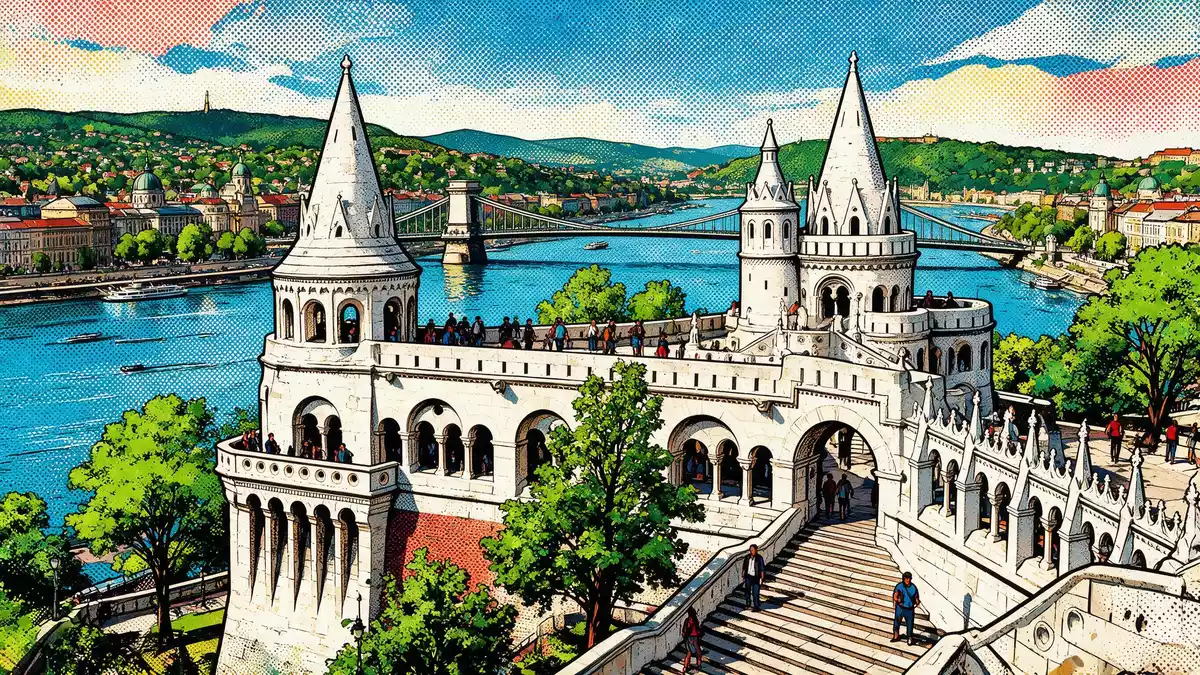
Halaszbastya in Budapest is a white neo-Romanesque terrace complex by Frigyes Schulek, completed in 1902. Its arcades, stairways and stone towers give the Buda Castle District a sharply defined profile.
Frigyes Schulek’s terrace above Castle Hill
The bastion stands in the Buda Castle District, beside Matthias Church and within the UNESCO-listed Budapest ensemble inscribed in 1987. That setting places it among the city’s most recognisable historic structures, shaped by a deliberate late nineteenth-century architectural language.UNESCO-listed Budapest ensemble
Schulek’s name belongs to the place as clearly as its pale stone. He also restored Matthias Church, and the bastion shares the church’s historicising vocabulary of arches, walls and towers.Frigyes Schulek
Neo-Romanesque forms and a castle-side silhouette
The structure takes the form of terraces, corridors and towers arranged along the castle edge. The seven towers are part of its familiar outline, and the long façade runs parallel to the Danube side of the hill.seven towers
Its materials and detailing are straightforward to read at close range: stone surfaces, arcades, balustrades and broad steps. The result is less a fortress than a carefully composed architectural terrace, with the city opening out beyond it.architectural terrace
From millennial Budapest to a lasting landmark
Construction ran between 1895 and 1902, and the bastion belongs to the millennium programme linked with the Hungarian state. That date places it firmly in the turn-of-the-century phase of Budapest’s monumental expansion.between 1895 and 1902
The name Halaszbastya refers to the fishermen’s quarter beneath Castle Hill, a reminder that the district’s identity was tied to the Danube edge as well as the royal hill above it. In the same ensemble, the bastion’s stone forms converse with Matthias Church and the surrounding castle fabric.fishermen’s quarter
Visiting Halaszbastya: what travellers from Western Europe should know
- The site is on Castle Hill in Budapest, beside Matthias Church in the Buda Castle District. It is reached on foot through the historic hill quarter and by the area’s public transport network.
- The approach includes broad steps, sloping paths and stone terraces. The hilltop position gives the place a raised, exposed feel.
- The official language is Hungarian and the currency is the Hungarian forint.
- Entry requirements depend on your nationality; UK travellers can check the FCDO travel advice at gov.uk/foreign-travel-advice, Irish travellers the Department of Foreign Affairs at ireland.ie.
Searching for Halaszbastya on social platforms
These links open searches for Halaszbastya on each platform.
Frequently asked questions about Halaszbastya
Where is Halaszbastya?
Halaszbastya stands on Castle Hill in Budapest, in the Buda Castle District beside Matthias Church. It belongs to the historic hilltop ensemble on the city’s Buda side.
What does a visit involve?
The place is a terrace complex with steps, arcades and elevated walkways. Its raised position and open edges make the stone structure and the city setting easy to read together.
What makes Halaszbastya distinctive?
Its neo-Romanesque form, Frigyes Schulek’s authorship and the 1902 completion date define it. The combination of towers, terraces and castle-edge siting gives it a clear architectural identity.


