
Halaszbastya, Budapest’s river?front fairy?tale terrace
Published on 09/10/2026 at 20:07 | Editorial responsibility: Rafael Müller, Editor-in-Chief AD HOC NEWS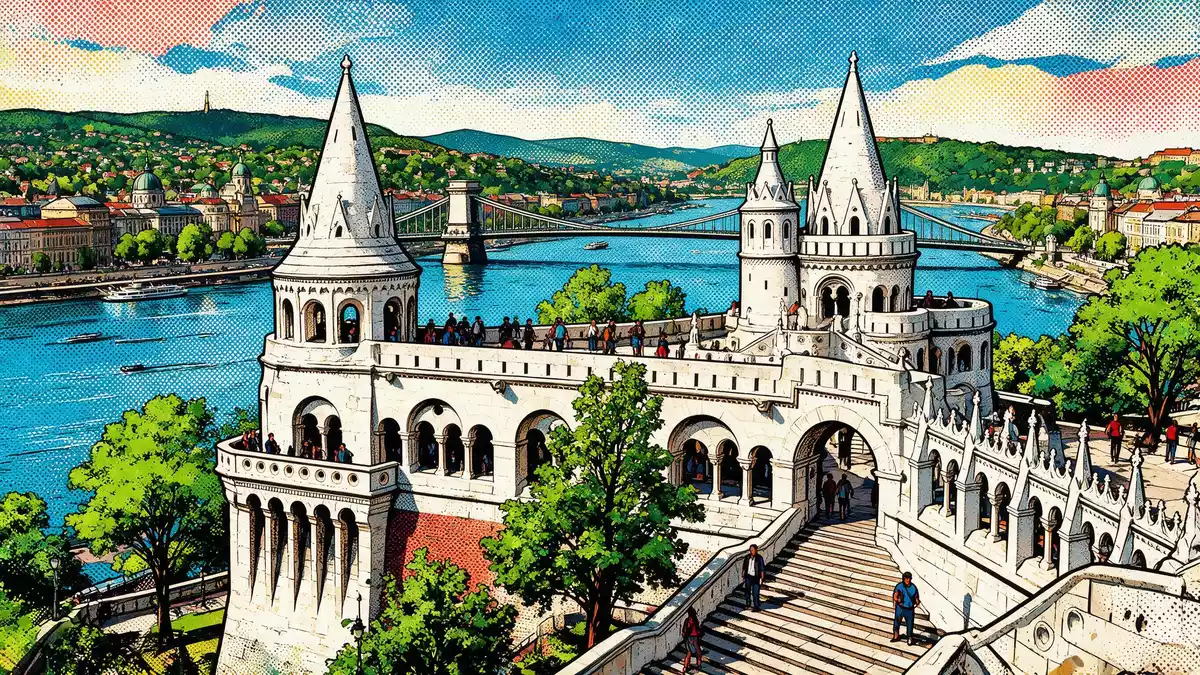
Halaszbastya, known in English as Fisherman’s Bastion, rises above the Danube on Budapest’s Castle Hill as a pale stone terrace of towers and arcades framing wide views over the city. Completed in the early twentieth century in a revival of neo?Romanesque and neo?Gothic styles, it turns a former stretch of fortification into a generous promenade, wrapped around Matthias Church and open to anyone who climbs its stairways.Fisherman’s Bastion
A terrace of turrets above the Danube
Halaszbastya occupies the eastern edge of Buda’s Castle Hill, directly above the river and facing across to the flat expanse of Pest, with the Hungarian Parliament building standing out on the opposite bank.panoramic views of the Danube River and the Pest historical district The complex runs as a long arcade and sequence of terraces along the former castle wall, so that each level offers a slightly different vantage point on the river, the bridges and the city roofs.
The building itself is a confection of staircases, arcades and towers in pale stone, with turrets that recall the storybook end of historicist architecture at the turn of the nineteenth and twentieth centuries.neo-Romanesque and neo-Gothic terrace on Castle Hill Seven towers rise from the upper terrace, each associated with one of the Magyar tribal groups whose settlement of the Carpathian Basin in 896 is a foundational moment in Hungarian history.7 towers in all, each representing one of Hungary’s tribes Between them, open walkways run along the edge of the hill, protected by balustrades and punctuated by viewpoints where the stonework frames the city beyond like a series of set pieces.
Late nineteenth?century nation building in stone
The present form of Halaszbastya belongs to the wave of construction that marked a millennium of Hungarian statehood in the late nineteenth century, when Budapest’s civic authorities reshaped the Castle Hill area with new monuments and terraces.built between 1895 and 1902 Architect Frigyes Schulek was commissioned to design the bastion, working on foundations of the old Buda Castle walls and integrating his terraces around the existing Matthias Church, whose own restoration formed part of the same programme.designed and built between 1895 and 1902 on the plans of Frigyes Schulek
Construction work began in the 1890s, and the main structural elements were in place by the turn of the century; Halaszbastya opened to the public in 1905 as an ornamental terrace rather than a working fortress.Construction started in the 1890s The name “Halaszbastya” recalls the medieval fishermen’s guild that was responsible for defending this segment of the castle wall, linking the new promenade to the memory of the older fortification that once stood on the same line, even though the bastion itself serves as a viewing platform rather than a military work.name of the Fisherman’s Bastion is Halaszbastya in Hungarian
Stonework details and surrounding ensemble
Walking through Halaszbastya reveals a sequence of carved details and framed spaces: arcades with round?headed arches, staircases climbing between levels, and lookout points where the parapet curves gently around a bay in the wall. The terrace runs for roughly 140 m (about 460 ft) along the former line of fortification, with additional sections extending to the south and north, so that the complex feels less like a single platform and more like a linked series of outdoor rooms overlooking the river.roughly 140 meters long
At the centre of the ensemble stands Matthias Church, its richly decorated exterior rising immediately behind the bastion’s terraces, while a bronze equestrian statue of King Stephen I of Hungary occupies the space between church and arcades, adding another historical layer to the site.bronze statue of Stephen I of Hungary mounted on a horse, erected in 1906 From the parapets, the gaze runs across the river towards landmarks such as Margaret Island and Gellért Hill, and along the course of the Danube as it bends through Budapest; the bastion has become one of the city’s recognised viewpoints and forms part of the Buda Castle District ensemble inscribed as a UNESCO World Heritage site.designated a UNESCO World Heritage Site as part of the Várkerület District
Visiting Halaszbastya: what travellers from Western Europe should know
- Halaszbastya stands on Castle Hill in the Buda Castle District, overlooking the Danube on the Buda side of Budapest and centred on Szentháromság tér beside Matthias Church.Szentharomsag Ter, Budapest 1014 Hungary
- The terraces are reached by stairways and sloping paths from the riverbank and from the surrounding streets of the Castle District, with several flights of stone steps linking the different levels.
- Public transport serves the area via Szentháromság tér on Castle Hill, with buses running up from Pest and trams following the riverbank below; Halaszbastya sits a short walk uphill from these stops.buses 16, 16A, 116 and 916, trams along the riverbank
- The official language is Hungarian and the currency is the forint.
- Entry requirements depend on your nationality; UK travellers can check the FCDO travel advice at gov.uk/foreign-travel-advice, Irish travellers the Department of Foreign Affairs at ireland.ie.
Searching for Halaszbastya on social platforms
These links open searches for Halaszbastya on each platform.
Frequently asked questions about Halaszbastya
Where is Halaszbastya in Budapest?
Halaszbastya stands on Castle Hill in the Buda Castle District, above the Danube river, centred on Szentháromság tér beside Matthias Church.
What can visitors expect at Halaszbastya?
Visitors find open terraces, arcades and towers in pale stone, with stairways between levels and wide views over the Danube, the bridges and the rooftops of Pest.
What makes Halaszbastya distinctive among Budapest landmarks?
Its seven towers, neo?Romanesque stonework and position on the former castle wall create a continuous riverside viewpoint that combines historic architecture with a broad panorama of the city.


