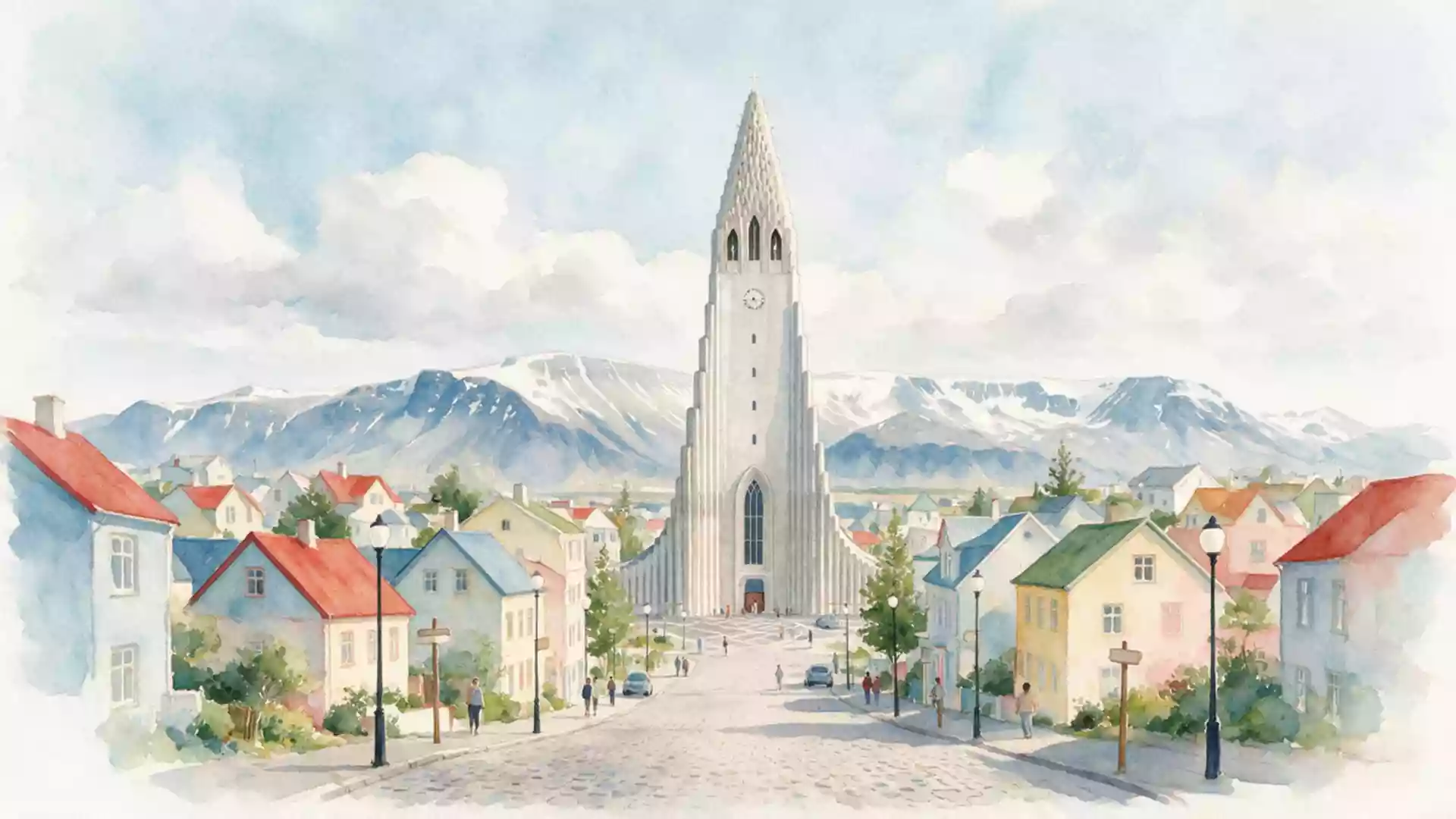
Hallgrimskirkja, Reykjavik’s basalt-like concrete landmark
Published on 08/15/2026 at 14:41 | Editorial responsibility: Rafael Müller, Editor-in-Chief AD HOC NEWS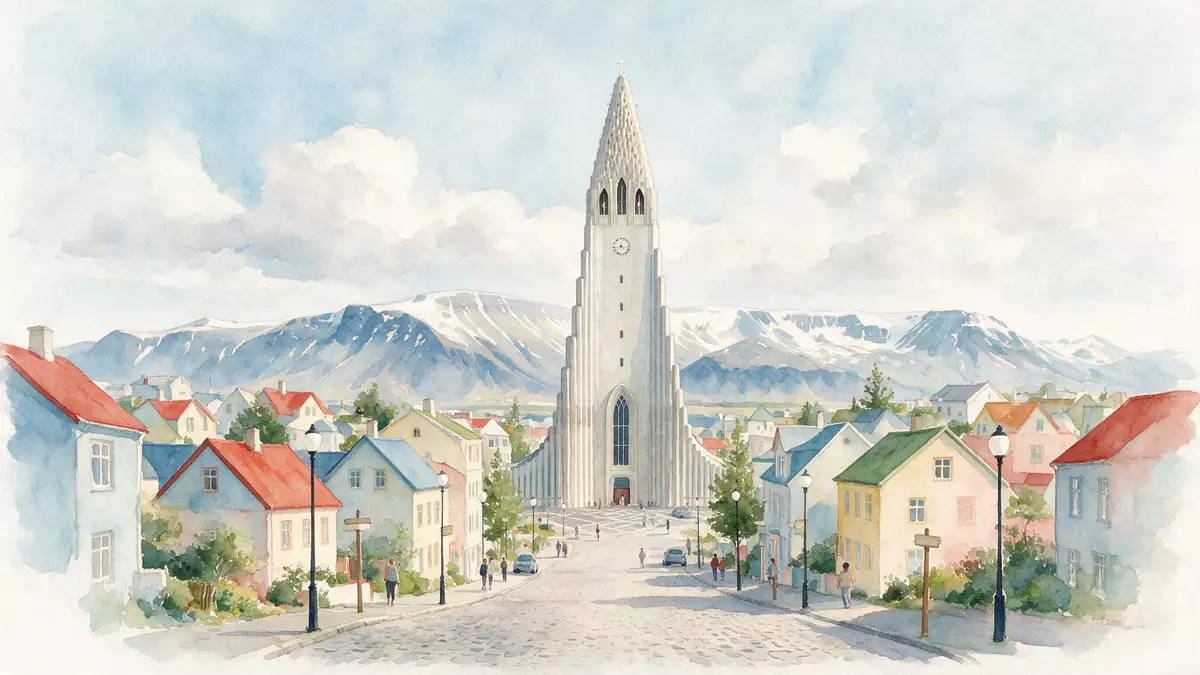
Hallgrimskirkja is the white-concrete church that commands the skyline of Reykjavik, its stepped tower rising high above the low roofs and surrounding hills. Designed by the Icelandic State Architect Guðjón Samúelsson from 1937 onwards and completed in 1986, it has become both a place of worship and a defining landmark for the capital.
A basalt-inspired tower above the city
Hallgrimskirkja stands on Skólavörðuholt, a hill in central Reykjavik that gives the church an elevated position over the surrounding streets and harbour. Its reinforced concrete structure is shaped into a tall central tower with flanking wings, and the exterior is finished in pale, almost white, concrete that stands out clearly against the typical Icelandic weather and the distant mountains.Construction of the church began in 1945 and the building was officially opened in 1986. The tower reaches about 74.5 m (244 ft), making Hallgrimskirkja the largest church in Iceland and among the tallest structures in the country.The church is a parish church of the national Lutheran Church of Iceland.
The tower and its attached wings are the most striking elements of the exterior, their vertical concrete forms recalling the hexagonal basalt columns that appear in many parts of Iceland’s volcanic landscape.The columns on either side of the tower have been described as representing volcanic basalt and form part of a national architectural style. From the streets below, the tower rises as a vertical stack of projecting concrete forms, leading the eye upwards to the spire and the simple cross at the top.
Architecture, structure and style
Guðjón Samúelsson, born in 1887 and serving as Iceland’s State Architect, drew on expressionist and Scandinavian modernist influences for Hallgrimskirkja, but the building also reflects an attempt to translate Icelandic geology into architecture.Samúelsson’s design was commissioned in 1937 and has often been compared with the expressionist Grundtvig’s Church in Copenhagen. The plan is divided into three clear parts: the tall tower with its side wings, the long nave in a more conventional rectangular form, and a cylindrical sanctuary at the far end of the nave.Architectural descriptions emphasise this tripartite arrangement of tower, nave and cylindrical sanctuary.
Inside, the architectural language shifts from the dramatic exterior to a restrained, almost austere interior typical of Lutheran churches in northern Europe. The nave is arranged with simple pews and tall windows that admit daylight, while the white surfaces and minimal decoration give the space a calm, uncluttered atmosphere. At the far end stands the sanctuary, whose cylindrical volume is expressed both inside and outside, creating a distinct focus at the liturgical end of the church. The most visually prominent feature of the interior is a large pipe organ with thousands of pipes, mounted high above the west end of the nave and framed by the concrete forms of the tower.The organ, installed in 1992, has a case that matches the strong vertical lines of the architecture.
Names, stories and the square in front
The name Hallgrimskirkja refers to Reverend Hallgrímur Pétursson, a seventeenth-century Icelandic clergyman and poet whose “Passíusálmar” hymn cycle holds a central place in Icelandic religious literature.The church takes its name from Hallgrímur Pétursson, born in 1614 and deceased in 1674. In front of the church, on a paved square, stands a prominent statue of the Norse explorer Leifur Eiríksson (Leif Erikson), who is associated with voyages to North America long before the age of Columbus.The statue, designed by Alexander Stirling Calder and given by the United States in 1930, stands directly in front of the church.
From the square, the full composition of Hallgrimskirkja comes into view: the statue on its stone pedestal, the rising series of concrete “columns” forming the wings and tower, and the hilltop setting above the older neighbourhoods of Reykjavik. The church’s long construction period, beginning in the mid-1940s and culminating in an opening in October 1986, reflects both the ambition of the project and the changing economic circumstances of Iceland in the twentieth century.Sources consistently date the opening of Hallgrimskirkja to 26 October 1986. Over the decades, the building has become a recognised symbol of the capital, appearing on postcards, guidebook covers and in countless photographs taken from the streets below.
Visiting Hallgrimskirkja: what travellers from Western Europe should know
- Hallgrimskirkja stands on Skólavörðuholt in central Reykjavik, above the street Skólavörðustígur. It is reached on foot from the city centre and lies within walking distance of the harbour and main shopping streets.
- The interior is entered at ground level from the paved square in front of the church. Inside, the nave floor is level, but access to the tower involves enclosed stairways and lift lobbies within the tall concrete structure.
- Hallgrimskirkja is part of the national Lutheran Church of Iceland, and regular services take place in the nave. Visitors should expect a working parish church rather than a purely tourist monument.
- The official language is Icelandic and the currency is the Icelandic króna.
Searching for Hallgrimskirkja on social platforms
These links open searches for Hallgrimskirkja on each platform.
Frequently asked questions about Hallgrimskirkja
Where is Hallgrimskirkja located in Reykjavik?
Hallgrimskirkja stands on Skólavörðuholt hill in central Reykjavik, at the upper end of the street Skólavörðustígur, above the older neighbourhoods and within walking distance of the harbour.
What can visitors expect inside Hallgrimskirkja?
Inside the church, visitors find a tall, light-filled nave with simple interior finishes, a large pipe organ aligned with the tower, and a cylindrical sanctuary at the far end.
What makes Hallgrimskirkja distinctive among Icelandic churches?
Hallgrimskirkja is distinctive for its basalt-inspired white-concrete tower, its height of about 74.5 m (244 ft), its hilltop position over Reykjavik and its dedication to the poet-clergyman Hallgrímur Pétursson.