
Hallstatt and the salt beneath its lakeside houses
Published on 09/23/2026 at 17:56 | Editorial responsibility: Rafael Müller, Editor-in-Chief AD HOC NEWS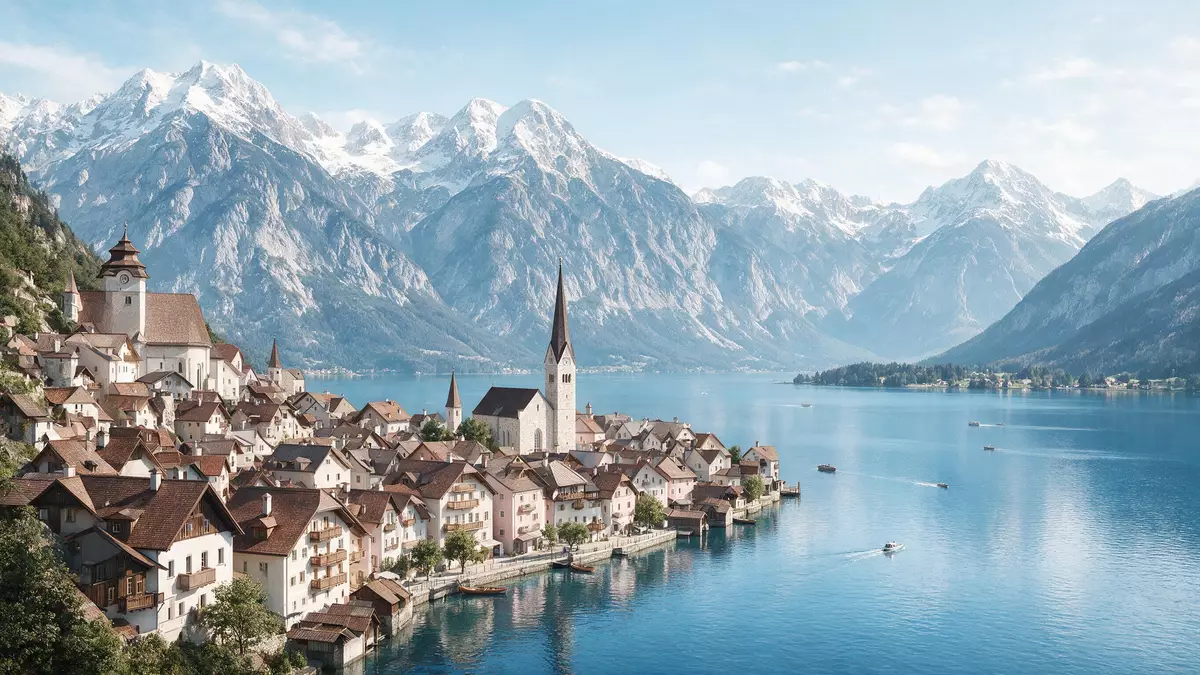
Hallstatt lies between Lake Hallstatt and the steep Salzberg in Austria’s Salzkammergut. Its clustered houses, narrow lakeside strip and mountain salt workings form a landscape shaped by a resource mined for millennia.
Hallstatt between lake, mountain and timber houses
The village occupies a narrow shore beside Lake Hallstatt, with wooded slopes rising directly behind it. Houses stand close together, and many combine timber construction with painted façades, balconies and steep roofs.
The setting joins several visible elements in a small space: lake water, mountain rock, church towers, compact streets and the Salzberg above the settlement. Hallstatt-Dachstein/Salzkammergut became a UNESCO World Heritage landscape in 1997.
Salt mining and the Hallstatt period
Salt extraction in the Hallstatt area reaches back to the second millennium BC. Archaeological evidence links the Salzberg with systematic production during the Bronze Age, while mining activity continued through the Iron Age and subsequent centuries.
The settlement gave its name to the Hallstatt period, an Early Iron Age culture dated from roughly 800 to 400 BC. Objects recovered from graves include metalwork, pottery and personal ornaments, showing connections across Central Europe. The history of Hallstatt salt mining remains closely connected with the identity of the village.
Churches, graves and a landscape of continuity
Hallstatt’s parish church and Lutheran church provide two prominent landmarks above the lakeside houses. The parish church contains late Gothic features, while the Lutheran church has a tall, slender tower visible across the lake.
Above the village, the cemetery and charnel house contain evidence of local burial customs. The mountain settlement, the archaeological record and the lake shore belong to the same cultural landscape. Salt, trade and habitation connect Hallstatt’s prehistoric evidence with its historic buildings.
Visiting Hallstatt: what travellers from Western Europe should know
- Hallstatt stands on the western shore of Lake Hallstatt in Upper Austria. Trains serve Hallstatt station on the opposite shore, with a boat connection across the lake.
- The historic settlement occupies a narrow strip between the lake and the mountain. The Salzberg rises above the village, and paths include steep sections and stairs.
- The official language is German and the currency is the euro.
Searching for Hallstatt on social platforms
These links open searches for Hallstatt on each platform.
Frequently asked questions about Hallstatt
Where is Hallstatt?
Hallstatt is in Upper Austria, on the western shore of Lake Hallstatt. It belongs to the Salzkammergut mountain and lake region.
What can travellers expect in Hallstatt?
The village has a compact historic centre, lakeside houses, churches, a cemetery and access to the Salzberg. The surrounding landscape includes steep wooded mountains and Lake Hallstatt.
What makes Hallstatt distinctive?
Its identity joins a lakeside settlement with a long salt-mining history. The name also identifies the Hallstatt period of the Early Iron Age.


