
Hallstatt between lake and salt mountain
Published on 09/14/2026 at 06:26 | Editorial responsibility: Rafael Müller, Editor-in-Chief AD HOC NEWS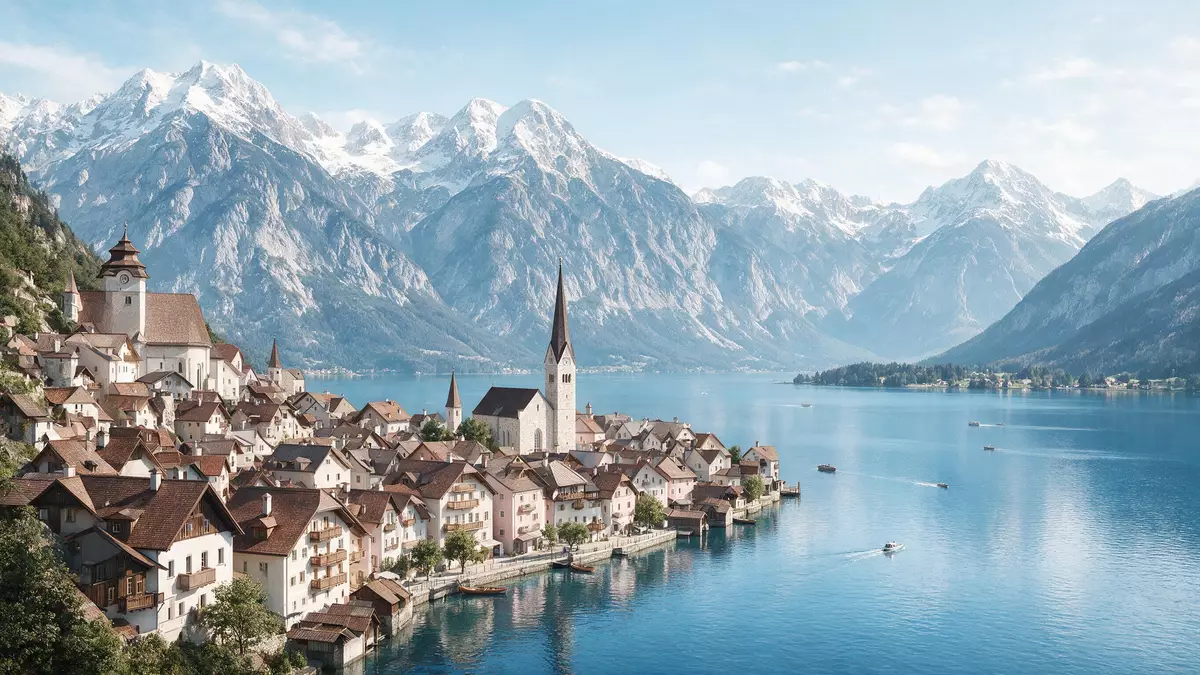
Hallstatt in Austria occupies a narrow strip of lakeside ground between steep limestone slopes and the waters of Lake Hallstatt, a setting shaped for millennia by salt mining and mountain geology. The settlement forms part of the Hallstatt-Dachstein / Salzkammergut Cultural Landscape, which UNESCO inscribed on the World Heritage List in 1997 as a cultural landscape recognising the long relationship between people and this alpine terrain.
Village between rock face and lake
Hallstatt lies in Upper Austria’s Salzkammergut region, on the western shore of Lake Hallstatt at the foot of the Dachstein massif. The lake’s surface covers about 8.55 km² (3.30 sq mi), with a maximum depth around 125 m (410 ft), and its fjord-like outline runs roughly north–south through the inner Salzkammergut.Lake Hallstatt’s dimensions Hallstatt occupies a narrow band of level ground on this western shore, with water to one side and near-vertical slopes rising immediately behind the houses.the lakeside settlement
The surrounding peaks create an enclosed valley that opens northwards towards Bad Goisern and the Traun river and southwards towards Obertraun and the higher Dachstein mountains.Hallstatt’s position in the inner Salzkammergut Traditional houses line narrow streets along the shore, and several buildings stand close to the water, so that lake, church tower and steep rock walls form a continuous visual ensemble. The geology belongs to the Dachstein limestone unit of the Northern Limestone Alps, and the rock walls behind the village rise sharply from the lakeside, emphasising how little flat terrain is available.
Salt deposits and the Hallstatt culture
Long before the lakeside village took on its present form, people came to Hallstatt for salt. The salt deposit in the mountain above the settlement formed around 250 million years ago, when an ancient sea evaporated and left thick rock-salt seams beneath later limestone slabs.the history of Hallstatt’s salt Archaeological work has shown that mining activity in Hallstatt can be dated to around 1,500 BC, by which time a fully developed salt mining industry operated in the high valley above the lake.prehistoric salt mining around 1500 BC
The prehistoric workings have yielded a modular wooden staircase whose timbers were felled and assembled around 1,300 BC, now regarded as one of the oldest preserved wooden staircases in Europe.the Bronze Age staircase Finds from the burial ground above the mine document an early Iron Age cultural horizon, known to archaeologists as the Hallstatt culture, dated broadly to between about 800 and 450 BC.the Hallstatt period in the burial ground In 1311, salt mining and brewing in Hallstatt were placed under state control, a regime that continued for many centuries.state control of salt mining from 1311
World Heritage landscape of lake, village and salt mountain
Hallstatt’s lakeside streets, steep roofs and church towers sit within a wider cultural landscape shaped by salt, water and mountains. The mining town stands on the west bank of Lake Hallstatt, with the Salzberg salt mountain above and the Dachstein massif forming the high skyline beyond.the mining town on the west bank The Hallstatt-Dachstein / Salzkammergut Cultural Landscape was inscribed on the UNESCO World Heritage List in 1997, recognising both the natural setting and the long continuity of salt mining and settlement in this inner-alpine valley.the World Heritage inscription in 1997
The World Heritage area extends beyond Hallstatt itself to include the Dachstein mountains and neighbouring communities such as Bad Goisern, Gosau and Obertraun.the Inner Salzkammergut World Heritage region Lake Hallstatt serves as a central element of this landscape, and a brine pipeline has linked the salt works to destinations such as Bad Ischl and Ebensee since the late sixteenth century.the brine pipeline from Hallstatt Taken together, mountain, lake, underground workings and village illustrate how an alpine valley became a centre of salt production and an archaeological reference point for understanding early European societies.
Visiting Hallstatt: what travellers from Western Europe should know
- Hallstatt lies in the Salzkammergut region of Upper Austria on the western shore of Lake Hallstatt, south-east of Salzburg; regional trains run to nearby Bad Goisern and Obertraun.
- The settlement occupies a confined lakeside ledge with steep slopes rising behind the houses, so streets are narrow and walking involves short gradients and stairways between levels.
- The lake and surrounding mountains form part of a wider alpine landscape, with views to the Dachstein massif and across the water towards Obertraun and other shore settlements.
- Hallstatt is in Austria; the official language is German and the currency is the euro.
Searching for Hallstatt on social platforms
These links open searches for Hallstatt on each platform.
Frequently asked questions about Hallstatt
Where is Hallstatt and what is its setting?
Hallstatt is a lakeside settlement in the Salzkammergut region of Upper Austria, on the western shore of Lake Hallstatt beneath steep limestone slopes.
What should visitors expect on a first visit?
Visitors encounter a compact village on a narrow lakeside ledge, with traditional houses, a church tower and streets that run close to the water under steep rock walls.
What makes Hallstatt distinctive among alpine villages?
Hallstatt combines an early salt mining history reaching back to the Bronze Age with a World Heritage-listed cultural landscape of lake, village and surrounding mountains.


