
Hallstatt between lake, mountain and salt history
Published on 09/11/2026 at 18:23 | Editorial responsibility: Rafael Müller, Editor-in-Chief AD HOC NEWS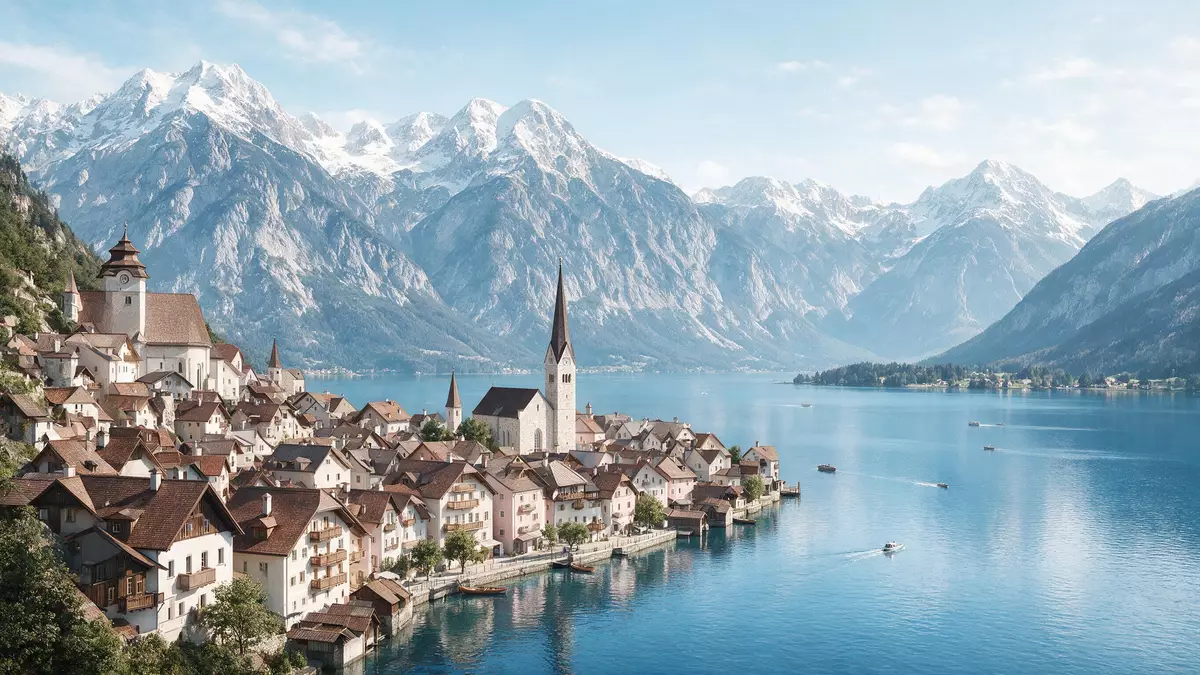
Hallstatt is a lakeside settlement in Upper Austria’s Salzkammergut region, pressed between the waters of Lake Hallstatt and steep limestone slopes rising behind its houses. Its position at the foot of the Dachstein massif and its prehistoric salt deposits have given the village an unusually long history of human activity, reflected in both its layout on the shore and the cultural landscape recognised by UNESCO in the late twentieth century.
A village confined between rock and water
Hallstatt occupies a narrow strip of level ground on the western shore of Lake Hallstatt, with the lake to one side and near-vertical slopes climbing immediately behind the buildings. The lake lies in the Salzkammergut region of Upper Austria at the northern foot of the Dachstein massif, and the surrounding peaks rise steeply from its edge, creating an enclosed valley that opens north towards Bad Goisern and south towards Obertraun.Hallstatt on the western shore of Lake Hallstatt Streets and houses follow this confined shoreline, so that many facades stand close to the water, while paths and stairways climb quickly towards the forested slopes.
The lake itself is long and narrow, framed by rock walls that form a continuous backdrop behind the church tower, traditional houses and the small harbour. The settlement’s position means that views along the water naturally include both the village and the rising mountains, and the contrast between built structures and the surrounding limestone cliffs is a constant feature of Hallstatt’s appearance.Hallstatt-Dachstein / Salzkammergut alpine landscape
Salt in the mountain and a prehistoric mining landscape
Hallstatt’s wealth in earlier periods was rooted in extensive salt deposits in the mountain above the village, which have been exploited for thousands of years. Research by institutions such as the Natural History Museum in Vienna indicates that organised mining activity was present by the Middle Bronze Age, with a fully developed salt mine operating around 1,300 BC and tunnels reaching hundreds of metres into the darkness of the mountain.prehistoric salt mine at Hallstatt Finds from burial grounds in the area gave their name to the Hallstatt period of the early Iron Age, roughly between 800 and 400 BC, highlighting the settlement’s role as a centre of an extensive trade network.
Archaeological work on the Salzberg above Hallstatt has revealed traces of mining activity that point to salt production beginning in the Stone Age and intensifying in the Bronze Age. Evidence suggests continuous habitation in the inner Salzkammergut region, with salt extraction shaping transport routes and settlement patterns for millennia.attributes of the Hallstatt mining landscape The salt mines on the mountain are described as the oldest known in the world, and remnants such as wooden stairways and mining tools illustrate sophisticated techniques used by prehistoric miners.
World Heritage cultural landscape and lakeside architecture
Hallstatt sits at the core of the Hallstatt-Dachstein / Salzkammergut Cultural Landscape, which UNESCO inscribed on the World Heritage List in 1997 as a cultural site. The designation covers an alpine area where steep mountains rise abruptly from narrow valleys, and recognises both the natural drama of the terrain and the long-standing interaction between human settlement, salt production and the environment.World Heritage region and history of Hallstatt The protected zone extends beyond the village to include parts of the Dachstein range and neighbouring communities in the Inner Salzkammergut.
The village itself retains a lakeside architecture that reflects its limited building space and historical development. Traditional houses line the shore, some with balconies facing the water, while narrow lanes and stairways connect the waterfront to higher terraces and the path towards the salt mines. The main church and small square form a focal point near the lake, and the view across the water takes in both these structures and the continuous rock face behind them.Hallstatt as archaeological heart of the World Heritage region
Visiting Hallstatt: what travellers from Western Europe should know
- Hallstatt lies in Upper Austria’s Salzkammergut region on the western shore of Lake Hallstatt, south-east of Salzburg. Regional trains run to nearby Bad Goisern and Obertraun, from where buses and boats connect to the village.
- The settlement occupies a narrow band of lakeside ground with steep slopes rising behind it, so walking routes in the village and towards viewpoints often involve stairways and short but noticeable gradients.
- The surrounding peaks belong to the Dachstein massif, and weather in the valley can be influenced by alpine conditions, with snow on higher ground in winter and cooler air from the lake.
- German is the official language and the currency is the euro.
Searching for Hallstatt on social platforms
These links open searches for Hallstatt on each platform.
Frequently asked questions about Hallstatt
Where is Hallstatt located?
Hallstatt is in Upper Austria’s Salzkammergut region, on the western shore of Lake Hallstatt at the northern foot of the Dachstein massif.
What can visitors expect on a visit to Hallstatt?
Visitors encounter a compact lakeside village confined between water and steep slopes, with traditional houses, a church near the shore and access routes climbing towards the salt mining area.
What makes Hallstatt distinctive among Austrian villages?
Hallstatt combines a long history of salt mining, archaeological burial grounds linked to the Hallstatt period and a setting within a UNESCO-listed alpine cultural landscape.


