
Harmandir Sahib: the gilded heart of Sikh devotion in Amritsar
Published on 08/24/2026 at 20:28 | Editorial responsibility: Rafael Müller, Editor-in-Chief AD HOC NEWS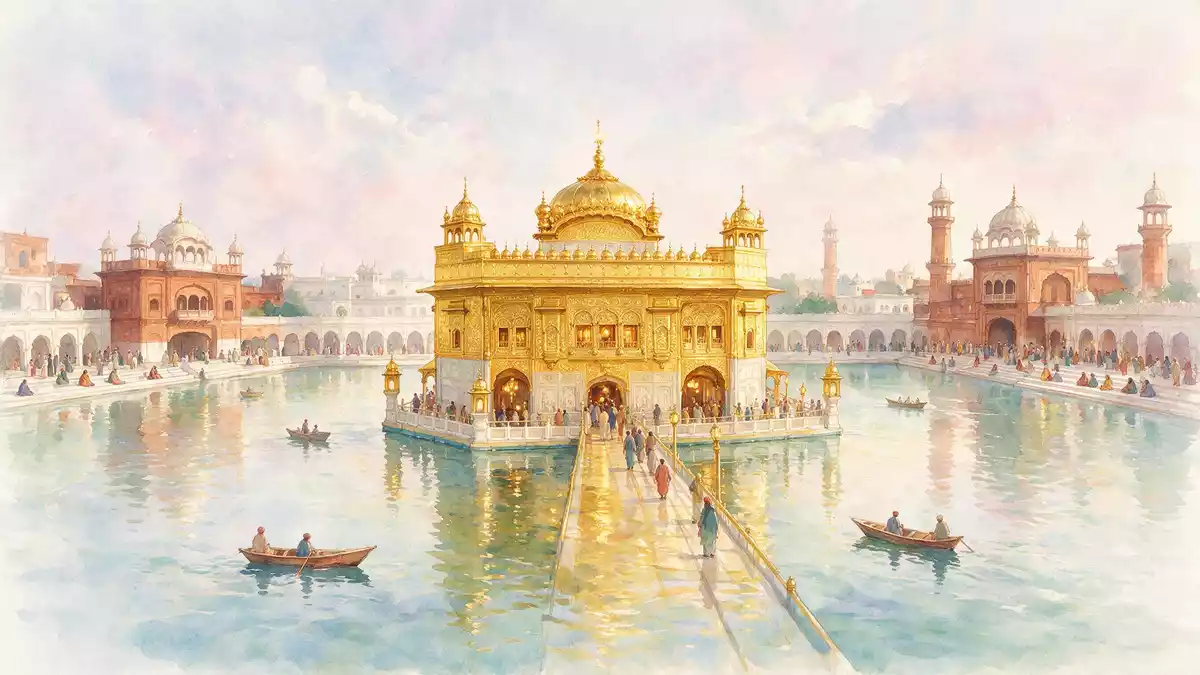
Harmandir Sahib, widely known in English as the Golden Temple, is the central shrine of Sikhism and the most recognisable landmark of Amritsar in Punjab, India. Founded under the guidance of Guru Arjan in the late sixteenth century and reshaped with marble and gilded copper during the reign of Maharaja Ranjit Singh in the early nineteenth century, it appears today as a luminous sanctuary rising from a broad sacred pool.
A shrine set in a “pool of nectar”
The defining experience of Harmandir Sahib is its setting within the Amrit Sarovar, the man-made pool whose name is often translated as “Pool of Nectar” and which gave Amritsar its name.Amrit Sarovar and the city’s name The water forms a broad rectangle, edged by stone walkways and arcaded buildings, with the shrine itself standing on a platform at the centre.
A straight causeway crosses the surface of the pool to the sanctum, creating a processional route framed by the water and by the low parapets on either side.causeway across the sarovar Around the water, the complex extends into courtyards, prayer halls and administrative buildings, forming a self-contained religious precinct within the wider city.
From sixteenth-century foundation to gilded sanctuary
Harmandir Sahib grew out of a sixteenth-century project to establish a central place of worship for the Sikh community in Amritsar. Guru Ram Das, the fourth Sikh Guru, oversaw the excavation of the sacred pool in the 1570s, while Guru Arjan, the fifth Guru, directed the construction of the shrine itself towards the end of that century.foundation under Guru Ram Das and Guru Arjan In 1604 Guru Arjan installed a copy of the Adi Granth, the foundational Sikh scripture, within the sanctum, establishing it as the spiritual focus of the site.installation of the Adi Granth in 1604
The shrine did not remain untouched by conflict. During the eighteenth century, invasions and warfare in Punjab led to repeated damage and destruction, and the temple complex was rebuilt several times by the Sikh community.reconstruction after eighteenth-century attacks A major transformation came under Maharaja Ranjit Singh, founder of the Sikh Empire, who in the early nineteenth century sponsored extensive marble facing, decorative inlay work and the gilding of the upper sections and dome, giving Harmandir Sahib the golden appearance that shaped its widely used English name.gilding under Maharaja Ranjit Singh
Marble, gold and a four-sided welcome
Architecturally, Harmandir Sahib combines elements associated with Sikh, Mughal and Rajput traditions, expressed through its profile, materials and surface decoration.blend of Mughal and Rajput styles The central shrine rises from the platform as a multi-storey structure faced in white marble at the lower levels, with carved panels and inlaid motifs, while the upper parts are sheathed in gilded copper and gold leaf. Above, a bulbous dome sits on a drum, its surface also covered in gold, catching sunlight and reflected light from the water below.
The building is accessible through entrances on all four sides of the surrounding complex, and the shrine itself is linked to the perimeter by the causeway across the water.four entrances and central shrine This four-sided arrangement, combined with the lower level of the sanctum relative to the surrounding walkways, forms one of the most distinctive spatial features of Harmandir Sahib and reflects a deliberate openness in the way the complex is organised.
Visiting Harmandir Sahib: what travellers from Western Europe should know
- Harmandir Sahib stands in the historic centre of Amritsar in the Indian state of Punjab, reached overland from other parts of India and served by Sri Guru Ram Dass Jee International Airport.
- The complex is set around the Amrit Sarovar, with stone walkways, broad stairways and a causeway to the shrine requiring walking over several levels.
- The official language of the state is Punjabi and the national currency is the Indian rupee.
- Entry requirements depend on your nationality; UK travellers can check the FCDO travel advice at gov.uk/foreign-travel-advice, Irish travellers the Department of Foreign Affairs at ireland.ie.
Searching for Harmandir Sahib on social platforms
These links open searches for Harmandir Sahib on each platform.
Frequently asked questions about Harmandir Sahib
Where is Harmandir Sahib and what kind of place is it?
Harmandir Sahib is a Sikh gurdwara complex in the city of Amritsar in Punjab, India, centred on a shrine set within a large sacred pool.
What should a visitor expect on a first visit?
A visitor encounters the broad Amrit Sarovar, stone walkways and the golden sanctum reached by a causeway, alongside extensive supporting buildings and spaces for worship and community life.
What makes Harmandir Sahib distinctive among religious sites?
Its combination of sixteenth-century Sikh foundation, marble and gold architecture, four-sided access around the pool and central shrine reached across water gives Harmandir Sahib a form and setting that are strongly characteristic.


