
Harvard Yard’s brick greens at the core of Cambridge
Published on 09/09/2026 at 11:54 | Editorial responsibility: Rafael Müller, Editor-in-Chief AD HOC NEWS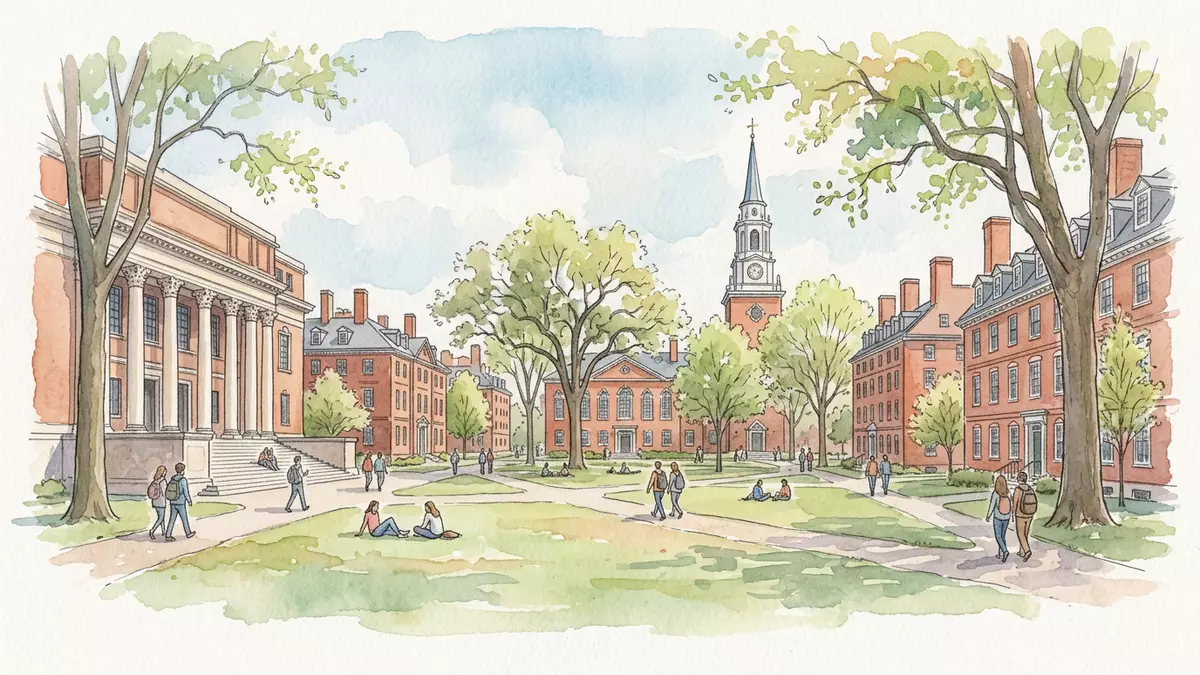
Harvard Yard is the historic core of Harvard University in Cambridge, Massachusetts, a broad campus green where brick buildings, trees and iron fencing define a compact academic landscape. Its story reaches back to the seventeenth century, when Harvard College emerged from a decision of the Massachusetts Bay Colony in 1636 and a first parcel of land became the nucleus of the present precinct.
A seventeenth-century college green shaped over centuries
The roots of Harvard Yard lie in the early years of Harvard College, founded by the Massachusetts Bay Colony in 1636 as a college for the new settlement on the Charles River.Harvard College in 1636 A first tract of land was acquired in 1637, forming what was then known as the “College Yard”, and this early parcel became the core around which the later campus grew.the original College Yard parcel
Over the eighteenth and nineteenth centuries Harvard added adjoining pieces of pasture and town land, turning the College Yard into a defined campus green bounded by streets such as Massachusetts Avenue, Cambridge Street, Broadway and Quincy Street.the streets that bound the Yard The area came to be known as Harvard Yard, and its architecture and planting developed in stages, shaped by successive building campaigns and landscape improvements.
Lawns, elms and Georgian brick
Harvard Yard reads as a large rectangular park of a little over 20 acres (about 8 or 9 ha), carpeted with grass and planted with trees, enclosed by academic and residential buildings in brick.approximately 21 acres of lawn and buildings Paths cross the lawns between the facades, linking libraries, classrooms, Memorial Church and first-year dormitories with the administrative offices of Harvard College and the wider university.
The landscape character of the Yard took recognisable form in the early nineteenth century, when President John Thornton Kirkland, in office between 1810 and 1828, oversaw the installation of lawns, gravel paths and tree planting, including elms and a pine grove.Kirkland’s early nineteenth-century work In 1813 the architect Charles Bulfinch designed University Hall, a stone building facing the central green whose placement established the scale and visual coherence of the Yard and helped turn it into an inwardly focused arena for collegiate life.University Hall by Bulfinch
Historic buildings and the enclosing fence
The buildings that frame Harvard Yard span centuries of collegiate architecture, with a strong emphasis on Georgian and later Colonial Revival styles in red brick.architectural character of the Yard Massachusetts Hall, dating from 1720, stands in the Old Yard and is recognised as the oldest surviving building on Harvard’s campus.Massachusetts Hall built in 1720 Nearby, Harvard Hall and Holden Chapel belong to a wider group of early Georgian buildings constructed before the American Revolution.
Later presidents, notably Charles William Eliot between 1869 and 1909, oversaw extensive building that filled the perimeter of the Yard with brick dormitories and academic blocks, giving the precinct a consistent massing and a logical organisation.nineteenth-century expansion under Eliot Around the turn of the twentieth century a decorative wrought-iron perimeter fence was installed, punctuated by brick and stone gates such as Johnston Gate, and constructed between about 1890 and 1930 by the firm McKim, Mead & White.Memorial Fence and gates Several buildings in the Yard have been designated National Historic Landmarks, and the precinct itself was listed on the National Register of Historic Places in 1987 as Old Harvard Yard.National Register listing in 1987
Visiting Harvard Yard: what travellers from Western Europe should know
- Harvard Yard lies in central Cambridge, Massachusetts, immediately adjacent to Harvard Square and bounded on several sides by streets including Massachusetts Avenue and Cambridge Street. It is reached by urban public transport and local roads that converge on Harvard Square.
- The terrain consists of level lawns broken by paved paths and surrounded by multi-storey brick buildings, with mature trees and several staircases at building entrances but no steep gradients across the main green itself.
- Harvard Yard sits within the city fabric of Cambridge on the banks of the Charles River, with other parts of the Harvard campus, the commercial streets of Harvard Square and civic spaces such as the Cambridge Common within walking distance.
- The official language is English and the currency is the United States dollar.
Searching for Harvard Yard on social platforms
These links open searches for Harvard Yard on each platform.Frequently asked questions about Harvard Yard
Where is Harvard Yard?
Harvard Yard is the central historic precinct of Harvard University in Cambridge, Massachusetts, immediately beside Harvard Square and bounded by several city streets.
What can visitors expect on a walk through Harvard Yard?
A walk through Harvard Yard runs across lawns and paved paths between Georgian and Colonial Revival brick buildings, mature trees, chapels, libraries and student residences enclosed by an iron fence and gates.
What makes Harvard Yard distinctive among university campuses?
Harvard Yard is distinctive for its seventeenth-century origins as a college green, its concentration of early Georgian academic buildings and its later enclosing fence and memorial gates forming a defined historic campus landscape.


