
Hierve el Agua and the waterfalls built by spring water
Published on 09/23/2026 at 15:15 | Editorial responsibility: Rafael Müller, Editor-in-Chief AD HOC NEWS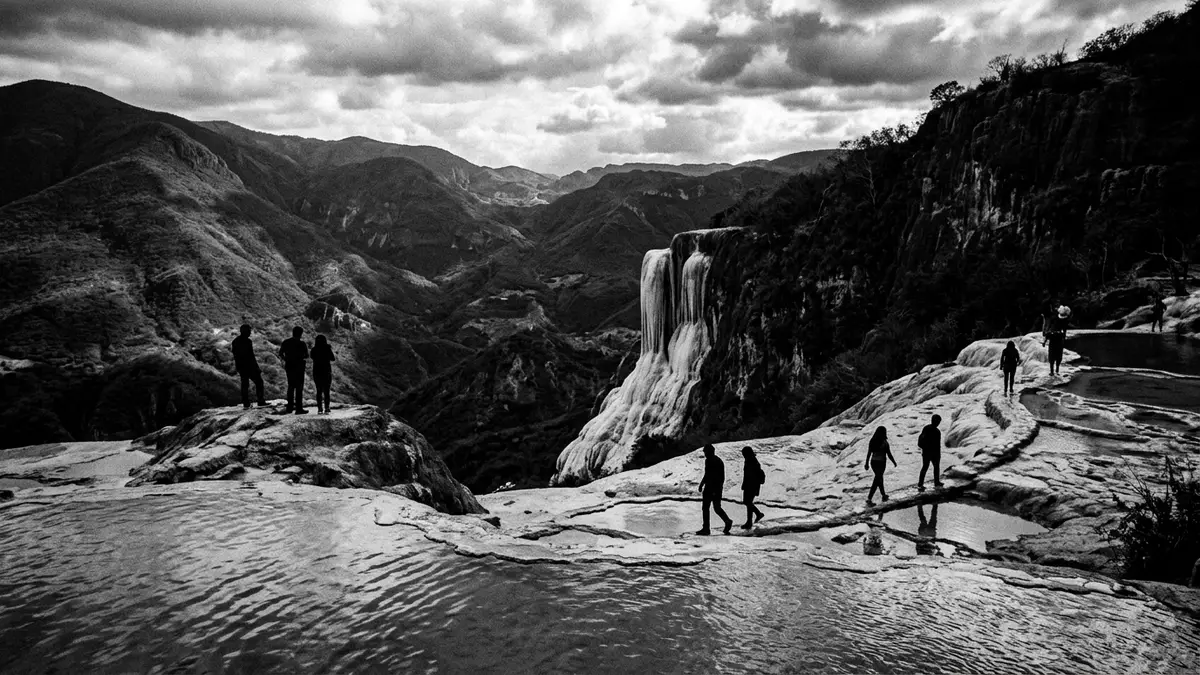
Hierve el Agua rises in Oaxaca as a cliff landscape shaped by spring water rather than a conventional river. Pale travertine folds resemble waterfalls suspended above a deep ravine, while mineral springs, pools and ancient channels occupy the terraces above.
Travertine cliffs that resemble falling water
Hierve el Agua consists of natural travertine formations in the municipality of San Lorenzo Albarradas, in the Mexican state of Oaxaca. Its Spanish name means “the water boils”, a reference to bubbling spring outlets rather than water reaching boiling point.
Two principal formations dominate the site. The larger descends for about 30 metres, while the smaller reaches approximately 12 metres. Both were formed when mineral-rich water emerged from springs and flowed across the rock. Calcium carbonate accumulated in successive layers, producing ridges, curtains and vertical bands that preserve the appearance of a waterfall.
The formations continue towards a ravine more than 200 metres deep. Their pale surfaces contrast with the darker mountain slopes, and the exposed mineral deposits reveal the direction taken by water across the cliffs. Oaxaca’s Hierve el Agua profile records the two main heights and the spring-fed origin of the formations.
Springs, pools and the chemistry of stone
The water at Hierve el Agua carries dissolved minerals acquired underground. When it reaches the surface, carbon dioxide escapes and calcium carbonate begins to settle on the rock. Repeated deposits build travertine around spring outlets, channels, pool edges and sloping surfaces.
This process explains the difference between the appearance and the substance of the site. The cliffs look fluid from a distance, yet their surfaces are solid carbonate rock. White and cream tones come from the travertine, while other minerals can add yellow, brown or orange traces.
The upper area includes mineral springs and pools associated with El Anfiteatro, a broad terrace from which the principal formations are visible. Water temperature is commonly recorded between 22 and 25 °C, making the pools temperate rather than boiling. The travertine formation process links the landscape to calcium carbonate deposition from mineral-rich spring water.
Zapotec terraces and ancient water channels
Hierve el Agua is also an archaeological landscape associated with the Zapotec civilisation. An extensive irrigation system was built more than 2,500 years ago, with channels and terraces extending around the spring area and the amphitheatre.
The surviving structures show how water was managed across steep ground. Their layout includes terraces, channels and lower platforms near the springs. The system forms a second layer of history beneath the natural formations, connecting the mineral water with agriculture and settlement in Oaxaca.
The site has also been associated with possible salt production and with ceremonial significance. These interpretations belong to the archaeological history of the place, while the visible channels and terraces remain physical evidence of long-term human use. The Zapotec connection and the age of the irrigation system are described in the archaeological record of Hierve el Agua.
Visiting Hierve el Agua: what travellers from Western Europe should know
- Hierve el Agua lies in Oaxaca state, near San Lorenzo Albarradas and the settlement of Roaguía. Road access from Oaxaca City reaches the mountain area through the regional route towards the Mixes and Albarradas.
- The site combines steep mountain ground, exposed travertine and a walking route of approximately 2 kilometres. The path reaches viewpoints near the base of the formations.
- The official language is Spanish and the currency is the Mexican peso.
- The landscape includes the Sierra Mixe and views across the Tlacolula Valley. Dry mountain vegetation surrounds the spring terraces and ravines.
Searching for Hierve el Agua on social platforms
These links open searches for Hierve el Agua on each platform.
Frequently asked questions about Hierve el Agua
Where is Hierve el Agua?
Hierve el Agua is in Oaxaca state, Mexico, near San Lorenzo Albarradas and Roaguía. The landscape lies within a mountainous area connected with the Tlacolula Valley and Sierra Mixe.
What can travellers expect at the site?
The visit combines travertine cliffs, mineral springs, pools, terraces and walking routes across exposed mountain ground. The principal formations can be viewed from El Anfiteatro and from paths descending towards the cliffs.
What makes Hierve el Agua distinctive?
Its pale travertine formations resemble waterfalls, although they are rock created by calcium carbonate deposits from spring water. The landscape also contains a Zapotec irrigation system more than 2,500 years old.


