
Honghe Hani Titian: sculpted rice terraces above the Hong River
Published on 09/02/2026 at 19:57 | Editorial responsibility: Rafael Müller, Editor-in-Chief AD HOC NEWS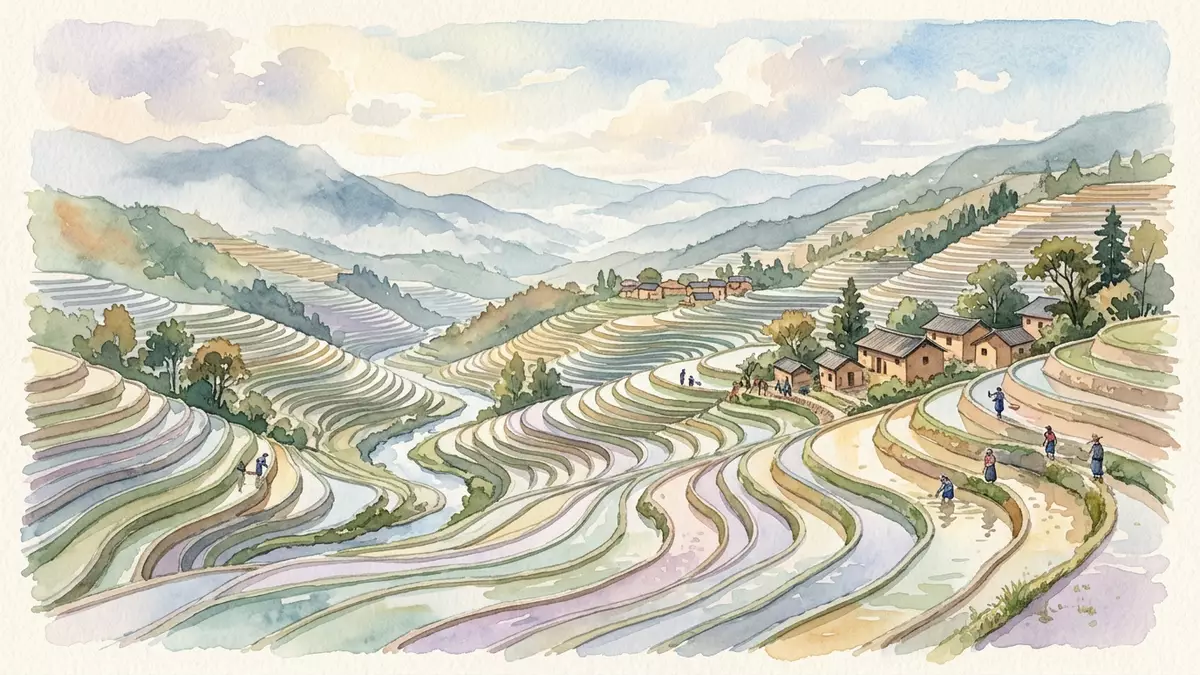
Honghe Hani Titian is the name given to the sweeping rice terraces that step down the southern slopes of the Ailao Mountains towards the Hong River in Yuanyang County, Yunnan. Shaped over more than a millennium by the Hani people, this cultural landscape has become one of China’s best-known World Heritage rice terrace systems, recognised by UNESCO in 2013 for its scale and the way farming, water and settlement interlock in the mountains.World Heritage inscription in 2013
Terraces cascading from forest to river
The core of Honghe Hani Titian lies in Yuanyang County, part of the Honghe Hani and Yi Autonomous Prefecture in the south of Yunnan Province.Location in Yuanyang County, Yunnan The terraces form long bands of paddy fields that follow the contours of steep hillsides, descending from forested uplands down towards river valleys. Across the wider Honghe area the terrace system occupies tens of thousands of hectares, but the most concentrated and visually dense patterns are found around Yuanyang, where slopes are etched by countless retaining walls of earth, mud and stone.
In this landscape, forest, village and field sit in a vertical sequence. Above the terraces, mountain ridges carry dense woodland that feeds spring water into channels. On intermediate ledges stand compact Hani villages, with houses grouped together to make use of the cultivable ground. Below these, terrace bands spread across the hillsides in stacked layers, reflecting the sky when flooded and turning saturated green when rice plants grow. The terraces in the Honghe Hani area extend across several counties, including Honghe, Yuanyang, Lüchun and Jinping, forming one continuous agricultural region.Distribution across four counties
A cultural landscape shaped over more than a thousand years
Honghe Hani Titian is not a recent engineering project but a landscape that developed gradually through Hani rice cultivation over roughly 1,200 to 1,300 years.History spanning around 1,200 years Hani communities adapted mountain slopes into rice paddies, extending terrace walls and water channels season by season. The result is a cultural landscape where agriculture, water management and settlement are layered on top of each other rather than separated.
The World Heritage listing formally recognises Honghe Hani Titian as a “cultural landscape”, a category that emphasises the interaction of human communities with their environment.Cultural Landscape of Honghe Hani Rice Terraces In Yuanyang, the main scenic areas of Bada, Laohuzui and Duoyishu are often cited as exemplary sections of the terraces, each with its own combination of slope angle, field size and backdrop of mountains and valleys.Three major scenic areas These names refer to parts of the same working landscape, where villagers maintain bunds, plant rice and tend surrounding woodland.
Patterns, viewpoints and village life
Honghe Hani Titian is known for the dramatic visual patterns formed by its terrace bands. On the steepest hillsides, terraces narrow into fine ribbons, while gentler slopes carry broader paddies that read as wide steps. The interplay of water and earth creates changing colours across the year, from mirrored silver surfaces when fields are filled, to green rice plants and later the warm tones of ripening crops.
Visitors encounter both the terrace panorama and the everyday life of Hani and other ethnic groups whose villages stand within the terrace zone. Paths lead through farming areas and towards platforms from which large sections of the terraces can be seen at once, with the Hong River valley below and the high crest of the Ailao Mountains above.Yuanyang terrace viewpoints and setting Markets in nearby towns and villages bring together produce from the terrace fields and surrounding slopes, linking the agricultural landscape with regional trade.
Visiting Honghe Hani Titian: what travellers from Western Europe should know
- Honghe Hani Titian lies in Yuanyang County in southern Yunnan, on the southern slopes of the Ailao Mountains above the Hong River, reached from larger hubs such as Kunming by road towards Yuanyang and Xinjie Town.Route from Kunming to Yuanyang terraces
- The terrace landscape is steep and stepped, with hillside paths, earthen bunds and stairways between fields; visiting involves walking on uneven ground and navigating changes in altitude.
- Honghe Hani Titian sits in a monsoon-influenced mountain climate, where rice terraces can appear as flooded mirrors or densely planted fields depending on the agricultural season.
- Yuanyang County forms part of the Honghe Hani and Yi Autonomous Prefecture in Yunnan, China; the official language is Chinese and the currency is the Chinese yuan (renminbi).
- Entry requirements depend on your nationality; UK travellers can check the FCDO travel advice at gov.uk/foreign-travel-advice, Irish travellers the Department of Foreign Affairs at ireland.ie.
Searching for Honghe Hani Titian on social platforms
These links open searches for Honghe Hani Titian on each platform.
Frequently asked questions about Honghe Hani Titian
Where is Honghe Hani Titian located?
Honghe Hani Titian refers to the Honghe Hani Rice Terraces on the southern slopes of the Ailao Mountains in Yuanyang County, Honghe Prefecture, in southern Yunnan, China.Terraces on the south banks of the Hong River
What can visitors expect on a visit to Honghe Hani Titian?
Visitors encounter a vast hillside landscape of stepped rice paddies, mountain forest, rivers and villages, with viewpoints and paths giving wide terrace panoramas and closer views of agricultural life.Yuanyang terraces and villages
What makes Honghe Hani Titian distinctive?
Honghe Hani Titian is distinctive for its long history of Hani terrace farming, its recognition as a UNESCO World Heritage cultural landscape and the way its terraces cascade between mountain forest, villages and the Hong River valley.Cultural Landscape designation


