
Huangshan’s granite peaks and cloud seas in Anhui
Published on 08/15/2026 at 15:00 | Editorial responsibility: Rafael Müller, Editor-in-Chief AD HOC NEWS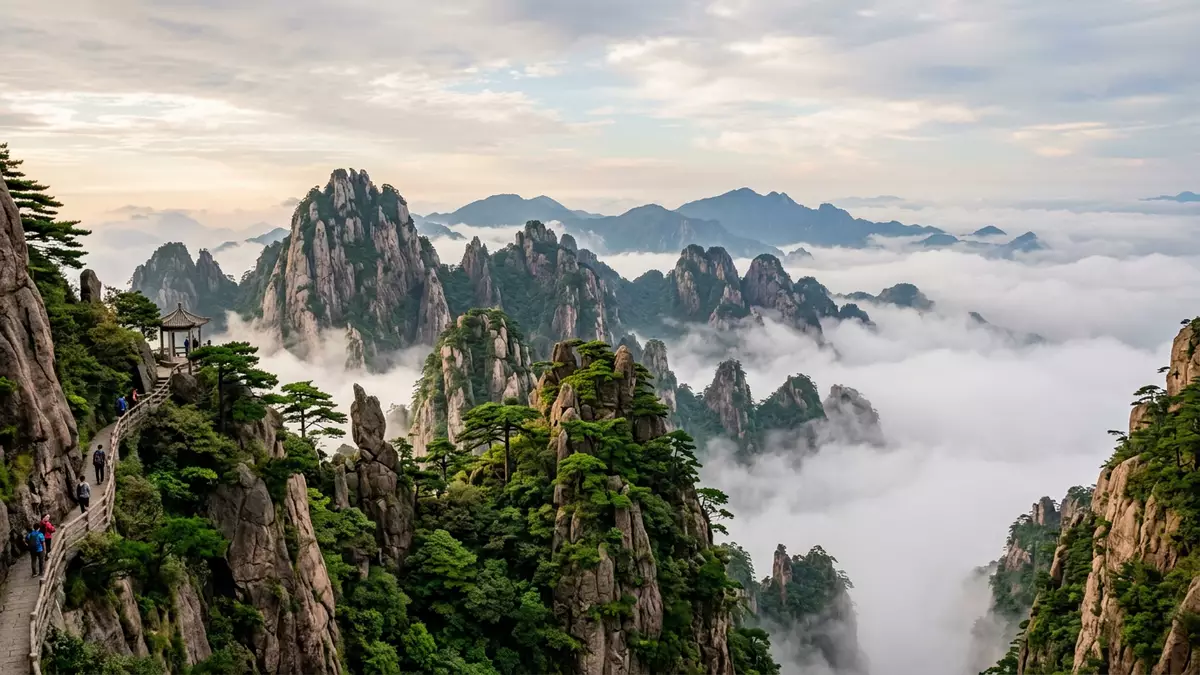
Huangshan, the Yellow Mountain range in Anhui Province, rises above eastern China in a landscape of bare granite peaks, ancient pines and drifting seas of cloud. It is both a renowned scenic mountain and a protected cultural and natural site, recognised by UNESCO in 1990 for its dramatic scenery and ecological value.UNESCO recognition in 1990
Granite cliffs, high peaks and changing cloud
Huangshan is a mountain range of largely granite rock, shaped over geological time into steep cliffs, narrow ridges and isolated towers that rise above forested valleys.Mesozoic granite landscape The highest summits reach elevations of more than 1,800 m (5,900 ft), with Lianhua Peak recorded at 1,864 m (6,118 ft) within the scenic area.Lianhua Peak elevation The rock itself forms jagged silhouettes that have long been compared to a forest of stone, their outlines changing with every step along the paths.
The atmosphere on Huangshan is defined as much by air and water as by rock. Moist air from the subtropical climate zone produces frequent cloud and mist around the peaks,humid subtropical setting creating views where summits stand like islands above a white “sea of clouds”. Valleys and gullies carry streams down towards the Xin’an, Qingyi and Qiupu river systems, and waterfalls appear along some approaches when rainfall is high.water source for regional rivers
Pines in the rock and a long cultural landscape
Huangshan’s vegetation combines dense mountain forest with scattered trees clinging directly to the granite. The mountain is noted for the Huangshan pine, which grows from cracks in bare rock, its roots anchoring in narrow crevices and its trunk bent by wind and snow.Huangshan pine on granite Many individual pines have been named and protected, and some stand on ridges and cliff edges where their horizontal branches frame views into neighbouring valleys.
The mountain has been celebrated in Chinese art and literature for centuries, particularly in the shanshui, or “mountain and water”, style of landscape painting that flourished from the mid-sixteenth century.role in shanshui painting Scholars, poets and painters travelled to Huangshan from the Ming period onwards, taking the shapes of its peaks, the twisting forms of its pines and the layering of cloud and rock as direct models for brushwork. Stone paths, pavilions and inscriptions now mark viewpoints and passes, turning the mountain itself into a kind of three-dimensional gallery of landscape scenes.
Protected status and the Huangshan scenic area
Huangshan lies within Huangshan City in southern Anhui Province, in a designated scenic area that covers more than 160 km².scenic area size The core protected property recognised by UNESCO extends over 16,060 ha, with a larger buffer zone round it.core area and buffer zone Huangshan has been inscribed as both a World Cultural and Natural Heritage Site and as a UNESCO Global Geopark, reflecting its combined geological, ecological and cultural significance.dual heritage and geopark status
The forest ecosystem on the mountain is described as being little changed since the last glacial period, providing habitat for many plant species, including locally endemic and threatened ones. ancient forest ecosystem Within the scenic area, trails link groups of peaks, passes and terraces, and there are areas where natural hot springs emerge at lower elevations around the foot of the massif.hot spring area near Tangkou
Visiting Huangshan: what travellers from Western Europe should know
- Huangshan rises in southern Anhui Province, with the main scenic area accessed from Huangshan City and from nearby towns such as Tangkou at the mountain’s foot.location in Huangshan City
- Paths and stairways on Huangshan climb steep slopes and run along ridges and gullies, and some approaches include long flights of stone steps at mountain altitudes above 1,000 m (3,281 ft).
- Huangshan lies in a humid subtropical climate zone, and conditions on exposed paths can vary with cloud, mist and rainfall, especially around the higher granite peaks.climate zone description
- The official language is Chinese and the currency is the renminbi (yuan).
- Entry requirements depend on your nationality; UK travellers can check the FCDO travel advice at gov.uk/foreign-travel-advice, Irish travellers the Department of Foreign Affairs at ireland.ie.
Searching for Huangshan on social platforms
These links open searches for Huangshan on each platform.
Frequently asked questions about Huangshan
Where is Huangshan?
Huangshan is a granite mountain range within Huangshan City in southern Anhui Province in eastern China, with a defined scenic area and buffer zone.
What can visitors expect on a visit to Huangshan?
Visitors encounter steep granite peaks, extensive stone stairways, ancient pines growing from rock, changing cloud and mist around the summits, and viewpoints linked by mountain paths.
What makes Huangshan distinctive compared with other mountains?
Its combination of bare granite cliffs, wind-shaped pines, frequent cloud seas and its long influence on Chinese landscape painting and poetry gives Huangshan a distinctive mountain character.


