
Hue authorities announce Imperial City restoration on 1 October
Published on 10/04/2026 at 06:49 | Editorial responsibility: Rafael Müller, Editor-in-Chief AD HOC NEWS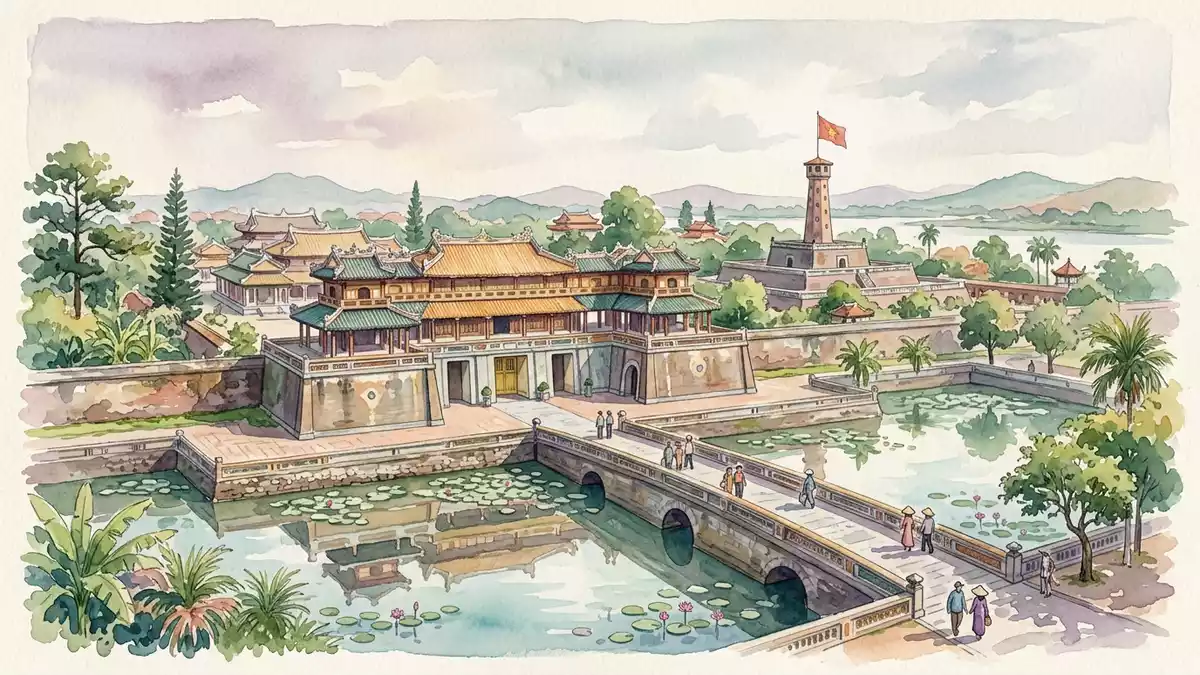
Hue authorities announced a restoration at Hue Imperial City on 1 October 2026, with work on Dai Cung Mon scheduled to begin in November. The project concerns the main gate to the Forbidden Purple City and gives visitors a clear new point of reference within Vietnam's former royal centre.
Dai Cung Mon restoration begins in November
The announcement covers Dai Cung Mon and another heritage site at the Gia Long Tomb complex. Phung Van Hoang, director of the project management board under the Hue Monuments Conservation Centre, said both restoration projects were expected to begin in November 2026. The work on the gate is planned to run from 2026 to 2030.
Dai Cung Mon was built in 1833 under Emperor Minh Mang. The structure was destroyed in 1947, leaving only its foundations, so the project will address a major gap in the route into the former royal residential precinct. The restoration announcement was reported by DTiNews on 1 October.
How the gate fits Hue Imperial City's history
The wider complex was established as the capital of unified Vietnam in 1802 and remained the political, cultural and religious centre of the Nguyen dynasty until 1945. The Imperial City stands within the Hue Citadel, alongside the Forbidden Purple City, royal palaces and other parts of the former capital.
UNESCO describes the complex as a planned defended capital whose buildings were arranged in relation to the Perfume River and the surrounding landscape. The property entered the World Heritage List in 1993, and the UNESCO description of the complex identifies the Hue Monuments Conservation Centre as the institution responsible for its management. The planned restoration therefore concerns more than a missing gate: it reconnects a surviving royal layout with a structure that disappeared during the twentieth century.
Restoration changes the story of the Forbidden Purple City
Dai Cung Mon was the principal entrance to the Forbidden Purple City, the part of the imperial compound associated with the Nguyen court's private royal life. Its lost foundations have remained within a complex where restored buildings, ruins and reconstructed elements stand together.
For travellers, the November 2026 start places active conservation alongside the established route through the Imperial City. The project also shows how the World Heritage site continues to develop through documented restoration rather than presenting the surviving buildings as an untouched whole.
Visiting Hue Imperial City: what travellers from Western Europe should know
- The Dai Cung Mon restoration is scheduled to begin in November 2026 at Hue Imperial City and is planned to continue from 2026 to 2030.
- The announcement concerns restoration of a named gate and does not state that the wider Imperial City will close. Visitors should follow on-site directions if routes change during the works.
- Hue Imperial City is in Hue, on the Perfume River in central Vietnam, within the wider Complex of Hue Monuments.
- The official language is Vietnamese and the national currency is the Vietnamese dong.
- Entry requirements depend on your nationality; UK travellers can check the FCDO travel advice at gov.uk/foreign-travel-advice, Irish travellers the Department of Foreign Affairs at ireland.ie.
Searching for Hue Imperial City on social platforms
These links open searches for Hue Imperial City on each platform.
Frequently asked questions about Hue Imperial City
When does the Dai Cung Mon restoration begin at Hue Imperial City?
Work is scheduled to begin in November 2026 and is planned to run from 2026 to 2030.
What has changed at Hue Imperial City?
Hue authorities announced restoration of Dai Cung Mon on 1 October 2026. The gate was built in 1833 and destroyed in 1947.
Where is Hue Imperial City and how do you get there?
It is in Hue, central Vietnam, within the Complex of Hue Monuments and beside the Perfume River. The site is managed by the Hue Monuments Conservation Centre.


