
Humayun's Tomb and the geometry of Mughal paradise in Delhi
Published on 08/23/2026 at 11:12 | Editorial responsibility: Rafael Müller, Editor-in-Chief AD HOC NEWS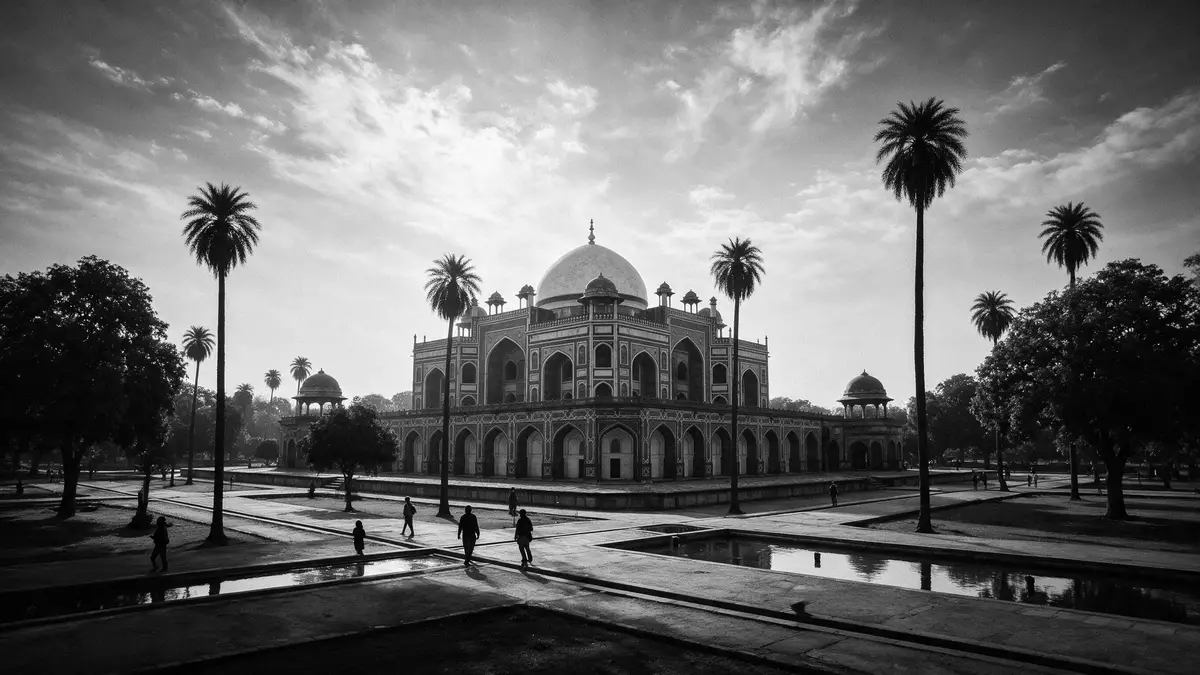
Humayun's Tomb in Delhi is the Mughal emperor’s grave set at the centre of a vast walled garden, where geometry, red sandstone and water channels form a single ordered composition anchored in Persian and Indian traditions.
A garden-tomb that reshaped imperial architecture
Humayun's Tomb stands in Nizamuddin East beside Mathura Road, south of central Delhi, within a walled enclosure that separates the mausoleum and its gardens from the surrounding cityscape.Nizamuddin East location The complex is one of the earliest large-scale examples of Mughal architecture in India, blending imported forms from Persia with building practices of the Indo-Islamic world.first substantial Mughal example At its centre rises the tomb of the emperor Humayun, who ruled the Mughal domains in the sixteenth century, enclosed within a garden laid out on a strict grid.
The monument is widely recognised as the first grand garden-tomb on the Indian subcontinent, marking a shift in how royalty were memorialised in stone and landscape.first garden-tomb on the Indian subcontinent The tomb and its garden are attributed to the patronage of Empress Bega Begum, Humayun’s senior widow and chief consort, working alongside the Mughal court to secure a resting place worthy of an emperor.Bega Begum as patron Construction took place during the 1560s, in the reign of Akbar, Humayun’s son, with completion around 1570, giving the site a clear place in the chronology of early Mughal power.
Red sandstone, white marble and the Mughal double dome
The main mausoleum at Humayun's Tomb is built predominantly from red sandstone, a material that came to define much Mughal architecture, with inlays and detailing in white marble that pick out arches, bands and decorative patterns across the facades.red sandstone and white marble The structure rises from a high platform, its mass articulated by a rhythm of high arched openings on each side, recessed niches and small pavilions, giving the building a clear profile from every direction within the garden. Above the square base, the building carries a prominent double dome, a feature associated with Persian design that allows the outer profile to remain lofty while the inner dome sits lower over the burial chamber.Persian double dome
The architect usually linked to Humayun's Tomb is Mirak Mirza Ghiyas, a designer from Persia whose work here introduced elements such as the high central arch and the use of the double dome to imperial funerary architecture in Delhi.Mirak Mirza Ghiyas Inside, the tomb chamber holds Humayun’s cenotaph beneath the inner dome, surrounded by further burial chambers and passageways that extend into the thick walls and around the central space. The exterior walls carry ornamental details drawn from Islamic geometric design, with carved stone screens, blind arcades and proportioned bays that maintain the building’s balance whether seen from near or far across the garden.
Charbagh geometry and the wider funerary landscape
The garden surrounding Humayun's Tomb follows the charbagh concept, a quadrilateral layout divided by axial paths and water channels, forming four large garden quarters with the tomb at their meeting point.charbagh garden layout This arrangement draws on Persian models of a paradise garden, translated at Humayun's Tomb into a large enclosure where planted areas, water features and paved walkways are held together by strict symmetry. The garden extends over several hectares, and within its walls stand additional, smaller mausoleums and structures, forming a wider funerary landscape around the emperor’s tomb.
Within the complex are other Mughal-era tombs such as Isa Khan’s and the Barber’s Tomb, along with the Arab Serai, where craftsmen associated with the project are recorded as having stayed.associated tombs and Arab Serai Together these structures demonstrate how Humayun's Tomb anchored a larger ensemble of burials and service buildings, giving the site a layered character beyond the central mausoleum. The complex has been recognised as a World Heritage Site for its architectural and historical significance, underlining its role as a precursor to later Mughal dynastic tombs including the Taj Mahal at Agra.World Heritage listing
Visiting Humayun's Tomb: what travellers from Western Europe should know
- Humayun's Tomb stands in the Nizamuddin East area of Delhi, close to the crossing of Mathura Road and Lodhi Road, and is reached over city streets by car, taxi or auto-rickshaw.
- The garden complex is enclosed by substantial boundary walls; reaching the main mausoleum involves walking along paved paths with flights of steps leading up to the raised platform.
- The tomb complex lies near the Nizamuddin Dargah and within sight of other historic sites in the area, so a visit can be combined with time at the neighbouring shrines and monuments.
- The official language is Hindi and the currency is the Indian rupee.
- Entry requirements depend on your nationality; UK travellers can check the FCDO travel advice at gov.uk/foreign-travel-advice, Irish travellers the Department of Foreign Affairs at ireland.ie.
Searching for Humayun's Tomb on social platforms
These links open searches for Humayun's Tomb on each platform.
Frequently asked questions about Humayun's Tomb
Where is Humayun's Tomb located in Delhi?
Humayun's Tomb stands in the Nizamuddin East area of Delhi, near Mathura Road and Lodhi Road, south of the old city and close to Nizamuddin Dargah.
What should visitors expect when entering the complex?
Visitors enter through gateways in the boundary walls into a formal garden divided by paths and water channels, then climb steps to reach the raised platform and the sandstone-and-marble mausoleum.
What makes Humayun's Tomb distinctive among Mughal monuments?
Humayun's Tomb is distinctive as an early grand garden-tomb that set the emperor’s mausoleum at the centre of a charbagh layout, combining red sandstone, white marble and a double dome in a form that influenced later dynastic tombs.


