
Intramuros and the stone walls that shaped Manila
Published on 08/18/2026 at 14:11 | Editorial responsibility: Rafael Müller, Editor-in-Chief AD HOC NEWS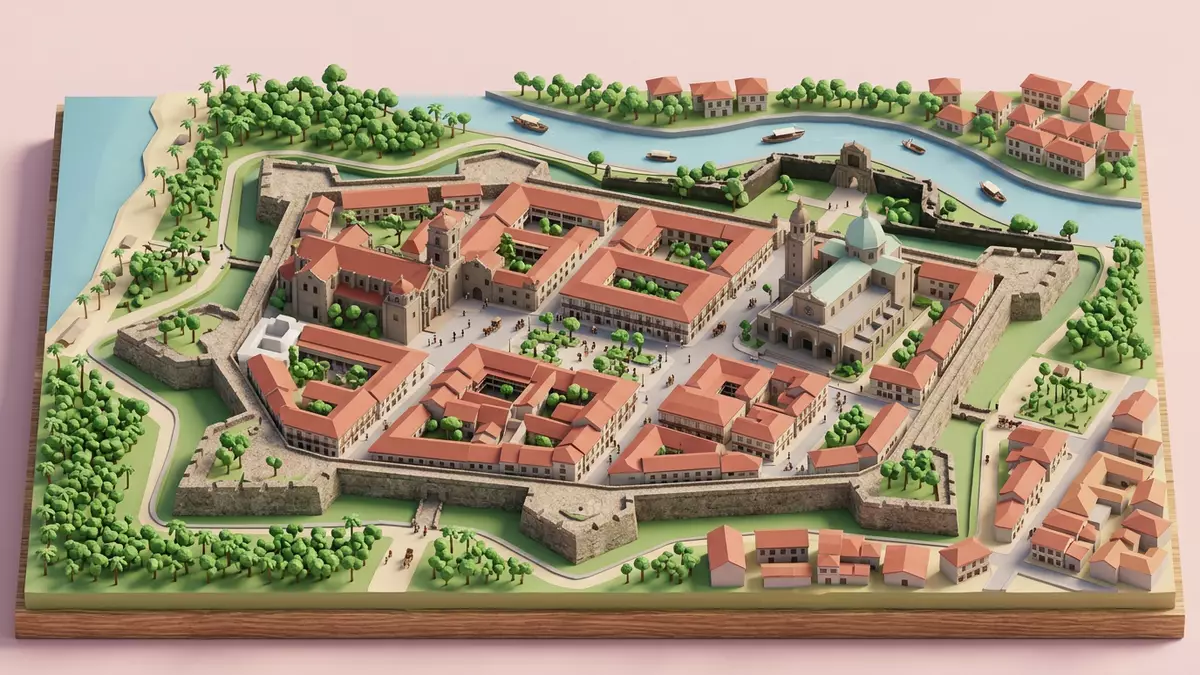
Intramuros is the historic walled city at the mouth of the Pasig River in Manila, where stone ramparts still enclose churches, plazas and colonial streets from the Spanish era.Spanish colonial rule centred here from the late sixteenth century, and the district remains one of the clearest surviving fragments of that period in the Philippines.
Walls, bastions and the shape of a stone city
Intramuros occupies a compact patch of ground beside Manila Bay and the Pasig River, enclosed by massive stone fortifications laid out under the authority of Miguel López de Legazpi after 1571.Miguel López de Legazpi gave the new colonial capital its Latin name, meaning “within walls”, and the boundary he fixed still reads clearly on a map.
The district fills an area of about 0.67 square kilometres (around 67 hectares), an irregular polygon of masonry whose walls reach several metres thick in places.historic walled area Bastions, ravelins and moats once formed a layered defence around the city, and many of these angular bulwarks remain legible, with sections of parapet and cannon positions overlooking road junctions that long ago replaced the open glacis.
Cathedrals, convents and the Spanish grid
Inside the walls, Intramuros follows a rectilinear street pattern laid out in the sixteenth century, with blocks arranged in a grid around central plazas.gridiron plan The formal heart of this layout is Plaza Roma, framed by government buildings and the current Manila Cathedral, a seat of the Roman Catholic archdiocese that continues a line of earlier churches on the same site.
Close by stands San Agustin Church, a Baroque stone structure dating from the late sixteenth and early seventeenth centuries, with an adjoining monastery that holds artworks, liturgical objects and furnishings linked to the Spanish period.San Agustin Church Around these religious houses, former schools, residences and administrative buildings line streets where the characteristic bahay na bato townhouses combine stone lower storeys with lighter upper levels.
Fort Santiago and memory along the Pasig
At the north-western corner of Intramuros, Fort Santiago guards the entrance from the sea and the Pasig River with thick stone walls, a gate and inner courtyards.Fort Santiago The fort formed part of the original Spanish defence system for Manila and housed military quarters as well as storerooms and dungeons.
Within Fort Santiago, a small shrine and exhibits commemorate José Rizal, the Filipino writer and nationalist who was imprisoned here in 1896 before his execution, linking the stone barracks directly to the struggle against Spanish rule.Rizal museum in Fort Santiago From the ramparts, views stretch across the Pasig towards the business districts beyond, underlining how the former colonial core now stands as a conserved enclave within a much larger metropolis.
Visiting Intramuros: what travellers from Western Europe should know
- Intramuros lies on the southern bank of the Pasig River in central Manila, west of the modern city districts and close to Manila Bay.
- The walled city is bordered by busy roads and tramlines, and exploring inside mostly involves walking on level cobbled or paved streets.
- Sections of the ramparts and bastions are accessible by staircases, which can be steep and uneven in places, and some viewpoints stand above the surrounding roadway.
- The official language is Filipino alongside English, and the currency is the Philippine peso.
- Entry requirements depend on your nationality; UK travellers can check the FCDO travel advice at gov.uk/foreign-travel-advice, Irish travellers the Department of Foreign Affairs at ireland.ie.
Searching for Intramuros on social platforms
These links open searches for Intramuros on each platform.
Frequently asked questions about Intramuros
Where is Intramuros and what kind of place is it?
Intramuros is a historic walled district in central Manila on Luzon, at the mouth of the Pasig River near Manila Bay in the Philippines.
What can visitors expect to see inside Intramuros?
Visitors encounter stone walls, bastions, Fort Santiago, churches such as Manila Cathedral and San Agustin, plazas, cobbled streets and a concentration of Spanish-era buildings.
What makes Intramuros distinctive compared with other parts of Manila?
Intramuros is distinctive because its fortified walls still enclose a compact colonial street grid, religious houses and government buildings that formed the original Spanish capital.


