
iSimangaliso Wetland Park where five African ecosystems meet
Published on 09/05/2026 at 10:12 | Editorial responsibility: Rafael Müller, Editor-in-Chief AD HOC NEWS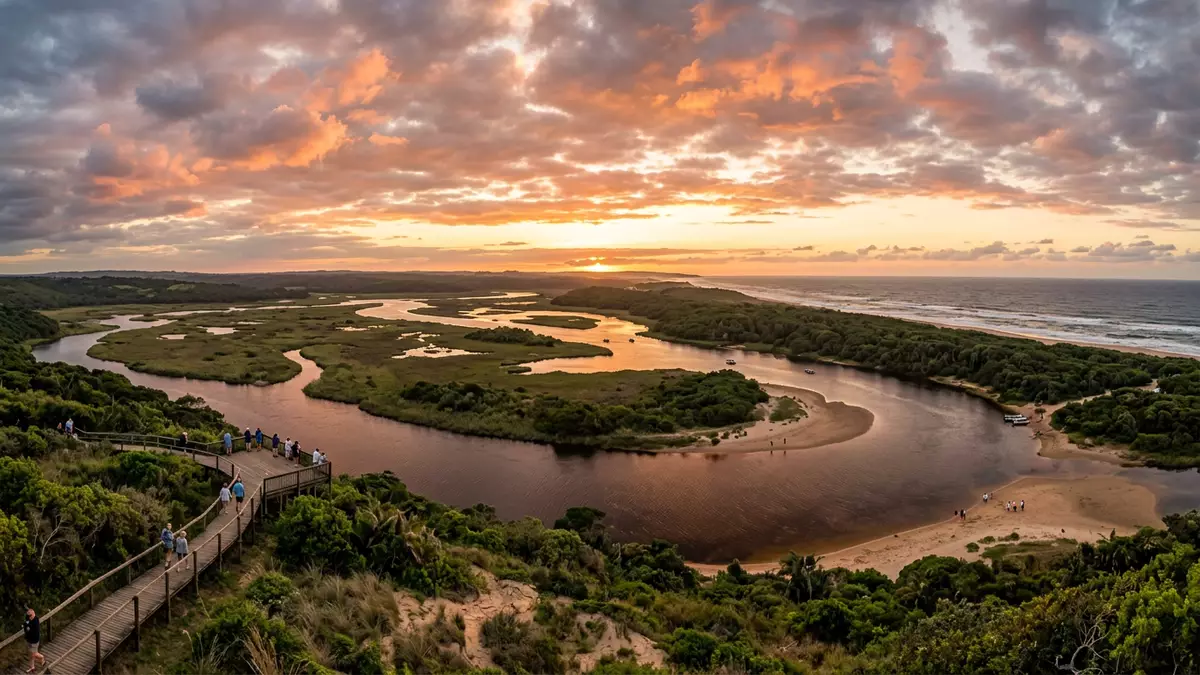
On the Indian Ocean coast of northern KwaZulu-Natal, iSimangaliso Wetland Park spreads along a long ribbon of South Africa’s shoreline and hinterland, gathering an unusual mix of sea, lakes and savannah into one protected landscape. Recognised as South Africa’s first UNESCO World Heritage Site in 1999, it lies near the small town of St. Lucia and is framed by dune forests, wetlands and estuarine waters that visitors encounter section by section along the coast.
Where ocean, lakes and savannah share one protected coast
iSimangaliso Wetland Park runs for around 220 km along the KwaZulu-Natal coast, from near the Mozambique border in the north to Mapelane south of the Lake St. Lucia estuary, and includes a band of land that varies from narrow strips of coastal forest to broader interiors of grassland and bush.runs for around 220 km Within its boundaries lie three major lake systems, among them the St. Lucia system, which forms Africa’s largest estuarine system with channels and lagoons edging sandbanks and reedbeds.three major lake systems
The coastline itself is a sequence of long sandy beaches, rocky points and offshore coral reefs that form South Africa’s largest marine protected area, extending seawards in a parallel strip along much of the park.South Africa’s largest marine protected area Inland, the terrain steps up into extensive coastal dunes, some of them described as being many thousands of years old, sheltering forest patches and grassland on their landward sides.coastal dunes The result is a mosaic of salt and fresh water, shifting sand and wooded uplands that can be explored through different sub-areas, reached by separate gates along the length of the park.
South Africa’s first World Heritage landscape
In December 1999, iSimangaliso Wetland Park was declared a UNESCO World Heritage Site under natural criteria (vii), (ix) and (x), recognising its scenic beauty, ongoing ecological processes and biodiversity.declared a UNESCO World Heritage Site It was South Africa’s first property to be placed on the World Heritage List and covers well over 200,000 ha of protected environments from sea to inland wetlands.well over 200,000 ha
The name “iSimangaliso” comes from isiZulu and refers to something wondrous, an apt label for a place where coral reef, sandy beach, forested dunes, lake systems, swamps and extensive reed and papyrus wetlands sit within a single protected boundary.isiZulu word for something wondrous The official World Heritage documentation highlights ongoing fluvial, marine and aeolian processes that have produced this variety of landforms, as well as the park’s transitional position between subtropical and tropical Africa, which helps to explain its broad range of species.ongoing fluvial, marine and aeolian processes Within the World Heritage site, a number of legally distinct protected areas, including marine reserves and provincial parks, are managed together under the wider park framework.
Wildlife across water, wetland and dry land
The ecological richness of iSimangaliso Wetland Park lies in the way its lakes, wetlands, savannah and marine areas connect, providing habitats for an array of wildlife that can be seen both on land and off shore. The St. Lucia estuarine system supports large numbers of waterfowl, and the reed and papyrus wetlands shelter many bird species, with more than 500 recorded across the park.more than 530 bird species Grasslands and savannah host antelope and other mammals, while forests add another layer of habitat.
Off the beaches and rocky points, the marine protected area provides feeding and breeding grounds for species such as whales, dolphins and whale sharks, and certain sections of the coast are known for nesting sea turtles including loggerhead and leatherback species.nesting turtles, whales, dolphins, whale sharks Lake St. Lucia itself is characterised by shifting salinity, moving between fresher and extremely saline states under different climatic cycles, which influences the mix of organisms found in its waters.shifting salinity The breadth of environments within one park gives travellers the chance to experience coastal wildlife drives, boat trips on estuarine waters and walks through forest and wetland landscapes within the same overall area.
Visiting iSimangaliso Wetland Park: what travellers from Western Europe should know
- iSimangaliso Wetland Park lies on the east coast of South Africa in northern KwaZulu-Natal, with the town of St. Lucia serving as a southern gateway near the Lake St. Lucia estuary.
- The terrain within the park ranges from flat coastal plains and sandy beaches to extensive dunes and areas of wetland, so sections involve driving on gravel roads and walking on sand or unpaved paths.
- Various parts of the park are reached through separate gates along its roughly 220 km coastal extent, and some sections combine road access with boat-based excursions on the estuarine or lake systems.
- The official language of South Africa is English alongside several other national languages, and the currency is the South African rand.
- Entry requirements depend on your nationality; UK travellers can check the FCDO travel advice at gov.uk/foreign-travel-advice, Irish travellers the Department of Foreign Affairs at ireland.ie.
Searching for iSimangaliso Wetland Park on social platforms
These links open searches for iSimangaliso Wetland Park on each platform.Frequently asked questions about iSimangaliso Wetland Park
Where is iSimangaliso Wetland Park in relation to St. Lucia?
iSimangaliso Wetland Park lies along the Indian Ocean coast of northern KwaZulu-Natal, with St. Lucia close to its southern sections around the Lake St. Lucia estuary.
What kind of landscapes and experiences can visitors expect?
Travellers encounter long beaches, coastal dunes, lake and estuarine systems, wetlands, savannah and patches of forest, with opportunities for wildlife viewing on land and from boats.
What makes iSimangaliso Wetland Park distinctive among African protected areas?
It brings together multiple ecosystems, including Africa’s largest estuarine lake system and a major marine protected area, within a single World Heritage-listed landscape on South Africa’s east coast.


