
Jameos del Agua, where Lanzarote’s lava meets architecture
Published on 09/14/2026 at 12:34 | Editorial responsibility: Rafael Müller, Editor-in-Chief AD HOC NEWS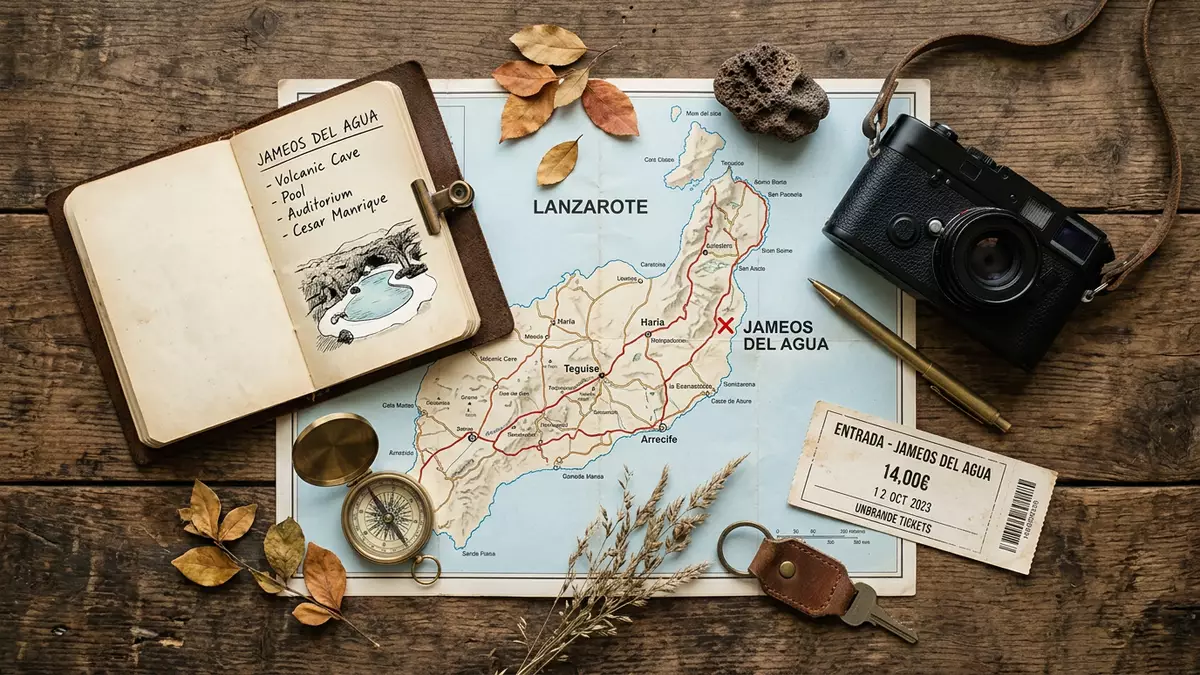
On the north coast of Lanzarote, Jameos del Agua takes a stretch of volcanic lava tube and turns it into an art, culture and tourism centre where rough basalt, still water and carefully placed structures share the same subterranean space. Created in the second half of the twentieth century by Lanzarote-born artist and architect César Manrique, it sits within the municipality of Haría in the Canary Islands and forms part of the long tunnel left by an eruption of the nearby Volcán de la Corona.
Lava, light and an underground lake
Jameos del Agua occupies several caverns along the La Corona volcanic tube, a geological formation that extends for several kilometres under the island’s north-east, linking surface collapses known locally as jameos with deeper subterranean sections. A key feature of the site is a naturally formed saltwater lake lying within one of these cavities, filled by seawater that filters inland through the porous lava and creating a calm, low-lying body of water beneath the rock.Its name refers directly to this interior lake, which sits partway along the route through the caves.
Within this lake lives a population of blind albino crabs, known scientifically as Munidopsis polymorpha, a small crustacean species that is regarded as endemic to Lanzarote and associated particularly with the quiet, mineral-rich waters of Jameos del Agua.The presence of these tiny white crabs has become one of the site’s defining natural characteristics. The surrounding rock walls show layers and textures typical of basaltic lava, while shafts where the tube roof has collapsed admit daylight that reflects off the water and reveals the uneven surfaces of the cave.
César Manrique’s first major centre
Beyond its geological interest, Jameos del Agua is known as the first of Lanzarote’s Centres of Art, Culture and Tourism, a group of sites managed by the Cabildo de Lanzarote and closely associated with César Manrique’s work on the island.Initial interventions in what is now called Jameo Chico were carried out between 1964 and 1966, adding pathways and platforms that follow the natural lines of the cave rather than imposing a standard building footprint.
Over the following years, further sections were adapted, including Jameo Grande, which houses landscaped terraces and an outdoor pool that continues the visual theme of water framed by dark volcanic rock.Work in the 1980s completed an auditorium in the area known as Jameo de la Cazuela, using the natural cavity as a setting for seated events beneath the lava roof. Above the caves, the Casa de los Volcanes adds a science centre focused on the island’s vulcanology, tying the artistic adaptation of the lava tube to information about the processes that formed it.
A sequence of spaces inside a volcanic tube
The route through Jameos del Agua moves between distinct atmospheres as it follows the volcanic tube. At one end, the subterranean restaurant and bar areas sit near the salt lake, with seating arranged on platforms that step down into the cavern and give views across the water and towards the crab habitat.The wider complex also includes gardens and an emerald-coloured pool in the open air, where planted palms and other vegetation stand out against the black and brown lava.
Further along the tube, the auditorium space occupies a natural chamber adapted with a stage and rows of seating, using the rocky surfaces as a backdrop. Paths and stairways constructed from stone and other robust materials connect these areas, tracing lines that follow the contours of the collapsed sections of the lava tunnel. Outside, Casa de los Volcanes sits on the upper level above parts of the cave system, presenting exhibitions about volcanic activity on Lanzarote and the broader geology of the Canary Islands.Together, these elements make Jameos del Agua both a geological site and a cultural venue, with each space clearly rooted in the form of the original lava tube.
Visiting Jameos del Agua: what travellers from Western Europe should know
- Jameos del Agua lies on the north-east coast of Lanzarote in the municipality of Haría, close to the road between Arrieta and Órzola, with vehicle access from the island’s main road network.
Public buses run to the surrounding area from Arrecife, and organised excursions include the site as a stop. - The visit involves descending into and climbing out of volcanic caverns, with stairways and stepped paths linking the different levels, so a walk through the complex includes changes in height and surfaces of rock and stone.
- Jameos del Agua forms part of the lava tunnel created by the eruption of Volcán de la Corona, and Casa de los Volcanes above the caves focuses on the island’s volcanic history within this wider geological setting.
- The Canary Islands form part of Spain, so the official language on Lanzarote is Spanish and the currency is the euro.
Searching for Jameos del Agua on social platforms
These links open searches for Jameos del Agua on each platform.
Frequently asked questions about Jameos del Agua
Where is Jameos del Agua on Lanzarote?
Jameos del Agua is in the municipality of Haría on the north-eastern coast of Lanzarote, within the Canary Islands of Spain, linked to the Volcán de la Corona lava tube.
What can visitors expect inside Jameos del Agua?
A visit includes volcanic caverns with a saltwater lake inhabited by blind albino crabs, terraces with an outdoor pool and gardens, a restaurant, and an auditorium integrated into the lava tube.
What makes Jameos del Agua distinctive among Lanzarote’s sites?
It combines a long basalt lava tunnel, a rare subterranean ecosystem and built spaces by César Manrique, forming Lanzarote’s first Centre of Art, Culture and Tourism within a natural cave system.


