
Jeonju Hanok Maeul and its tiled-roof cityscape
Published on 09/24/2026 at 05:25 | Editorial responsibility: Rafael Müller, Editor-in-Chief AD HOC NEWS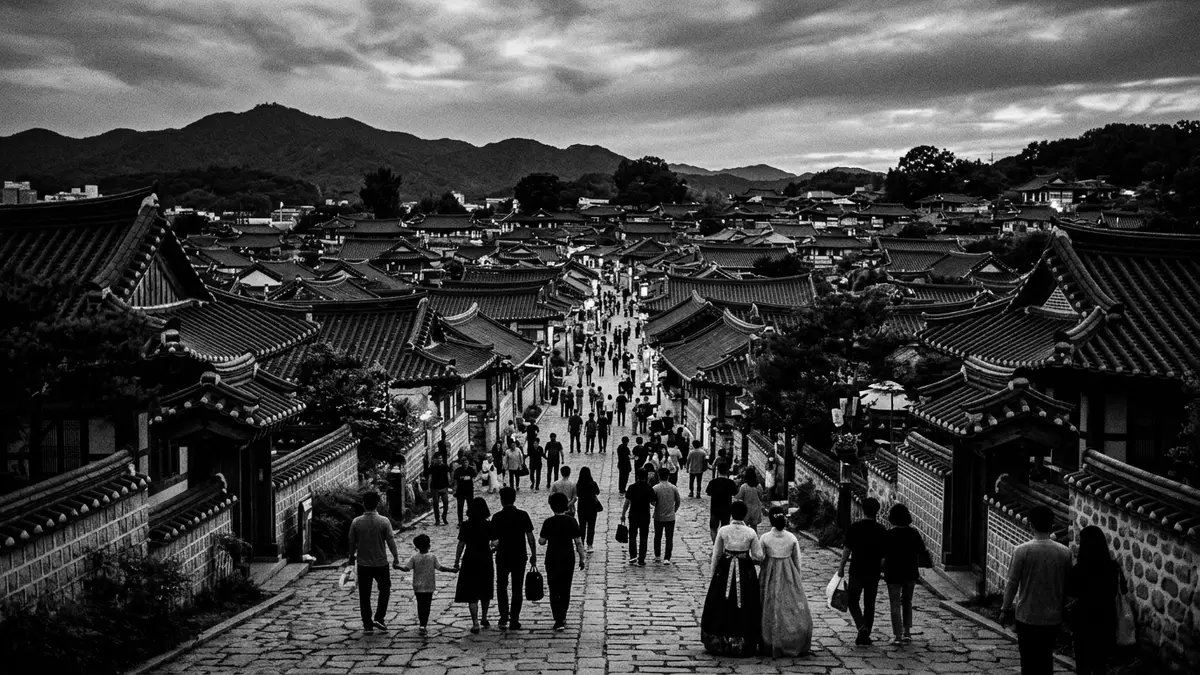
Jeonju Hanok Maeul is an urban quarter where tiled roofs, timber houses and historic monuments occupy the same cityscape. The district lies in Wansan-gu, Jeonju, and contains more than 700 hanok buildings, making the roofline itself a defining feature of the place.
Jeonju Hanok Maeul: a cityscape of tiled roofs
The traditional Korean houses are known as hanok. Their courtyards, timber frames, tiled roofs and enclosed lanes form a dense neighbourhood rather than an isolated historic building. The district overlaps the Pungnam-dong and Gyo-dong areas, with heritage sites distributed among homes, workshops, cafés and cultural spaces.
Jeonju’s hanok quarter has roots in the twentieth century, while its surrounding monuments reach much further into Korean history. The city served as an administrative and cultural centre during the Joseon Dynasty, and the district preserves buildings connected with royal memory, Confucian education, Catholic history and local government. the district’s preservation history includes its designation as a historic preservation area in 1978.
Royal history beside homes and workshops
Gyeonggijeon Shrine was built in 1410 for the portrait of King Taejo Yi Seong-gye, founder of the Joseon Dynasty. Its compound contains shrine buildings and courtyards, creating a formal architectural setting within the wider neighbourhood. The portrait links Jeonju with the royal house and the city’s place in Joseon history.
Omokdae Historic Site occupies a hilltop above the tiled roofs. The site is associated with Yi Seong-gye and his victory at Hwangsan in 1380. Nearby Jeonjuhyanggyo Local Confucian School contains Manhwaru Pavilion, Daeseongjeon Shrine and Myeongnyundang Lecture Hall. Gyeonggijeon Shrine’s history and the school’s buildings place royal and educational traditions within the same walkable district.
Stone monuments and living cultural practice
Pungnammun Gate is the southern gate of the former Jeonjubuseong Fortress. Built in 1389, it is the surviving gate associated with the old fortress, whose other gates disappeared when the walls were demolished in 1905. The gate’s masonry, roof and tower differ in character from the surrounding residential hanok.
Jeondong Catholic Cathedral provides another architectural contrast. Built between 1907 and 1914, it uses Romanesque and Byzantine forms, with brickwork and a prominent church interior. Across from Gyeonggijeon, it places a modern Christian monument beside a Joseon royal shrine. Jeonju Hanok Maeul also contains spaces for calligraphy, fan making, ceramic work, Korean paper art and pansori, the Korean tradition of musical storytelling.
Food and craft remain part of the district’s cultural identity. Jeonju is associated with bibimbap, bean-sprout soup and traditional table d’hote, while hanok buildings accommodate workshops, restaurants and lodging. The result is a neighbourhood where historic fabric and active cultural use occupy the same streets.
Visiting Jeonju Hanok Maeul: what travellers from Western Europe should know
- Jeonju Hanok Maeul is in Wansan-gu, Jeonju, around Taejo-ro and Girin-daero. Jeonju Station connects with the city bus network.
- The neighbourhood includes sloping lanes and the hilltop at Omokdae. Walking routes combine paved streets, steps and traditional compounds.
- Named landmarks include Gyeonggijeon Shrine, Pungnammun Gate, Jeondong Catholic Cathedral and Jeonjuhyanggyo Local Confucian School.
- The official language is Korean and the currency is the South Korean won.
- Entry requirements depend on your nationality; UK travellers can check the FCDO travel advice at gov.uk/foreign-travel-advice, Irish travellers the Department of Foreign Affairs at ireland.ie.
Searching for Jeonju Hanok Maeul on social platforms
These links open searches for Jeonju Hanok Maeul on each platform.
Frequently asked questions about Jeonju Hanok Maeul
Where is Jeonju Hanok Maeul?
Jeonju Hanok Maeul is in Wansan-gu, within Jeonju in South Korea. The district includes the Pungnam-dong and Gyo-dong areas.
What can visitors see there?
The neighbourhood contains hanok houses, Gyeonggijeon Shrine, Omokdae Historic Site, Pungnammun Gate, Jeondong Catholic Cathedral and Jeonjuhyanggyo Local Confucian School.
What makes the district distinctive?
Its defining feature is the concentration of traditional Korean houses among royal, religious and educational monuments. Tiled roofs, courtyards, workshops and historic compounds share the same urban quarter.


