
Jeonju Hanok Maeul and its tiled-roof streets
Published on 09/23/2026 at 17:43 | Editorial responsibility: Rafael Müller, Editor-in-Chief AD HOC NEWS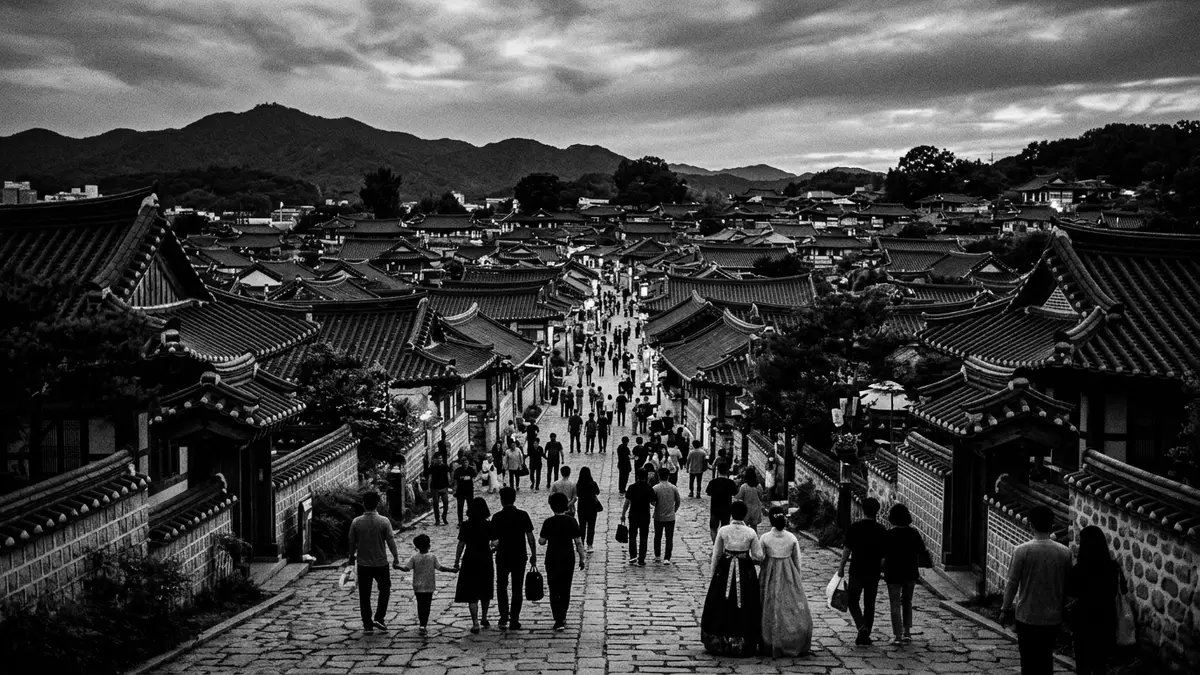
Jeonju Hanok Maeul is a historic quarter of Jeonju, South Korea, where tiled roofs form a continuous urban landscape across narrow lanes. More than 700 traditional Korean houses stand in the district, bringing domestic architecture, shrines, cafés and cultural institutions into the same city setting.
Jeonju Hanok Maeul: a city shaped by tiled roofs
The district lies across the Pungnam-dong and Gyo-dong neighbourhoods of Wansan-gu. Its defining buildings are hanok, traditional Korean houses with timber frames, clay or stone elements, paper-covered windows and curved tiled roofs.
The present neighbourhood began forming around 1910, when construction expanded within central Jeonju. A historic preservation area followed in 1978, placing the housing quarter within a long period of architectural protection.
Hanok houses, courtyards and ondol floors
Hanok houses are arranged around courtyards and enclosed domestic spaces. Their roofs use traditional Korean tiles, while timber columns and beams remain visible in many buildings.
Inside, the ondol system places heated surfaces beneath the floor. Hanji, a traditional Korean paper, appears in doors and windows, while wooden screens divide rooms and courtyards. The combination creates a building type closely associated with the Joseon Dynasty, which ruled Korea from 1392 to 1897.
The village contains more than 700 hanok buildings across an area measured at about 300,000 square metres. The preserved hanok quarter forms part of Jeonju’s wider cultural identity.
Gyeonggijeon, Jeondong and the historic centre
Jeonju Hanok Maeul is not a single building but a neighbourhood containing several distinct landmarks. Gyeonggijeon Shrine stands within the district and dates from 1410, when it was established for royal portraits connected with the Joseon dynasty.
Jeondong Catholic Cathedral marks another architectural layer beside the hanok streets. Its construction was completed in 1914, and its Romanesque and Byzantine forms contrast with the low timber houses nearby.
Jeonju also has a strong connection with the Joseon royal line. Yi Seong-gye, founder of the dynasty, came from Jeonju, and Gyeonggijeon preserves a portrait associated with him. Gyeonggijeon Shrine gives the residential quarter a royal and historical reference point.
The district’s streets combine private homes, guesthouses, workshops, food businesses, galleries and museums. Traditional forms therefore remain visible alongside everyday urban uses, rather than existing only as isolated monuments.
Visiting Jeonju Hanok Maeul: what travellers from Western Europe should know
- Jeonju Hanok Maeul lies in central Jeonju, across Pungnam-dong and Gyo-dong in Wansan-gu. Jeonju Station connects with the city transport network, while local buses serve the historic centre.
- The district is an urban neighbourhood with paved lanes, courtyards, steps and slopes around its historic sites. Some traditional buildings have raised thresholds and uneven floor levels.
- Gyeonggijeon Shrine, Jeondong Catholic Cathedral and Omokdae are named landmarks within or beside the hanok quarter.
- The official language is Korean and the currency is the South Korean won.
- Entry requirements depend on your nationality; UK travellers can check the FCDO travel advice at gov.uk/foreign-travel-advice, Irish travellers the Department of Foreign Affairs at ireland.ie.
Searching for Jeonju Hanok Maeul on social platforms
These links open searches for Jeonju Hanok Maeul on each platform.Frequently asked questions about Jeonju Hanok Maeul
Where is Jeonju Hanok Maeul?
Jeonju Hanok Maeul is in central Jeonju, South Korea, across the Pungnam-dong and Gyo-dong neighbourhoods of Wansan-gu.
What can visitors see there?
The district contains tiled-roof hanok houses, courtyards, narrow lanes, Gyeonggijeon Shrine, cultural venues and Jeondong Catholic Cathedral.
What makes the district distinctive?
Its identity comes from the concentration of traditional Korean houses within an active urban quarter, alongside landmarks connected with the Joseon Dynasty.


