
Jiuzhaigou in Aba: water, forest and travertine terraces
Published on 09/12/2026 at 11:26 | Editorial responsibility: Rafael Müller, Editor-in-Chief AD HOC NEWS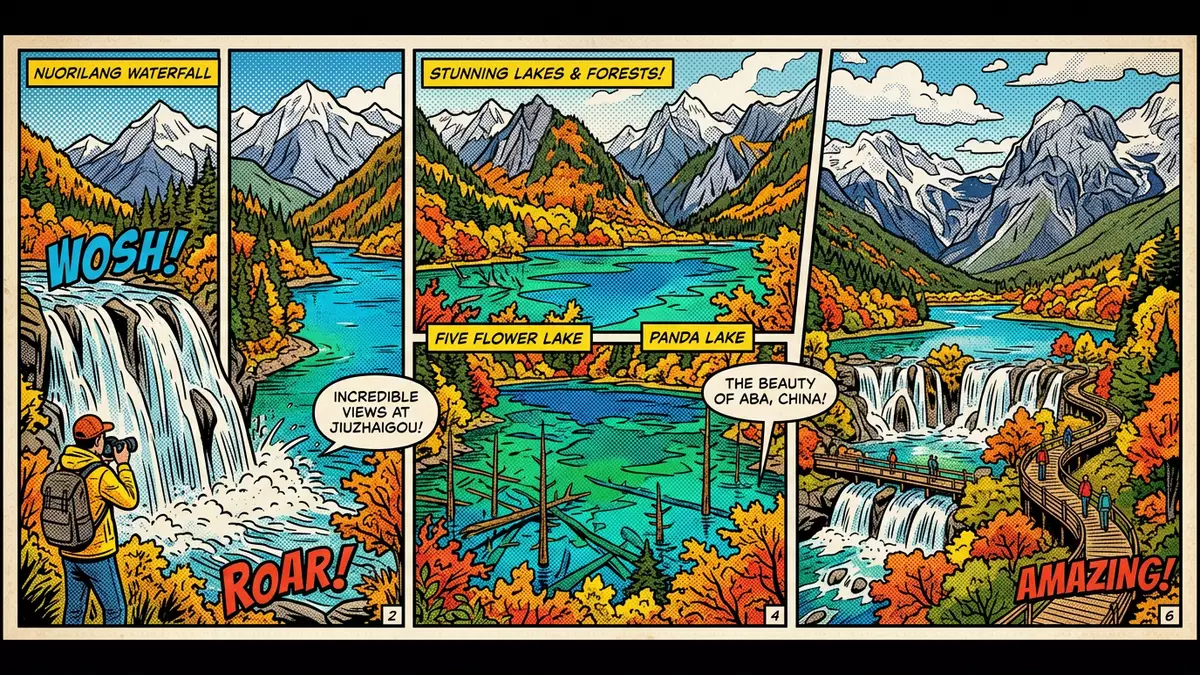
Jiuzhaigou in Aba in northern Sichuan is a long mountain valley where forest, water and pale travertine terraces form a stepped landscape recognised for its outstanding natural beauty. Set on the southern slopes of the Minshan Mountains, it is protected as the Jiuzhaigou Valley Scenic and Historic Interest Area and has held UNESCO World Heritage status since 1992 alongside designation as a biosphere reserve from 1997.
A high Sichuan valley shaped by water and rock
Jiuzhaigou occupies a branching basin on the southern flanks of the Minshan Mountains, within the Aba Tibetan and Qiang Autonomous Prefecture in north-western Sichuan Province. The protected area stretches across tens of thousands of hectares, with valley floors and slopes rising from high-altitude forests towards peaks that reach well above 4,000 m (13,123 ft) in the wider Minshan range.Stretching over 72,000 ha the scenic area preserves extensive forest ecosystems and a sequence of lakes and waterfalls bound into the valley by travertine formations.
The valley lies in a transition zone between the Sichuan Basin and the Qinghai–Tibet Plateau, where uplifted limestone and dolomite are exposed to surface water. Streams flowing down the side valleys carry calcium carbonate, which precipitates as soft travertine along the courses and across the floor of the main basin.This biosphere reserve lies on the southern slopes of the Minshan Mountains and forms part of a broader karst landscape of eroded carbonate rock, cliffs and forested slopes.
Lakes in chains and travertine terraces
Water in Jiuzhaigou falls through narrow gullies, spreads across shallow fans and settles into still pools, with the mineral content and travertine shaping the valley’s most recognisable scenes. Over long periods, calcium carbonate deposits have created natural dams across many of the streams, impounding water behind each barrier and turning sections of the valley into chains of lakes that step gently down the slope.Streams in the valleys carry carbonate-rich water that deposits travertine so that terraces and basins develop as flat shelves above the lower courses.
Lakes here are noted for clear water where submerged trunks and branches remain visible, and their surfaces show a range of blue and green tones influenced by mineral composition, depth and forest reflections.Over long periods, calcium carbonate in the water has precipitated into pale travertine terraces and dams so that many pools have become stepped basins with water held at several levels across the valley floor. Travertine waterfalls such as Nuorilang Falls form wide curtains as water spills over terrace edges, while cascades like Panda Waterfall follow narrower, multi-level paths down among the trees.
Forest, villages and protected status
Jiuzhaigou sits in a region where conifer forest, mixed woodland and alpine meadows occupy different bands of elevation, contributing both to the scenery and to the ecological significance of the site. The World Heritage designation recognises the valley for its sequences of lakes, waterfalls and travertine formations, for its forest ecosystems and for the way these elements combine within a single protected landscape.Inscribed as a UNESCO world natural heritage in 1992 the area is managed both as a nature reserve and as a national park under Chinese conservation categories.
The valley’s name refers to nine historic Tibetan villages that lie within its catchment, and the wider county around the scenic area forms part of the Aba Tibetan and Qiang Autonomous Prefecture.Jiuzhaigou was inscribed as a World Heritage Site in 1992 and a World Biosphere Reserve in 1997 under its official English title Jiuzhaigou Valley Scenic and Historic Interest Area. This dual recognition highlights both natural features and cultural context, with formal protection for landscapes that carry religious sites, grazing areas and forest resources alongside their lakes and waterfalls.
Moving through a layered valley
The main valley in Jiuzhaigou runs broadly north to south with side branches that rise into smaller basins and upland forest areas, and visitor infrastructure follows these lines of the landscape. Elevated viewpoints look across terraces where still water, forested slopes and bare travertine shelves form alternating bands of colour, and paths and boardwalks trace sections of shoreline close enough to see submerged logs and mineral patterns on the lake beds.Jiuzhaigou Valley Scenic and Historic Interest Area is commonly experienced as a sequence of scenes along a single corridor rather than as a wide, open basin.
Branches of the valley contain named features that have become reference points for visitors and mapping, including lakes such as Five-Flower Lake, Panda Lake and Mirror Lake and waterfalls like Pearl Shoal Waterfall and Nuorilang Falls.Highlights include Shuzheng Lakes, Nuorilang Waterfall and Five-Flower Lake alongside stretches of primeval forest in the upper reaches. Together they produce a layered route in which water in different forms—deep basins, shallow terraces, curtains of falling streams—is framed by conifer stands and limestone slopes.
Visiting Jiuzhaigou: what travellers from Western Europe should know
- Jiuzhaigou lies in Jiuzhaigou County within the Aba Tibetan and Qiang Autonomous Prefecture of Sichuan Province, with access routes from larger cities in Sichuan and neighbouring Gansu by road and regional air links.
- The terrain combines high-altitude valley floors with steeper forested slopes and travertine steps, and routes within the protected area involve walking on boardwalks and paths that rise and fall with the natural terraces.
- Jiuzhaigou sits in the Minshan Mountains where elevations vary markedly, and weather conditions reflect a mountain environment with cooler temperatures than in the Sichuan Basin and potential for rapid changes.
- The official language is Chinese and the currency is the renminbi yuan.
- Entry requirements depend on your nationality; UK travellers can check the FCDO travel advice at gov.uk/foreign-travel-advice, Irish travellers the Department of Foreign Affairs at ireland.ie.
Searching for Jiuzhaigou on social platforms
These links open searches for Jiuzhaigou on each platform.
Frequently asked questions about Jiuzhaigou
Where is Jiuzhaigou?
Jiuzhaigou is a protected valley in Jiuzhaigou County in the Aba Tibetan and Qiang Autonomous Prefecture of north-western Sichuan Province in China.
What can visitors expect on a visit to Jiuzhaigou?
A visit centres on mineral-rich lakes in chains, multi-level travertine waterfalls and forested mountain slopes, viewed from paths, boardwalks and designated vantage points.
What makes Jiuzhaigou distinctive among mountain landscapes?
Jiuzhaigou combines karst geology, travertine terraces and clear, coloured lakes with high-altitude forest and Tibetan village landscapes under joint World Heritage and biosphere reserve protection.


