
Jungfraujoch, where Europe’s highest railway meets the ice
Published on 09/07/2026 at 15:29 | Editorial responsibility: Rafael Müller, Editor-in-Chief AD HOC NEWS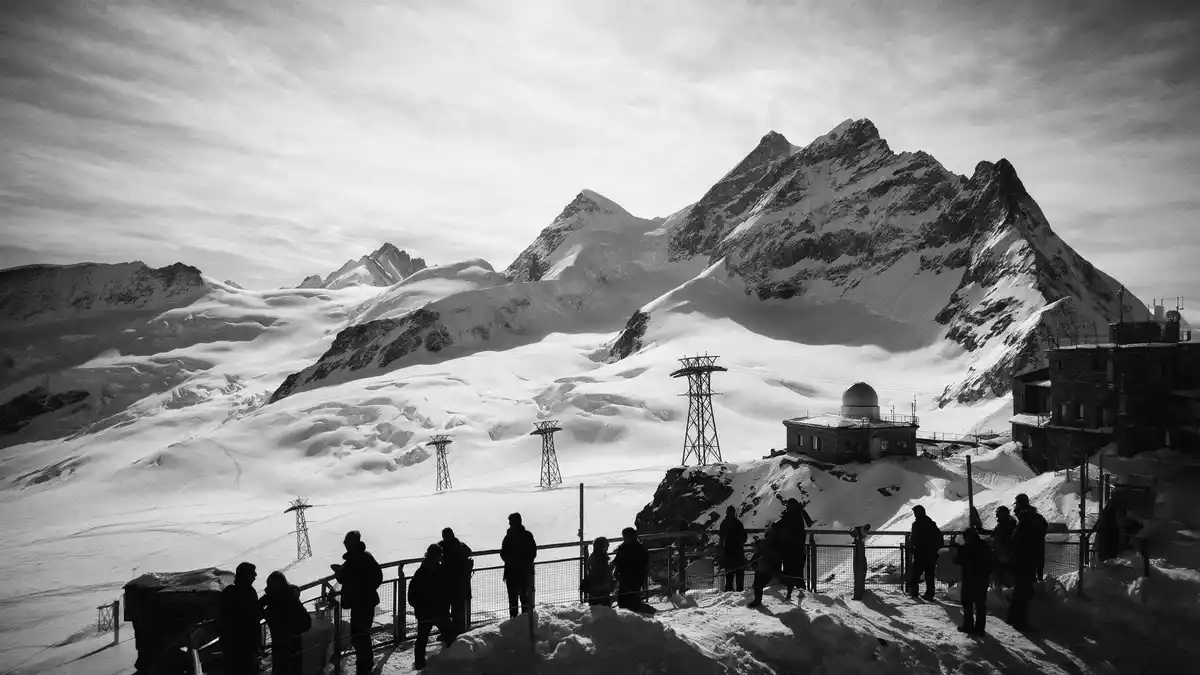
Jungfraujoch in Switzerland is a high alpine saddle in the Bernese Alps, where Europe’s highest railway station opens directly onto a broad plateau of snow and ice. At around 3,454 m (11,332 ft), the underground station and visitor complex sit just below the crest of the pass, with the glacier surface stretching away on the southern side and steep rock walls dropping towards the valleys in the north.Europe’s highest railway station
A high saddle between Jungfrau and Mönch
Geographically, Jungfraujoch is a glacier saddle between the peaks of Jungfrau and Mönch, both major summits of the Bernese Alps. The crest of the pass lies above 3,460 m (around 11,350 ft), making it one of the highest regularly visited points in Switzerland that can be reached without mountaineering techniques.A glacier saddle between Jungfrau and Mönch To the south, the snow surface forms part of the upper reaches of the Aletsch Glacier, the largest glacier system in the Swiss Alps, flowing away in a broad sweep towards the Rhône valley.Heart of the Swiss Alps Jungfrau-Aletsch site
Jungfraujoch sits on the boundary between the cantons of Bern and Valais, with the visitor facilities themselves grouped on the Valais side of the ridge. The saddle is snow-covered and glaciated, and its position gives clear views of both the icy plateau in the south and the rock faces of the Eiger, Mönch and Jungfrau dropping towards Grindelwald and Lauterbrunnen in the north.On the Bern–Valais boundary The wider Jungfrau-Aletsch area, including Jungfraujoch, is recognised as a UNESCO World Heritage Site for its high-alpine landscapes and glaciers.UNESCO World Heritage listing
The Jungfrau Railway and the “Top of Europe” station
The character of Jungfraujoch is defined by the Jungfrau Railway, a rack railway that climbs from Kleine Scheidegg to the underground station at the saddle. Opened in 1912 after a long construction period, this line runs for about 9 km (5.6 mi), much of it inside tunnels driven through the massifs of the Eiger and Mönch.Jungfrau Railway from Kleine Scheidegg The top station stands at 3,454 m (11,332 ft) above sea level, giving Jungfraujoch its status as the highest railway station in Europe.Highest railway station in Europe
Visitors arriving by train step out into a network of corridors, lifts and galleries cut into the rock, leading towards viewing platforms and exits onto the snow plateau. From the Bernese Oberland, access usually starts at Interlaken Ost, with onward travel by Bernese Oberland Railway to Grindelwald Terminal or Lauterbrunnen, and then by connecting lines to Kleine Scheidegg before the final ascent on the Jungfrau Railway.Rail access via Interlaken and Kleine Scheidegg The branding “Top of Europe”, used by the railway company, refers to the combination of high-altitude rail travel and the panoramic views over the Aletsch Glacier and surrounding summits.Top of Europe visitor complex
Ice plateau, observatory and high-alpine research
On the glacier surface south of the station, a snow plateau is arranged as a walking area where visitors can step out onto the ice in suitable conditions. From here, the Aletsch Glacier’s upper basin stretches away, bordered by ridges and peaks and giving a sense of the scale of the high-alpine landscape.Snow plateau above the Aletsch Glacier Within the visitor complex, one of the most prominent structures is the Sphinx Observatory, set on a rocky outcrop above the main buildings and reached by a lift.
The Sphinx is a permanently staffed research and weather station, used for scientific observations at high altitude, as well as a viewing terrace for visitors.Permanently staffed research station Inside the complex, attractions include an Ice Palace carved within the glacier and indoor galleries oriented towards the surrounding peaks and valleys.Ice Palace and indoor attractions Jungfraujoch also serves as a starting point for guided glacier hikes, ski tours and the marked route to the Mönchsjoch Hut, which continues across the snowfield deeper into the high mountains.Access towards the Mönchsjoch Hut
Visiting Jungfraujoch: what travellers from Western Europe should know
- Jungfraujoch lies between the Jungfrau and Mönch peaks in the Bernese Alps, reached from the Bernese Oberland via Interlaken, Grindelwald or Lauterbrunnen and the connecting mountain railways.
- The railway journey ends at an underground station at 3,454 m (11,332 ft), where tunnels, stairways and lifts link the platforms with indoor galleries and exits onto the glacier plateau.
- The altitude and glacier terrain mean that outdoor areas involve snow underfoot and exposure to high-alpine conditions, even when the valley below is free of snow.
- Jungfraujoch lies within the Swiss Alps Jungfrau-Aletsch UNESCO World Heritage Site in Switzerland; the official language is German and the currency is the Swiss franc.
- Entry requirements depend on your nationality; UK travellers can check the FCDO travel advice at gov.uk/foreign-travel-advice, Irish travellers the Department of Foreign Affairs at ireland.ie.
Searching for Jungfraujoch on social platforms
These links open searches for Jungfraujoch on each platform.
Frequently asked questions about Jungfraujoch
Where is Jungfraujoch?
Jungfraujoch is a high-alpine saddle between the Jungfrau and Mönch peaks in the Bernese Alps, on the boundary between the cantons of Bern and Valais in Switzerland.
What can visitors expect on a visit?
Visitors arrive at an underground station at 3,454 m (11,332 ft) and move through tunnels and galleries to indoor viewpoints, the Sphinx terrace and a snow plateau on the glacier surface.
What makes Jungfraujoch distinctive among mountain destinations?
Jungfraujoch combines a glacier saddle within a UNESCO-recognised high-alpine landscape with Europe’s highest railway station and a permanently staffed research observatory on the Sphinx outcrop.


