
Kakadu National Park’s vast wetlands and ancient stone country
Published on 08/14/2026 at 14:46 | Editorial responsibility: Rafael Müller, Editor-in-Chief AD HOC NEWS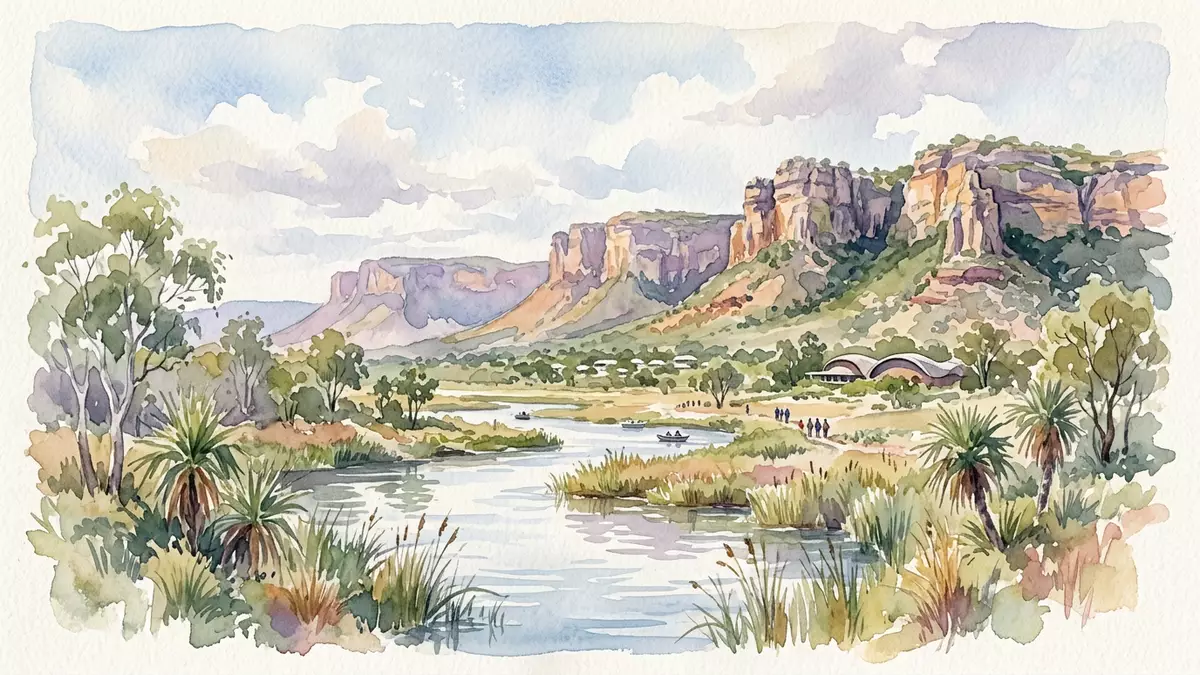
Kakadu National Park in northern Australia stretches across a vast tropical landscape east of Jabiru, where floodplains, rivers and sandstone plateaux meet in a single protected area. Its dual status as a UNESCO World Heritage site for both natural and cultural values anchors Kakadu among the most significant national parks in Australia, with inscriptions beginning in 1981 and extending through further stages in the late twentieth century.
A World Heritage landscape shaped by water and stone
Kakadu National Park lies in the Alligator Rivers Region of the Northern Territory, covering roughly 19,804 square kilometres (7,646 square miles) of monsoonal country between the Wildman and East Alligator rivers.Alligator Rivers Region Within this expanse, tidal flats, lowlands, floodplains and sandstone escarpments create a mosaic of ecosystems that has been recognised internationally for its outstanding universal value.complex of ecosystems
The park’s World Heritage inscription occurred in three stages, with Stage I accepted in 1981 and later extensions in 1987 and 1992, reflecting the gradual protection of the wider catchment.three stages of inscription Kakadu is listed for both natural and cultural criteria, an unusual combination that acknowledges not only the richness of its wetlands and stone country but also the long human history preserved in rock art and archaeological sites.mixed natural and cultural values
Aboriginal culture and rock art over tens of thousands of years
Kakadu National Park has been inhabited continuously for tens of thousands of years, with Aboriginal cultures maintaining a presence that predates the last ice age.continuous habitation Rock shelters and escarpment galleries across the park carry an immense range of cave paintings and engravings, recording changing ways of life from early hunter-gatherer societies to more recent contact-period scenes.cave paintings and carvings
Some of Kakadu’s rock art is dated to many thousands of years ago, while other panels show more recent depictions of animals, ceremonies and everyday activities, forming a visual archive of human interaction with the tropical environment. The park is jointly managed by Aboriginal landowners and Australian government agencies, with Traditional Owners playing a central role in decisions and on-ground work such as caring for country and controlling invasive species.Traditional Owners manage the park
Wetlands, stone plateaux and rich wildlife
Kakadu National Park brings together contrasting landforms, from low-lying floodplains that carry seasonal wetlands to elevated sandstone plateaux often referred to as stone country.stone country and floodplains During the tropical wet season, extensive floodplains drain the park’s river systems, and water later recedes into rivers, creeks and billabongs as conditions change.
This variety of habitats supports a notably rich fauna, with Kakadu providing secure habitat for estuarine crocodiles and many bird species, alongside reptiles, fish and mammals.secure habitat for fauna One overview notes that roughly one third of Australia’s bird species and a quarter of its freshwater fish species are represented within the park, underlining the ecological breadth found in this single protected area.rich plant and animal life
Visiting Kakadu National Park: what travellers from Western Europe should know
- Kakadu National Park lies in the tropical north of Australia, east of Darwin, with Jabiru as the main township within the park that serves as a local centre.
- The terrain ranges from low-lying wetlands to sandstone plateaux and escarpments, and access to viewpoints or rock art shelters can involve walking on uneven ground and climbing natural rock steps.
- The climate is tropical, with high temperatures and a monsoonal rainfall pattern, and conditions on exposed floodplains and stone country can feel markedly different between dry and wet parts of the year.
- The official language in Kakadu National Park is English and the national currency is the Australian dollar.
- Entry requirements depend on your nationality; UK travellers can check the FCDO travel advice at gov.uk/foreign-travel-advice, Irish travellers the Department of Foreign Affairs at ireland.ie.
Searching for Kakadu National Park on social platforms
These links open searches for Kakadu National Park on each platform.
Frequently asked questions about Kakadu National Park
Where is Kakadu National Park and what is the nearest township?
Kakadu National Park is in the Northern Territory of Australia in the Alligator Rivers Region, with Jabiru identified as the nearest township within the park.
What can visitors expect when exploring Kakadu National Park?
Visitors encounter extensive wetlands, river systems, sandstone plateaux and escarpments, along with Aboriginal rock art sites that record a long history of occupation.
What makes Kakadu National Park distinctive among Australian national parks?
Kakadu is distinctive for its combination of rich tropical ecosystems and continuous Aboriginal cultural heritage, and for its dual listing as both a natural and cultural World Heritage site.


