
Kakh-e Golestan and Teheran’s layered royal complex
Published on 09/07/2026 at 08:56 | Editorial responsibility: Rafael Müller, Editor-in-Chief AD HOC NEWS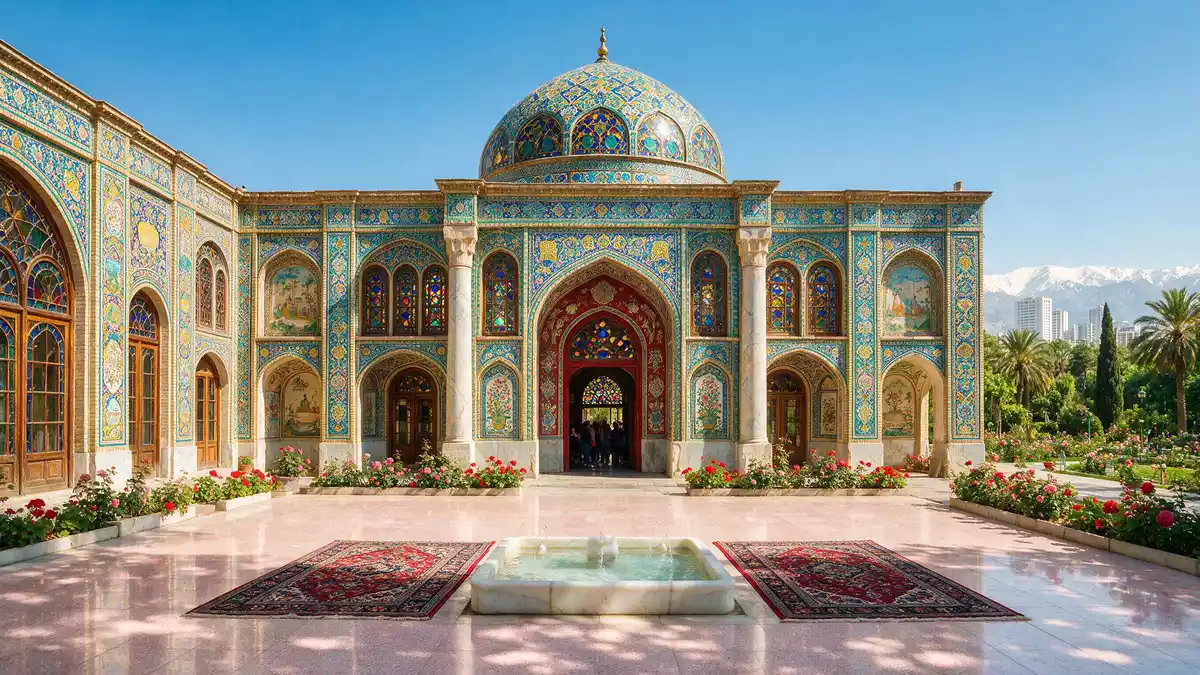
Kakh-e Golestan in Teheran is a royal complex built across several periods, with Safavid origins and a strong Qajar presence. Its tiled façades, mirrored halls and garden spaces make the palace’s layered character visible at a glance.
Safavid roots and Qajar grandeur at Kakh-e Golestan
The palace complex is among the oldest historic monuments in Teheran and is linked with the Safavid dynasty, the Zand period and the Qajar court. It became a royal seat under the Qajar ruling family, and its best-known form belongs to the nineteenth century.Safavid dynasty Qajar ruling family
The complex carries the marks of Iranian craft and European influence in a single setting. That combination appears in decorative surfaces, formal rooms and the arrangement of the surviving royal buildings, which are part of a UNESCO World Heritage Site.UNESCO World Heritage Site
Decorative surfaces and royal rooms
What stands out first is the palace’s emphasis on surface: glazed tile, mirror work and ornament sit beside heavier masonry and garden walls. The result is a palace that reads as a sequence of rooms, courtyards and façades rather than a single block.glazed tile
The royal buildings serve as museums today, and that change of function has preserved a compact reading of court culture in the centre of Teheran. Painted ceilings, reception rooms and display spaces make the complex feel like an archive of imperial taste as much as an architectural ensemble.former royal Qajar complex
Teheran’s historic core around the palace
Kakh-e Golestan belongs to the historic centre of Teheran, inside the city’s older royal and administrative quarter. Its setting places it close to the political geography that made the city a capital under the Qajars.historic centre of Teheran
The palace complex is tied to a walled urban landscape that once formed part of Teheran’s citadel. That older urban frame helps explain why the site feels enclosed, formal and distinctly metropolitan rather than isolated from the city around it.walled urban landscape
Visiting Kakh-e Golestan: what travellers from Western Europe should know
- Kakh-e Golestan stands in central Teheran, within the older royal quarter. It is reached in the city rather than by a separate excursion route.
- The complex is made up of royal buildings, gardens and enclosed courtyards. Expect layered surfaces, rather than a single hall or a single façade.
- Teheran is the capital of Iran, and the official language is Persian and the currency is the Iranian rial.
- Entry requirements depend on your nationality; UK travellers can check the FCDO travel advice at gov.uk/foreign-travel-advice, Irish travellers the Department of Foreign Affairs at ireland.ie.
Searching for Kakh-e Golestan on social platforms
These links open searches for Kakh-e Golestan on each platform.
Frequently asked questions about Kakh-e Golestan
Where is Kakh-e Golestan?
It stands in Teheran, in Iran’s historic centre, among the city’s older royal buildings and administrative streets.
What does a visit involve?
The place is an urban palace complex with gardens, courtyards and museum rooms. The experience is architectural rather than landscape-based.
What makes Kakh-e Golestan distinctive?
Its value lies in the visible layering of Safavid beginnings, Qajar royal life and later museum use, all gathered in one compact complex.


