
Kapadokya’s carved landscape around Göreme
Published on 09/02/2026 at 18:43 | Editorial responsibility: Rafael Müller, Editor-in-Chief AD HOC NEWS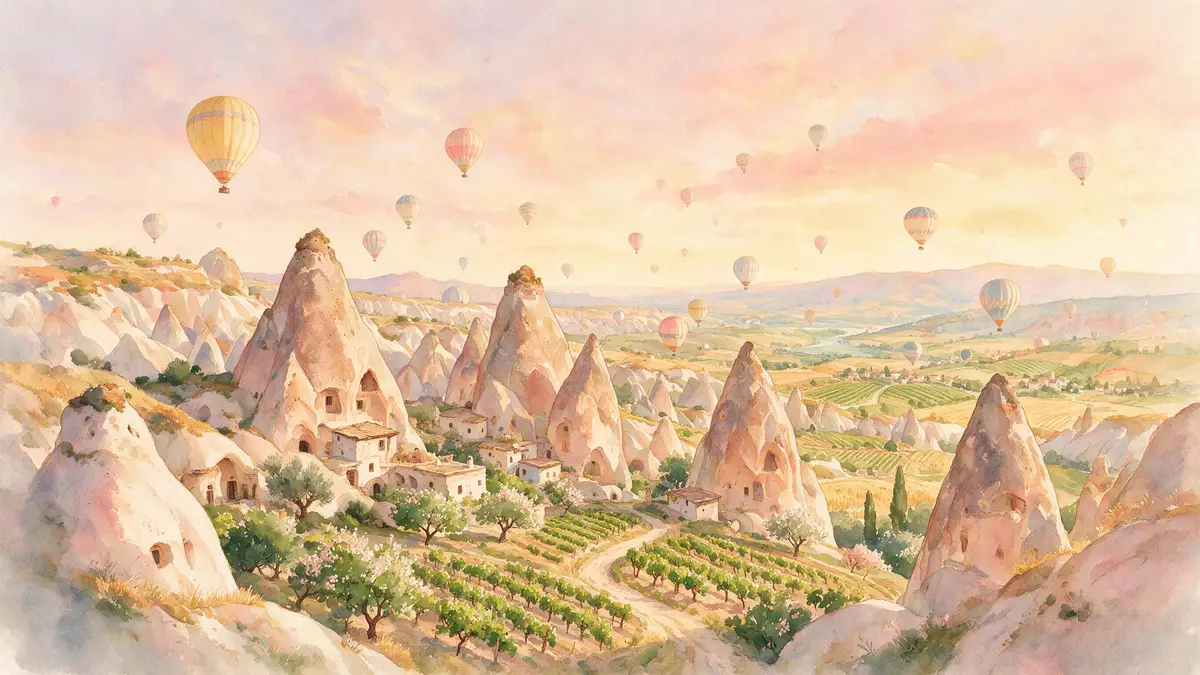
Kapadokya around Göreme is a place where a volcanic plateau has been hollowed into homes, sanctuaries and whole underground cities over many centuries. In this central Anatolian region of Turkey, the rock landscape and human settlement merge, and visitors encounter a terrain of cones, ridges and valleys that has been formally protected as Göreme National Park and the Rock Sites of Cappadocia since 1985.
Volcanic tuff shaped into fairy chimneys
The lead impression of Kapadokya is geological: a broad plateau of soft volcanic tuff cut into valleys and studded with towers of rock known locally as peribacalar?, or fairy chimneys. The region belongs to the Central Anatolian Volcanic Province, where major stratovolcanoes such as Mount Erciyes, Mount Hasan and Güllüda? once erupted explosively across a wide area, blanketing the plateau in deep layers of ash and pyroclastic material that later compacted into tuff.Central Anatolian Volcanic Province Subsequent lava flows capped parts of this softer rock with harder basalt and andesite, a contrast that allowed wind and water to remove the exposed tuff while leaving protected cones standing as solitary pillars in the valleys.cones and pillars standing
In Göreme and the surrounding valleys of Kapadokya, these fairy chimneys reach heights comparable to multi-storey buildings and take varied forms: slender spires, broader pillars and irregular pinnacles rising above the valley floors. The UNESCO listing describes this landscape as a succession of ridges, valleys and pinnacles sculpted entirely by erosion, with the Göreme valley and nearby areas forming a distinctive ensemble on the central Anatolian plateau.succession of ridges, valleys and pinnacles The fairy chimneys stand alongside cliffs of layered tuff, their surfaces weathered into shades of cream, ochre and rose that catch the light differently through the day.
Rock-hewn sanctuaries and underground cities
Kapadokya is not only a geological spectacle; it is also a long-inhabited cultural landscape in which the rock itself became the primary building material. People carved dwellings, stables, wine presses, granaries and pigeon towers directly into the tuff, creating troglodyte villages embedded in valley sides and hill slopes.troglodyte villages Göreme National Park and the Rock Sites of Cappadocia contain rock-hewn sanctuaries with extensive wall paintings that preserve Byzantine art of the post-Iconoclastic period, as well as multi-level underground towns that represent a traditional form of habitation dating back at least to the fourth century.rock-hewn sanctuaries
Among the most visited parts of Kapadokya is the Göreme Open Air Museum, set in a valley near the town of Göreme and recognised as part of the UNESCO World Heritage Site. Here, churches, chapels and monastic complexes have been cut into the tuff cones and valley walls, many preserving frescoes that depict biblical scenes and saints in vivid colours.Göreme Open Air Museum The region also includes well-known subterranean cities such as Kaymakl? and Derinkuyu, where chambers, tunnels and ventilation shafts extend for multiple storeys below the surface; these underground systems form part of a wider pattern of rock-cut habitation across Kapadokya.
Göreme and the valleys of Kapadokya
Göreme itself is a town in Nev?ehir Province, in the central part of Turkey’s Anatolia region, located within the boundaries of Göreme National Park.town in Nev?ehir Province The wider UNESCO property stretches between the settlements of Nev?ehir, Ürgüp and Avanos and includes valleys such as Love Valley, Pigeon Valley, Rose Valley, Zelve Valley and the So?anl? area, each characterised by its own combination of cliff formations, fairy chimneys and carved structures.Göreme National Park and the Rock Sites of Cappadocia Some valleys are noted for particular rock forms, such as camel-shaped outcrops or groups of fairy chimneys arranged like a natural colonnade.
The UNESCO inscription of Göreme National Park and the Rock Sites of Cappadocia in 1985 under both natural and cultural criteria reflects this dual character: a dramatic eroded landscape combined with an extensive record of rock-cut architecture and settlement. The protected area covers nearly 10,000 hectares, embracing elevated ridges, enclosed valleys and open slopes where human-made openings and facades appear across the rock surfaces.inscribed as a UNESCO World Heritage Site in 1985 Standing in Göreme, the proximity of these shaped rocks is evident: fairy chimneys rise beside paths, and valley walls show rows of doors and windows cut into the tuff, indicating the density of earlier habitation.
Visiting Kapadokya: what travellers from Western Europe should know
- Kapadokya lies in central Turkey, with Göreme in Nev?ehir Province; travellers usually reach the region via Nev?ehir or Kayseri airports and onward road connections through the plateau.
- The terrain around Göreme is formed of soft volcanic tuff cut by valleys, with paths that may involve uneven ground, short climbs and stairways hewn into the rock surfaces.
- Seasonal conditions on the plateau can vary markedly between warm summers and cold winters; visitors encounter exposed valley walks and higher viewpoints above the town.
- Göreme is surrounded by named valleys such as Rose Valley and Pigeon Valley, meaning walking routes begin close to the settlement and pass directly among fairy chimneys and carved cliffs.
- The official language is Turkish and the currency is the Turkish lira. Entry requirements depend on your nationality; UK travellers can check the FCDO travel advice at gov.uk/foreign-travel-advice, Irish travellers the Department of Foreign Affairs at ireland.ie.
Searching for Kapadokya on social platforms
These links open searches for Kapadokya on each platform.Frequently asked questions about Kapadokya
Where is Kapadokya and Göreme located?
Kapadokya is a historical region in central Turkey, and Göreme is a town in Nev?ehir Province within Göreme National Park and the Rock Sites of Cappadocia.
What can visitors expect on a visit to Kapadokya?
Visitors encounter eroded valleys filled with fairy chimneys, rock-cut dwellings and churches, as well as nearby underground cities and the Göreme Open Air Museum carved into the tuff.
What makes Kapadokya distinctive among landscapes?
Kapadokya combines a volcanic plateau sculpted into pinnacles and ridges with extensive rock-hewn sanctuaries and subterranean towns, a combination recognised through its UNESCO World Heritage status.


