
Kapellbrucke in Luzern: a walk through a painted wooden past
Published on 08/14/2026 at 14:38 | Editorial responsibility: Rafael Müller, Editor-in-Chief AD HOC NEWS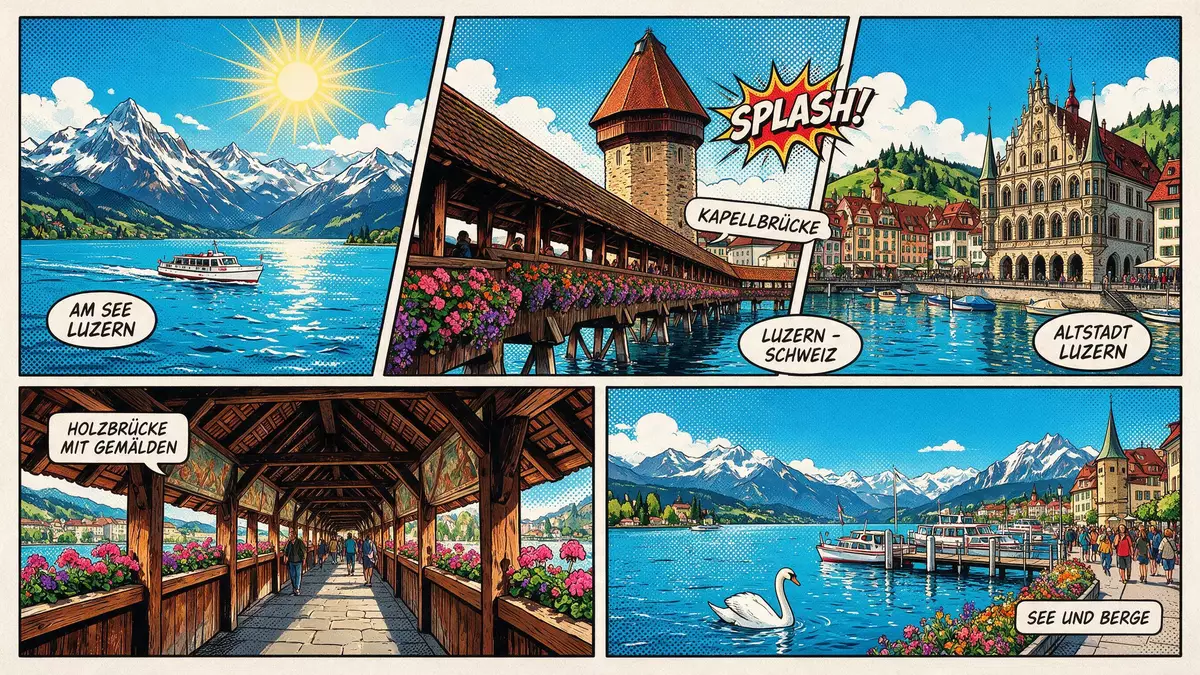
Kapellbrucke in Luzern is a covered wooden footbridge crossing the Reuss River on a diagonal line, accompanied by a stout stone water tower that rises directly from the water. Built in the fourteenth century as part of Luzern’s fortifications, it carries a cycle of seventeenth-century paintings beneath its roof that turn a short walk into a passage through Swiss history.
A medieval river crossing with a defensive role
Kapellbrucke links the historic parts of Luzern on opposite banks of the Reuss, reaching between the area around St Peter’s Chapel on the right bank and the riverside near the Luzerner Theater on the left bank.runs from the Luzerner Theater The bridge is constructed as a timber truss resting on stone supports below the river’s surface, with a continuous wooden roof that shelters the walkway.
The structure is dated to the middle of the fourteenth century, with documentary mentions from 1367 and dendrochronological analysis indicating construction in the decades around 1360.constructed around 1360 In its medieval form, Kapellbrucke served a dual function as a footbridge and as part of the defensive ring around the city, connecting the “Grossstadt” and “Kleinstadt” across the river while contributing to protection from the lakeside approach.doppelte Funktion als Bestandteil des Verteidigungsringes The lakeside wall of the bridge is higher than the inner wall, an arrangement that once made it easier for soldiers to rest their weapons along the outer side.lakeside wall is higher than the other side
Wood, stone and paintings: the fabric of Kapellbrucke
Kapellbrucke is widely described as one of the oldest surviving covered wooden bridges in Europe, and its structure combines long timber spans with a prominent stone water tower, Wasserturm, that predates the bridge.oldest wooden covered bridge in Europe The tower, rising directly from the river near the centre of the crossing, has served different roles over the centuries, including watchtower, treasury and prison, and now houses uses such as a souvenir shop.Wasserturm served as Wachturm, Schatzkammer und Kerker The bridge follows a distinctive zigzag line as it passes the tower, giving visitors alternating views up and down the Reuss as they walk.
Inside, Kapellbrucke is immediately recognisable by the series of triangular painted panels mounted under the eaves of the roof. The main cycle of paintings was developed in the seventeenth century, with a concept by the municipal clerk Renward Cysat, images by artist Hans Heinrich Wägmann and accompanying text by councilman Hans Rudolf von Sonnenberg.cycle of paintings was created in the first quarter of the 17th century The scenes show episodes from the history of Luzern and the Swiss Confederation, along with legends of patron saints such as Mauritius and Leodegar.depicts the history of the Swiss Confederation as well as the patron saints Timber, stone and painted narrative combine to make the bridge a compact gallery of civic memory.
Fire, restoration and a shortened span
The bridge that travellers see now is the result of many adaptations. In its original medieval form Kapellbrucke was longer than today, with an initial length given in historical studies as around 285 m (935 ft).ursprünglich 285 m lange Bauwerk During the nineteenth century, the construction of embankments along the Reuss led to the removal and shortening of sections, bringing the length to a little over 200 m (about 660 ft) and shifting the bridgeheads inland.shortened several times during the 19th century
Kapellbrucke has also endured major damage from fire. On 18 August 1993 a blaze destroyed a large part of the span and many of the original roof paintings, leaving only the bridgeheads and the water tower standing above the river.almost burned down on 18 August 1993 Reconstruction followed, with the missing section rebuilt in timber and many of the surviving paintings rehung, while panels that had been removed earlier in the nineteenth century were brought back into use as replacements.innerhalb von acht Monaten rekonstruiert The bridge has been under federal protection as a cultural monument of national significance since 1913, and its current fabric combines historic elements with carefully executed modern timber.seit 1913 steht die Brücke als kulturhistorisches Objekt von nationaler Bedeutung
Visiting Kapellbrucke: what travellers from Western Europe should know
- Kapellbrucke spans the Reuss in the historic centre of Luzern, linking the area around Luzerner Theater on the south bank with Rathausquai and St Peter’s Chapel on the north bank.
- The bridge is a covered wooden walkway with a slight zigzag plan and a continuous roof; the route includes timber steps at the bridgeheads and passes the stone water tower rising from the river.
- Nearby, the Spreuer Bridge crosses the Reuss downstream, and the riverside quays, theatre and Rathaus square lie within short walking distance of Kapellbrucke.
- The official language is German and the currency is the Swiss franc.
Searching for Kapellbrucke on social platforms
These links open searches for Kapellbrucke on each platform.
Frequently asked questions about Kapellbrucke
Where is Kapellbrucke located in Luzern?
Kapellbrucke crosses the Reuss River in Luzern’s historic centre, linking the riverside near Luzerner Theater to Rathausquai and St Peter’s Chapel.
What can travellers expect when walking across Kapellbrucke?
A walk across Kapellbrucke follows a covered wooden path with a slight bend around the stone water tower, passing beneath a sequence of triangular painted panels under the roof.
What makes Kapellbrucke distinctive among European bridges?
Kapellbrucke combines a fourteenth-century timber truss, a medieval stone water tower and an extensive seventeenth-century painting cycle, and it is recognised as one of Europe’s oldest surviving covered wooden bridges.


