
Kasbah des Oudaias, Rabat’s cliff-top Almohad citadel
Published on 09/09/2026 at 09:42 | Editorial responsibility: Rafael Müller, Editor-in-Chief AD HOC NEWS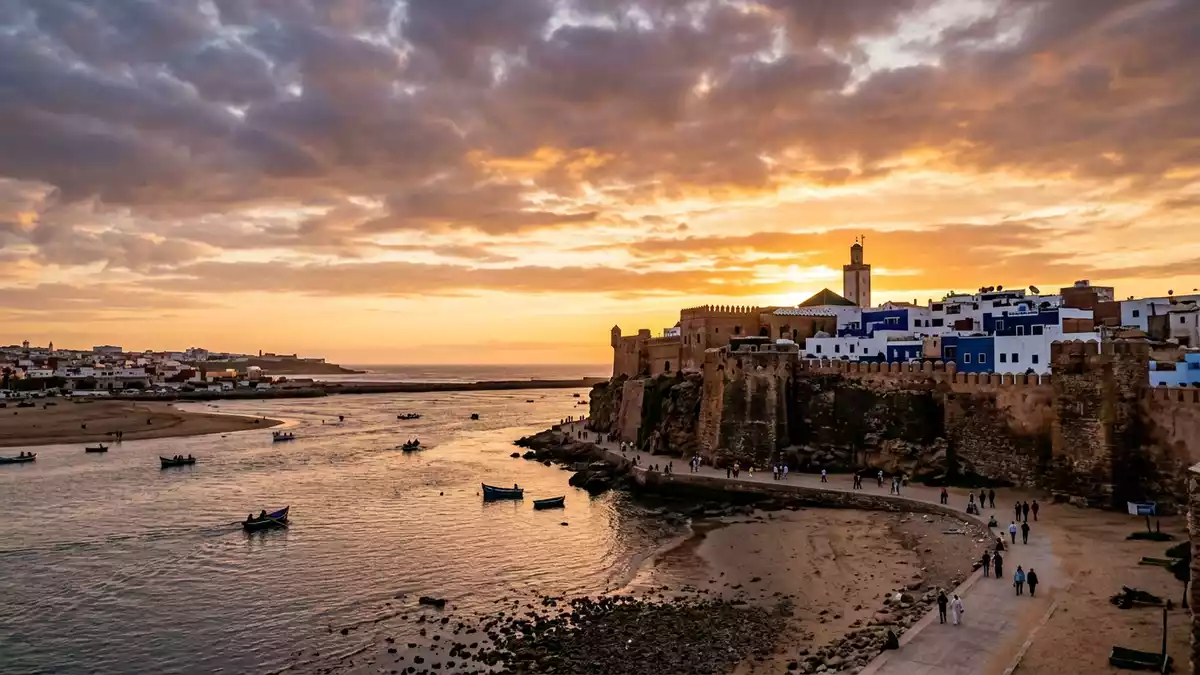
On the Atlantic edge of Rabat, Kasbah des Oudaias rises above the mouth of the Bou Regreg River as a fortified quarter of stone ramparts, blue-and-white houses and enclosed gardens. Built as an Almohad citadel in the twelfth century and later folded into Rabat’s wider historic fabric, it forms part of the “Rabat, Modern Capital and Historic City: a Shared Heritage” ensemble that UNESCO inscribed on the World Heritage List for its layered mix of fortifications and urban neighbourhoods.World Heritage List
Fortress on the Bou Regreg
Kasbah des Oudaias stands on a headland at the mouth of the Bou Regreg River where it enters the Atlantic Ocean, facing the city of Salé on the opposite bank and adjoining Rabat’s old medina to the south.headland at the mouth The site was developed as a fortress during the Almohad dynasty in the twelfth century, creating a walled enclosure above the river that formed Rabat’s original stronghold.fortress during the Almohad dynasty
The outer walls are built of substantial stone and brick ramparts that trace the cliff edge and encircle the kasbah, punctuated by fortified gateways and towers anchored in the slope. Inside, the main entrance for visitors is Bab Oudaïas, a monumental gate dating from the late twelfth century and associated with the Almohad sultan Yaqub al-Mansur, whose decorative stone façades lead into a sequence of chambers linked to judicial and ceremonial functions in the kasbah’s earlier life.Bab Oudaïas gate
Blue-and-white lanes and river views
Beyond the entrance, Kasbah des Oudaias turns from fortress to compact residential quarter, with a network of narrow lanes edged by whitewashed houses and vivid blue lower walls that have become a defining image of Rabat’s historic riverfront.Rabat's oldest neighbourhood The streets climb and turn within the enclosure, framed by simple doorways, small squares and occasional flights of steps that reflect the kasbah’s position on the slope above the estuary.
Towards the northern edge of the kasbah, a platform opens towards the Atlantic and the Bou Regreg estuary, giving long views over the river mouth, the sandbar and the urban spread of Rabat and Salé along the banks.mouth of the Bou Regreg river The position above the water explains why the fortress was sited here in the first place, as the elevated ground at the river entrance offered an advantageous lookout over maritime approaches and the coastal route linking northern and central Morocco.
Andalusian garden inside the walls
Within the kasbah, close to Bab Oudaïas, an enclosed Andalusian-style garden occupies the site of a former parade ground beside an older pavilion associated with a seventeenth-century sultan’s residence.Andalusian-style garden The garden layout dates from the period of the French Protectorate in the early twentieth century, when designers such as Maurice Tranchant de Lunel and landscape gardener Jean-Claude Nicolas Forestier introduced geometric paths, raised beds and dense planting inspired by Moorish and Andalusian precedents in places such as Seville and the Alhambra.French Protectorate garden
Today the garden forms a quiet inner world of orange and lemon trees, clipped hedges, seasonal flowers and shaded corners within the stone boundaries of the kasbah, contrasting with the tight urban lanes nearby. At one end stands the pavilion that has been adapted as the National Jewellery Museum, extending the site’s role beyond fortification and housing to include cultural display that highlights Moroccan decorative arts within the historic fabric of Rabat’s oldest surviving quarter.National Jewellery Museum pavilion
Visiting Kasbah des Oudaias: what travellers from Western Europe should know
- Kasbah des Oudaias stands on the north-western side of Rabat above the Bou Regreg estuary, and is reached on foot from the lower city streets and the riverfront.
- The approach into the kasbah rises up a relatively steep entrance ramp and includes narrow cobbled lanes and internal stairways, so walking surfaces are uneven in places.
- Within the walls, the Andalusian garden sits near Bab Oudaïas, providing level paths and shaded seating areas beside the historic pavilion and museum buildings.
- The official language is Arabic and the currency is the Moroccan dirham.
- Entry requirements depend on your nationality; UK travellers can check the FCDO travel advice at gov.uk/foreign-travel-advice, Irish travellers the Department of Foreign Affairs at ireland.ie.
Searching for Kasbah des Oudaias on social platforms
These links open searches for Kasbah des Oudaias on each platform.
Frequently asked questions about Kasbah des Oudaias
Where is Kasbah des Oudaias located within Rabat?
Kasbah des Oudaias occupies a cliff-top position on the north-western edge of Rabat, above the Bou Regreg River mouth and opposite Salé on the far bank.
What should visitors expect on a visit?
A visit combines fortified gates and ramparts, intimate blue-and-white residential lanes, broad river and ocean views from the platform and an enclosed Andalusian-style garden within the walls.
What makes Kasbah des Oudaias distinctive among Rabat’s historic sites?
Its combination of twelfth-century Almohad fortifications, later residential fabric and an early twentieth-century garden ensemble within a UNESCO-listed historic city makes it a layered quarter rather than a single monument.


