
Kathmandu Durbar Square and the royal heart of Kathmandu
Published on 09/05/2026 at 10:46 | Editorial responsibility: Rafael Müller, Editor-in-Chief AD HOC NEWS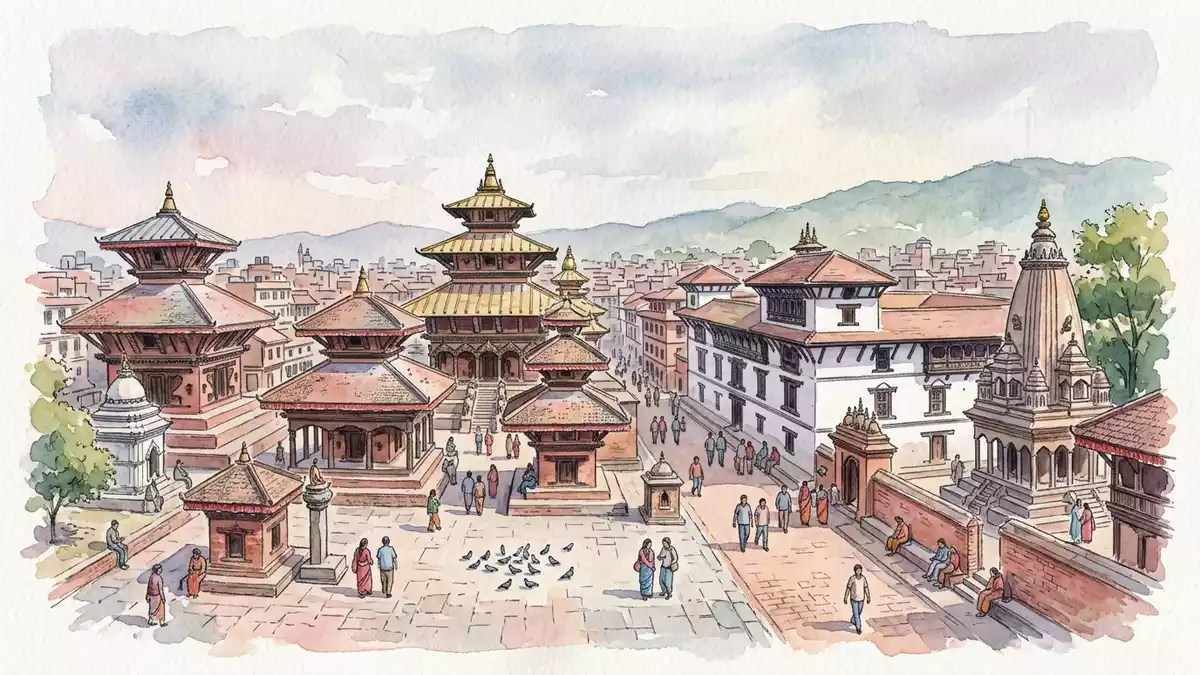
Kathmandu Durbar Square in Kathmandu is the historic royal centre of the city, where palace courtyards, tiered temples and carved façades gather into a dense urban ensemble framed by stone and timber. The square forms one of the monument zones of the Kathmandu Valley inscribed on the UNESCO World Heritage List in 1979, reflecting its long role as a royal and ceremonial hub of Nepal.
Royal palaces of the Malla and Shah dynasties
At the core of Kathmandu Durbar Square stands the Hanuman Dhoka palace complex, the former royal residence of the Malla kings of Kantipur and later the Shah dynasty after the unification of Nepal under Prithvi Narayan Shah in the eighteenth century.Royal palaces of the Malla and Shah Within the complex, successive rulers added new wings, courtyards and shrines between about the fifteenth and twentieth centuries, creating a layered palace that mirrors centuries of political power in the Kathmandu Valley.kings from Ratna Malla to Prithivi Bir Bikram Shah
The origins of royal construction at this site reach back to the Licchavi period between the fourth and eighth centuries, when earlier palaces stood in the same part of the city.construction of royal palaces at this site Later, under the Malla dynasty from roughly the twelfth to the eighteenth century, Kathmandu Durbar Square became the courtly centre of the kingdom of Kantipur, with Hanuman Dhoka functioning as both royal residence and administrative seat.political and administrative center of Kantipur After Prithvi Narayan Shah captured Kathmandu in 1768 and unified Nepal, he continued to use the palace as the capital’s royal seat, and important ceremonies such as coronations were held in the courtyards.
Courtyards, carved timber and pagoda temples
The architectural character of Kathmandu Durbar Square is defined by Newar craftsmanship: timber-framed palace wings with carved wooden façades, pagoda-style roofs and elaborate window lattices sit around open courtyards and stone-paved squares.carved wooden façades and courtyards Newar artists and builders shaped many of the temples and palace structures in the sixteenth and seventeenth centuries, adding tiers, struts and sculptures that still give the square its distinctive silhouette.pagoda-style temples with carved facades
Hanuman Dhoka itself once contained more than thirty courtyards before earthquakes reduced the complex to a smaller number, but even in its present form it remains a maze of interconnected courts, staircases and reception halls.originally housed 35 courtyards The eastern wing, dating from the mid sixteenth century, is among the oldest surviving parts, while later rulers such as Mahendra Malla and Pratap Malla expanded the square with new temples and restored earlier shrines.eastern wing dated to the mid 16th century Between palace façades stand freestanding temples, stone platforms and ceremonial gateways, so that religious structures and royal architecture merge into a single urban fabric.
Hanuman, Kumari and the UNESCO monument zone
Kathmandu Durbar Square takes its local name Hanuman Dhoka from a stone image of the Hindu deity Hanuman installed near the palace gate by King Pratap Malla in 1672, which has become a focal point of devotion at the entrance.idol installed by King Pratap Malla in 1672 Elsewhere in the square, the living goddess tradition of the Kumari is housed in Kumari Ghar, a brick and timber residence where a prepubescent girl from a Newar community is venerated as an embodiment of a goddess, and ceremonial processions pass between palace and temple spaces.Kumari Ghar and temple cluster
The square forms one of the seven protected monument zones of the Kathmandu Valley World Heritage property, alongside the Durbar squares of Patan and Bhaktapur and major religious ensembles such as Swayambhu and Bauddhanath.Durbar squares of Kathmandu, Patan and Bhaktapur This recognition reflects the archaeological, historical, cultural and religious significance of the palaces, temples and public spaces that have developed here over many centuries.seven Protected Monument Zones Kathmandu Durbar Square thus offers a concentrated view of courtly ritual, urban design and Newar architecture within a single walkable area at the heart of Nepal’s capital.
Visiting Kathmandu Durbar Square: what travellers from Western Europe should know
- Kathmandu Durbar Square lies in the old urban core of Kathmandu, south of the commercial districts around Thamel and New Road, and is reached on foot or by road vehicles along city streets.
- The palace and temple complex forms an irregular stone-paved square with multiple flights of steps, uneven surfaces and interior staircases, including narrow stairways in the Hanuman Dhoka palace.
- The site stands at the elevation of Kathmandu’s basin, so visits involve urban walking rather than high-mountain conditions, but the combination of courtyards and lanes can make routes intricate.
- The official language is Nepali and the currency is the Nepalese rupee.
- Entry requirements depend on your nationality; UK travellers can check the FCDO travel advice at gov.uk/foreign-travel-advice, Irish travellers the Department of Foreign Affairs at ireland.ie.
Searching for Kathmandu Durbar Square on social platforms
These links open searches for Kathmandu Durbar Square on each platform.Frequently asked questions about Kathmandu Durbar Square
Where is Kathmandu Durbar Square located?
Kathmandu Durbar Square is located in the old centre of Kathmandu, within the Kathmandu Valley in Nepal, south of the city’s commercial districts.
What can visitors expect when exploring Kathmandu Durbar Square?
Visitors find a compact area of palace courtyards, pagoda temples and carved timber façades, with stone-paved squares and narrow stairways linking different parts of the complex.
What makes Kathmandu Durbar Square distinctive among Kathmandu’s sights?
Kathmandu Durbar Square is distinctive for its role as the former royal seat of Malla and Shah dynasties, its Newar architectural ensemble and its status as part of a UNESCO World Heritage monument zone.


