
Khoja Ahmed Yasawi Keshenesi, a Timurid landmark in Turkistan
Published on 08/25/2026 at 09:54 | Editorial responsibility: Rafael Müller, Editor-in-Chief AD HOC NEWS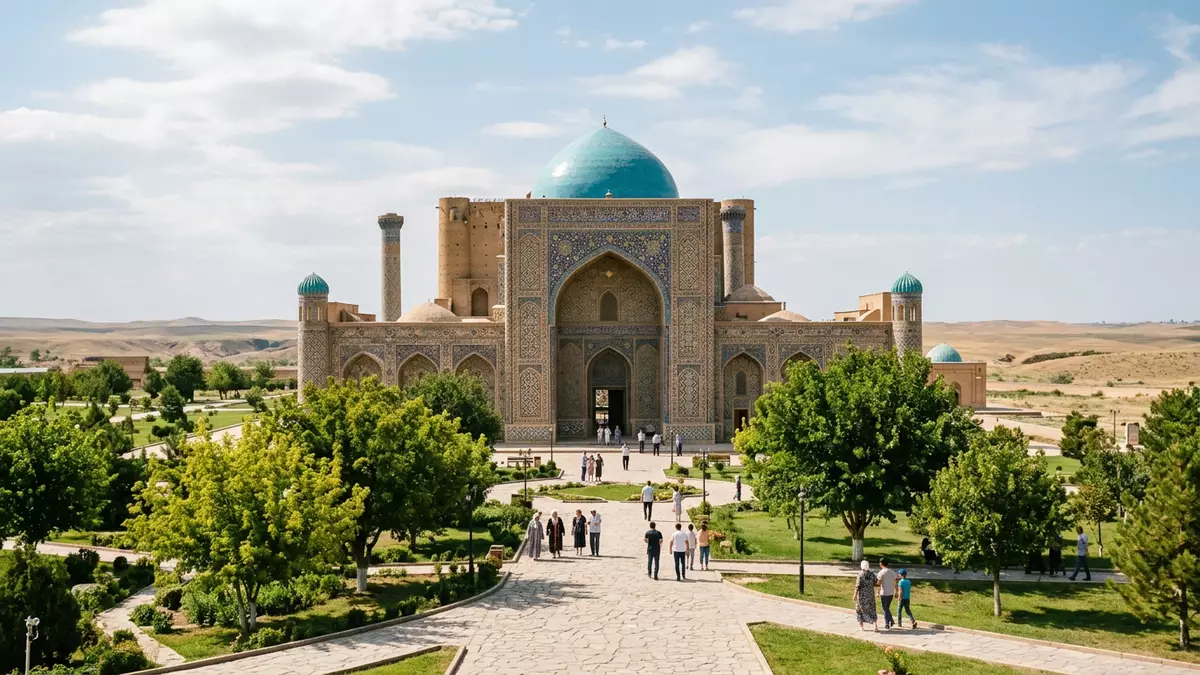
Khoja Ahmed Yasawi Keshenesi in Turkistan, Kazakhstan, is a monumental Timurid-era mausoleum complex that rises over the old citadel of the city and honours the Sufi poet Khoja Ahmed Yasawi, who lived in the twelfth century. Commissioned by Timur in the late fourteenth century, it remains one of the most substantial surviving buildings from his empire and defines the historic heart of Turkistan.
A Timurid mausoleum over a Sufi poet’s grave
The building known as Khoja Ahmed Yasawi Keshenesi is the large brick mausoleum that stands over the burial place of Khoja Ahmed Yasawi, a Turkic poet and Sufi mystic who died in the twelfth century.Khoja Ahmed Yasawi, a distinguished Sufi master was laid to rest in a smaller shrine that drew pilgrims from across Central Asia, and the present structure replaced that earlier building during the rule of Timur, also known as Tamerlane.Timur ordered the mausoleum between 1389 and 1405 and the project was left unfinished after his death, leaving a rare example of a major Timurid monument where some intended elements were never completed.
The mausoleum stands inside the former citadel of Yasi, the earlier name of Turkistan, in the north-eastern part of the historic town.It occupies a rectangular footprint roughly 46 by 63 metres and is aligned on a south-east to north-west axis within the old fortifications. Built in fired brick, it presents a powerful mass of walls, portals and domes which have endured the region’s harsh continental climate and the long history of the city as a trading centre on caravan routes.
Architecture, layout and the great brick dome
Khoja Ahmed Yasawi Keshenesi is an architectural complex rather than a single chamber, combining the functions of mausoleum, mosque, khanqah and madrasa within one integrated structure.Sources describe 34 rooms, including prayer halls and service spaces grouped around major interior volumes. The entrance façade is marked by a soaring arched portal, behind which lies the Kazandyk Hall, a great domed space that forms one of the architectural highlights of the complex.
Above the central part of Khoja Ahmed Yasawi Keshenesi rises one of the largest brick domes in Central Asia.Descriptions give the main dome a diameter in the order of several tens of metres and an imposing height that makes the building visible from far across the flat steppe landscape. The interior incorporates a mix of vaulted and domed spaces, thick brick piers and decorative elements such as glazed tiles and muqarnas niches characteristic of Timurid architecture, and parts of the building retain unfinished surfaces where the planned cladding was never added.
Turkistan, UNESCO status and the site’s wider setting
The mausoleum stands in the city of Turkistan in southern Kazakhstan, a settlement known historically as Yasi and later Hazrat-e Turkestan.Its position in the north-eastern part of the old town places it within an archaeological area where traces of earlier fortifications and urban fabric are visible. The complex forms the core of a wider ensemble of religious and historical structures connected with the cult of Khoja Ahmed Yasawi and with the history of Turkistan as a spiritual centre on the steppe.
Khoja Ahmed Yasawi Keshenesi has been recognised internationally for its architectural and historical importance.In 2003 it was inscribed on the UNESCO World Heritage List as an architectural monument meeting criteria for a masterpiece of human creative genius. The nomination emphasised the role of the mausoleum as a major example of Timurid construction where Persian master builders explored architectural and structural solutions later applied at Samarkand, making the site important not only as a place of pilgrimage but also as a key document of Central Asian building history.
Visiting Khoja Ahmed Yasawi Keshenesi: what travellers from Western Europe should know
- Khoja Ahmed Yasawi Keshenesi stands in Turkistan in southern Kazakhstan, within the historic citadel area at the north-eastern edge of the old town, and is reached on foot from the surrounding city streets.
- The complex occupies a broad area of masonry structures, with interior routes that include stairways, high halls and enclosed passages, and visiting involves walking across uneven historic surfaces.
- The official language is Kazakh and the currency is the Kazakh tenge.
- Entry requirements depend on your nationality; UK travellers can check the FCDO travel advice at gov.uk/foreign-travel-advice, Irish travellers the Department of Foreign Affairs at ireland.ie.
Searching for Khoja Ahmed Yasawi Keshenesi on social platforms
These links open searches for Khoja Ahmed Yasawi Keshenesi on each platform.
Frequently asked questions about Khoja Ahmed Yasawi Keshenesi
Where is Khoja Ahmed Yasawi Keshenesi located?
Khoja Ahmed Yasawi Keshenesi stands in the city of Turkistan in southern Kazakhstan, within the area of the historic citadel at the edge of the old town.
What should visitors expect at the site?
Visitors encounter a vast brick mausoleum complex with mosques and halls, high interior volumes, historic masonry surfaces and architectural decoration characteristic of the Timurid period.
What makes Khoja Ahmed Yasawi Keshenesi distinctive?
The site combines the tomb of a major twelfth-century Sufi poet with one of the largest brick-domed Timurid monuments and carries UNESCO World Heritage status recognising its architectural significance.


