
Khoja Ahmed Yasawi Keshenesi and the Timurid monument of Turkistan
Published on 08/24/2026 at 06:59 | Editorial responsibility: Rafael Müller, Editor-in-Chief AD HOC NEWS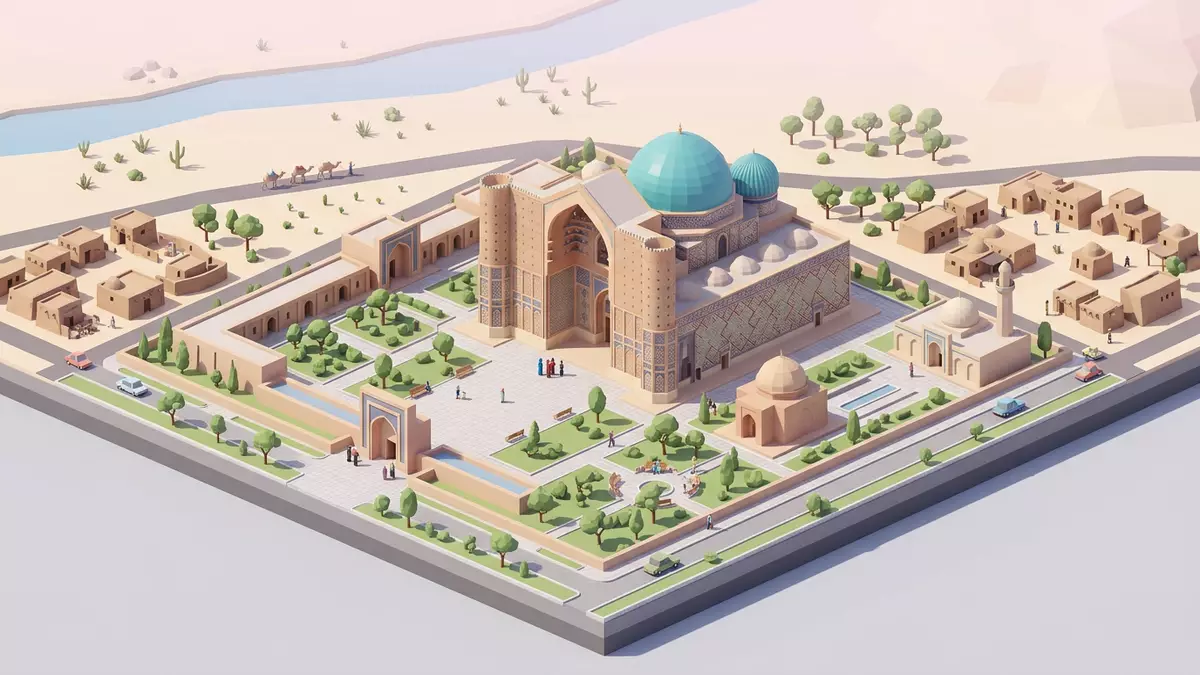
Khoa Ahmed Yasawi Keshenesi in Turkistan, southern Kazakhstan, is a vast Timurid-era mausoleum complex raised over the tomb of the Sufi poet Khoja Ahmed Yasawi and still anchored in the skyline of the steppe city. Built under the patronage of Timur in the late fourteenth century, it fuses mausoleum, mosque and khanqah functions into a single baked-brick monument that later became a model for other Timurid buildings in Central Asia.
Timur’s unfinished mausoleum for a Sufi master
The mausoleum of Khoja Ahmed Yasawi stands in the north-eastern part of Turkistan, on the site of the older town of Yasi, which lay on caravan routes across southern Kazakhstan.The mausoleum in the town of Yasi Timur, the Central Asian ruler better known in the West as Tamerlane, ordered a new monumental structure over Yasawi’s grave in 1389, replacing a smaller twelfth-century tomb.Commissioned in 1389 to replace an earlier mausoleum Construction is dated between 1389 and 1405, and was halted after Timur’s death, leaving parts of the design unfinished while the main mass of the building remained standing.
Khoja Ahmed Yasawi himself lived in the twelfth century and became known across the Turkic world as a poet and Sufi mystic whose grave drew pilgrims from the region.Khoja Ahmed Yasawi as a Sufi poet and philosopher The mausoleum raised in his memory later formed part of a wider architectural complex within the former citadel of Yasi, turning the burial place into an architectural monument recognised as a significant Timurid structure. Its walls in baked brick, large domes and facades decorated with glazed tiles link the site directly to the experimentation that shaped the later imperial city of Samarkand.Persian master builders experimented here with forms later used in Samarkand
Scale, plan and the Kazandyk hall
The overall plan of Khoja Ahmed Yasawi Keshenesi is a large rectangle aligned on a south-east to north-west axis, measuring roughly 65 m by 46 m (213 ft by 151 ft).Overall dimensions of the complex Within this shell, the complex integrates dozens of rooms serving religious, residential and service functions, including prayer spaces, cells and ancillary chambers; Kazakh sources name 34 rooms, while other descriptions refer to around thirty-five, indicating a dense internal layout rather than a simple single hall.A multifunctional mausoleum with many rooms A monumental entrance portal marks the western side, behind which visitors step into the main interior volume.
The heart of the complex is the Kazandyk hall, a vast central chamber beneath one of the largest brick domes in Central Asia, with a diameter given as around 18 m (59 ft).Kazandyk hall and its brick dome In the centre stands the Tai Kazan, a huge bronze cauldron used in religious ceremonies, which visually anchors the room under the dome. Towards the far end of the building lies the tomb chamber housing Yasawi’s sarcophagus, itself covered by a high domed roof whose exterior is clad in hexagonal green glazed tiles with gold patterns. Together, the Kazandyk and the tomb chamber articulate a progression from public ceremonial space to the more enclosed core of the mausoleum.
Timurid style and UNESCO recognition
Architecturally, Khoja Ahmed Yasawi Keshenesi is a textbook work of Timurid style: baked brick construction, massive portal, high domes, muqarnas niches and extensive turquoise and blue glazed tile decoration on the outer surfaces.Timurid features of the Turkistan mausoleum The building incorporates functions beyond a simple tomb, acting historically as a mosque, khanqah and madrasa within one complex, which gives the interior a rhythm of large halls and more modest rooms around them.A complex combining mausoleum, mosque, khanqah and madrasa Persian builders working on the site experimented with structural solutions here that informed Timurid monument building more widely.
The mausoleum and its surrounding archaeological area are inscribed on the UNESCO World Heritage List as “Mausoleum of Khoja Ahmed Yasawi”, recognising its status as one of the largest and best-preserved constructions from the Timurid period.UNESCO World Heritage inscription The property lies within a core zone and buffer zone in Turkistan and is described formally as an architectural monument within the South Kazakhstan region.World Heritage documentation for the mausoleum For visitors from Western Europe, this status underlines that the building is protected within an international framework and stands as a key site for understanding Central Asian Islamic architecture.
Visiting Khoja Ahmed Yasawi Keshenesi: what travellers from Western Europe should know
- Khoa Ahmed Yasawi Keshenesi stands in the north-eastern part of Turkistan in southern Kazakhstan, within the former citadel area of the ancient town of Yasi.
- Turkistan is reached overland and by air through regional transport hubs in Kazakhstan; from the city centre the mausoleum complex is accessible on foot along urban streets.
- Inside the complex, movement between levels and rooms involves staircases and passages within the historic masonry structure, and the main halls rise to significant heights under large brick domes.
- The region has a continental climate with marked seasonal temperature differences, and the exposed steppe surroundings of Turkistan mean conditions can be hot in summer and cold in winter.
- The official language is Kazakh and the currency is the Kazakh tenge. Entry requirements depend on your nationality; UK travellers can check the FCDO travel advice at gov.uk/foreign-travel-advice, Irish travellers the Department of Foreign Affairs at ireland.ie.
Searching for Khoja Ahmed Yasawi Keshenesi on social platforms
These links open searches for Khoja Ahmed Yasawi Keshenesi on each platform.
Frequently asked questions about Khoja Ahmed Yasawi Keshenesi
Where is Khoja Ahmed Yasawi Keshenesi located?
Khoa Ahmed Yasawi Keshenesi is located in the city of Turkistan in southern Kazakhstan, in the north-eastern sector of the historic town area known earlier as Yasi.
What should visitors expect inside the complex?
Visitors enter through a monumental portal into large domed halls such as the Kazandyk, see the Tai Kazan cauldron, and move through numerous smaller rooms towards the domed tomb chamber.
What makes Khoja Ahmed Yasawi Keshenesi distinctive among mausoleums?
The complex stands out for its Timurid baked-brick construction, integration of mausoleum, mosque and khanqah functions, vast brick domes, and formal recognition as a UNESCO World Heritage Site.


