
Kilimanjaro above Moshi: Africa’s roof as a standalone giant
Published on 08/17/2026 at 14:30 | Editorial responsibility: Rafael Müller, Editor-in-Chief AD HOC NEWS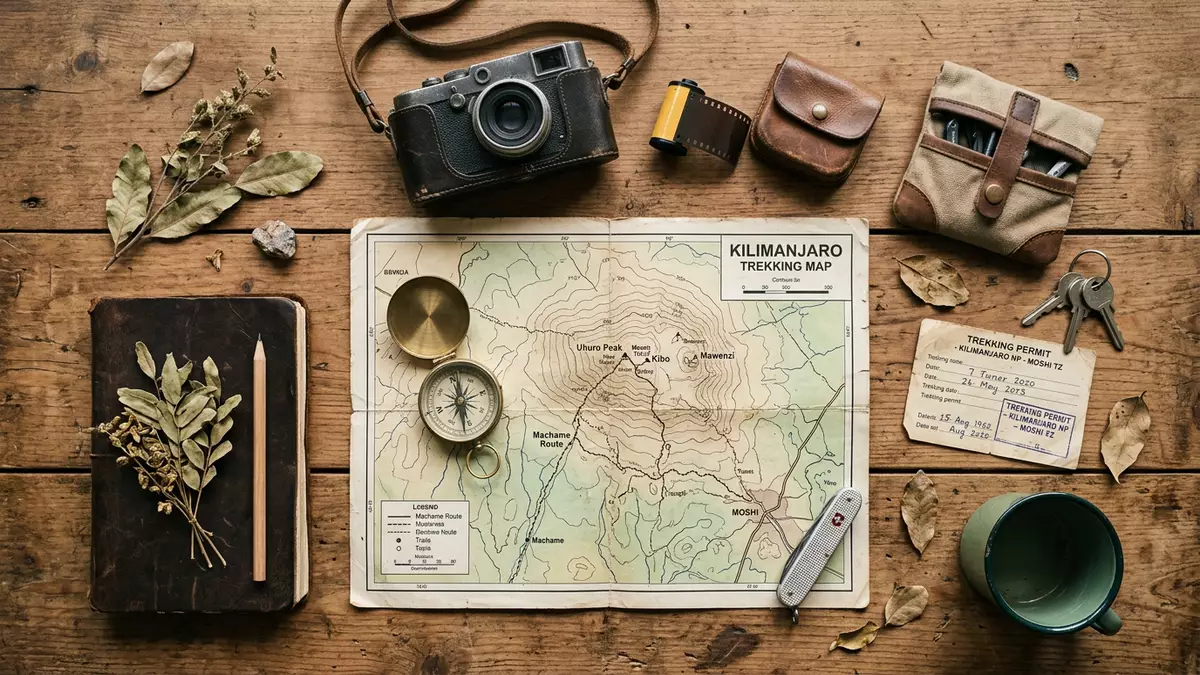
Kilimanjaro rises above Moshi in northern Tanzania as Africa’s highest mountain, a solitary volcanic massif with glaciers crowning its summit and forested slopes falling towards the plains.Kilimanjaro National Park protects the mountain itself, including the upper slopes and the high plateau above the surrounding savanna.
A free-standing volcano at Africa’s highest point
Mount Kilimanjaro stands in north-eastern Tanzania near the border with Kenya, looming over the town of Moshi on its southern side.Moshi lies on the lower slopes and serves as a gateway to the mountain’s approaches.Kilimanjaro’s main starting towns for ascents are Moshi and Arusha, both in the Kilimanjaro Region.
Kilimanjaro is a volcanic complex composed of three principal cones: Kibo, Mawenzi and Shira.The highest cone is Kibo, whose crater rim carries Uhuru Peak, recognised as the highest point in Africa.Uhuru Peak on Kibo reaches an elevation of 5,895 m (19,341 ft) above sea level, making the mountain the continent’s highest summit and the highest free-standing rise on Earth’s land surface.
Layers of climate and vegetation on the slopes
The bulk of Kilimanjaro’s mass is formed of volcanic rock, including basalt and andesite, which gives the mountain its dark flanks beneath the snow-covered upper slopes.The mountain’s volcanic composition reflects a long history of eruptions and lava flows that built up Kibo, Mawenzi and Shira over hundreds of thousands of years.
Climbing from Moshi towards the summit, the environment changes in marked bands that can be seen even from a distance.National Geographic describes Kilimanjaro as a snow?capped volcano rising from the plains, with montane forest, heathland and alpine desert zones on its slopes.NASA’s Earth Observatory imagery shows the dark volcanic surfaces and the bright icefields around the summit that together create the mountain’s “shining” appearance in the equatorial light.
Kilimanjaro National Park and the summit area
Kilimanjaro National Park encompasses the mountain above the cultivated lower slopes, including the forest belt, moorland and the high alpine desert reaching towards the crater rim.The UNESCO World Heritage listing recognises both the ecological variety and the dramatic silhouette of the volcanic mass rising 4,877 m (15,997 ft) above the surrounding plains to its 5,895 m (19,341 ft) summit.
At the highest elevations, near Uhuru Peak on Kibo, the terrain consists of bare volcanic rock, ash and icefields arranged around the summit crater.Topographic mapping of Uhuru Peak shows the crater rim forming a high ring above steep flanks, with glaciers and seasonal snow lying on the upper slopes despite the mountain’s position only a few degrees south of the equator.Descriptions of Kibo’s summit appearance emphasise the contrast between the dark volcanic rock and the white ice at Africa’s roof.
Visiting Kilimanjaro: what travellers from Western Europe should know
- Kilimanjaro rises in northern Tanzania near the Kenyan border, with Moshi on its southern foothills and Kilimanjaro International Airport serving the region.
- Approaches towards the mountain move from cultivated lower slopes into forested terrain and then open, high?altitude ground where paths cross rock and volcanic ash.
- The official language is Swahili and the currency is the Tanzanian shilling.
- Entry requirements depend on your nationality; UK travellers can check the FCDO travel advice at gov.uk/foreign-travel-advice, Irish travellers the Department of Foreign Affairs at ireland.ie.
Searching for Kilimanjaro on social platforms
These links open searches for Kilimanjaro on each platform.
Frequently asked questions about Kilimanjaro
Where is Kilimanjaro in relation to Moshi?
Kilimanjaro rises immediately above Moshi in northern Tanzania, with the town situated on the mountain’s lower southern slopes in the Kilimanjaro Region.
What kind of landscape should visitors expect?
The mountain’s slopes pass from cultivated land into montane forest, then heath and alpine desert, before reaching volcanic rock and ice around the summit crater.
What makes Kilimanjaro distinctive among African mountains?
Kilimanjaro is Africa’s highest point and the largest free?standing volcanic massif on the continent, rising thousands of metres above the surrounding plains.


