
Kilimanjaro: Africa’s highest freestanding volcano
Published on 08/23/2026 at 11:56 | Editorial responsibility: Rafael Müller, Editor-in-Chief AD HOC NEWS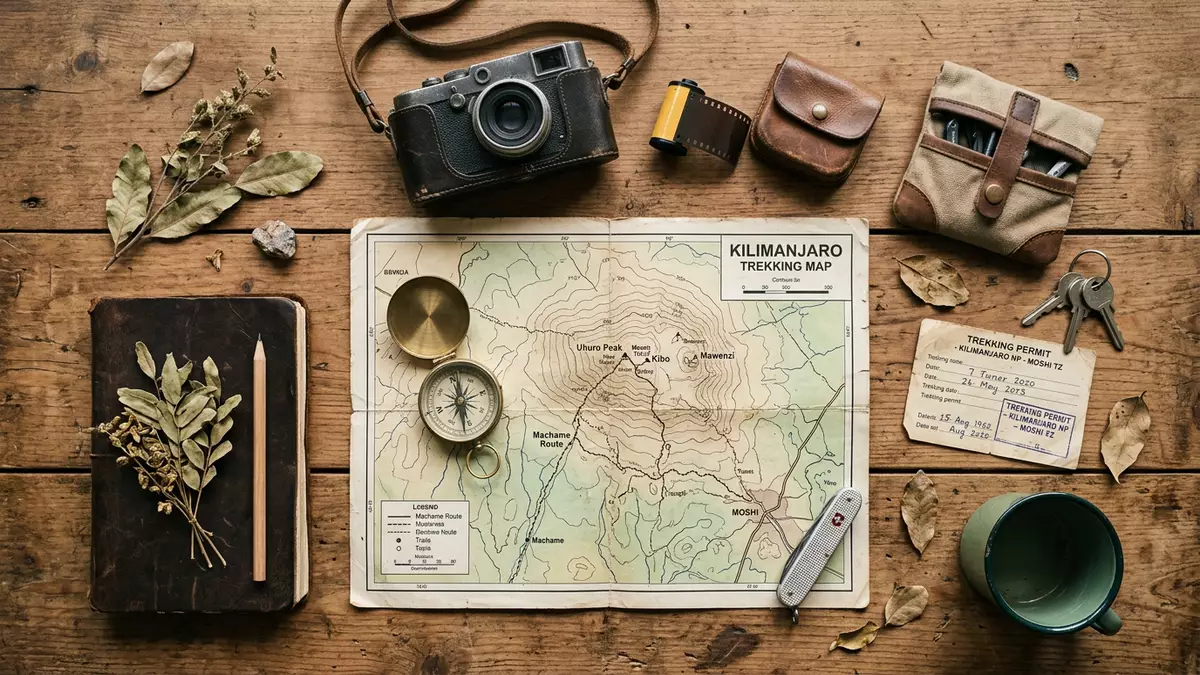
Kilimanjaro rises north of Moshi in northern Tanzania as a vast volcanic massif, crowned by the ice-capped summit of Uhuru Peak on the cone of Kibo in the Kilimanjaro National Park. The mountain is the highest point on the African continent, reaching 5,895 m (19,341 ft) above sea level and standing far above the surrounding plains as a freestanding stratovolcano rather than part of a compact range.highest mountain in Africa
A volcanic giant of three distinct peaks
Geologically, Kilimanjaro is a large stratovolcano built from layers of ash, lava and rock, formed above the East African Rift as magmatic activity pushed the land upwards into a high massif.stratovolcano made of ash, lava and rock The mountain is composed of three main volcanic cones, Kibo, Mawenzi and Shira, each representing a different stage in its eruptive history and each visible as a distinct highland form on the skyline.three volcanic cones Kibo, Mawenzi, Shira
Kibo occupies the central position and forms the highest part of the mountain, with its summit at Uhuru Peak reaching 5,895 m (19,341 ft) above sea level.Uhuru Peak 5,895 m Mawenzi rises to the east of Kibo as a deeply eroded, jagged peak, with its highest point known as Point Hans Meyer at 5,149 m (16,893 ft), presenting steep ridges and gullies that contrast with the broader summit dome of Kibo.Mawenzi 5,149 m To the west, Shira survives mainly as a broad ridge and plateau, the remnant of an older cone whose caldera has largely collapsed and been infilled by later lava flows, leaving a high open upland known as the Shira Plateau.
From montane forest to summit ice
One of Kilimanjaro’s most striking features is the change in vegetation and terrain as the mountain rises from the savanna plains into montane forest and then into high alpine zones, all within a relatively short horizontal distance.five main vegetation zones The lower slopes carry cultivated land and remnant forest, giving way to a belt of dense montane forest inside the National Park that shelters rivers, deep valleys and a rich variety of tree species.
Above the forest, heath and moorland mark the transition to higher ground, with shrubs and grasses gradually replacing taller trees, and the terrain opening out into long ridges, shallow valleys and scattered rock outcrops. Higher still, an alpine desert zone spreads around the upper flanks of Kibo and Mawenzi, with loose scree, lava flows and volcanic rocks dominating the landscape and only sparse hardy plants clinging to the ground.alpine desert and summit zones At the summit on Kibo, glaciers and perennial snowfields descend from the crater rim, forming ice cliffs and frozen surfaces that frame the high point of Uhuru Peak.
Kilimanjaro National Park and trekking routes
The upper reaches of Kilimanjaro and part of its forest belt are protected within Kilimanjaro National Park, which covers the mountain above roughly 2,700 m together with access corridors through the surrounding forest.National Park above 2,700 m The park was formally inscribed on the UNESCO World Heritage List in 1987 for its outstanding natural beauty, including the snow-capped summit rising above tropical plains and the sequence of ecological zones stacked on its slopes.UNESCO World Heritage site since 1987
A series of recognised trekking routes cross these zones, converging towards the summit of Kibo and offering different approaches and perspectives on the mountain. Marangu, Machame, Lemosho, Shira, Rongai and Umbwe are among the named ascent paths, while additional trail variants and connecting paths link camps and viewpoints around the massif.officially recognised ascent routes Many of these routes traverse the Shira Plateau or approach Kibo from different compass directions, giving trekkers views towards Mawenzi’s sculpted ridges and down to the plains around Moshi.
Visiting Kilimanjaro: what travellers from Western Europe should know
- Kilimanjaro rises north of Moshi in northern Tanzania, close to the border with Kenya, and is reached from Moshi by road and then by park access tracks.
- The ascent routes inside Kilimanjaro National Park climb from cultivated lower slopes into montane forest and then into high-altitude terrain, with long uphill sections on uneven volcanic ground.
- The official language is Swahili and the currency is the Tanzanian shilling.
- Entry requirements depend on your nationality; UK travellers can check the FCDO travel advice at gov.uk/foreign-travel-advice, Irish travellers the Department of Foreign Affairs at ireland.ie.
Searching for Kilimanjaro on social platforms
These links open searches for Kilimanjaro on each platform.
Frequently asked questions about Kilimanjaro
Where is Kilimanjaro in relation to Moshi?
Kilimanjaro rises to the north of Moshi in northern Tanzania, close to the border with Kenya, forming a dominant volcanic massif above the surrounding plains.
What kind of landscape should visitors expect?
Visitors encounter cultivated foothills and montane forest that give way to heathland, moorland, alpine desert and summit ice, with distinct belts of vegetation and volcanic terrain.
What makes Kilimanjaro distinctive among African mountains?
Kilimanjaro stands out as a freestanding stratovolcano with three main volcanic cones, including Kibo with the continent’s highest summit at Uhuru Peak.


