
Kiyomizu-dera and its cliffside wooden stage in Kyoto
Published on 08/23/2026 at 11:41 | Editorial responsibility: Rafael Müller, Editor-in-Chief AD HOC NEWS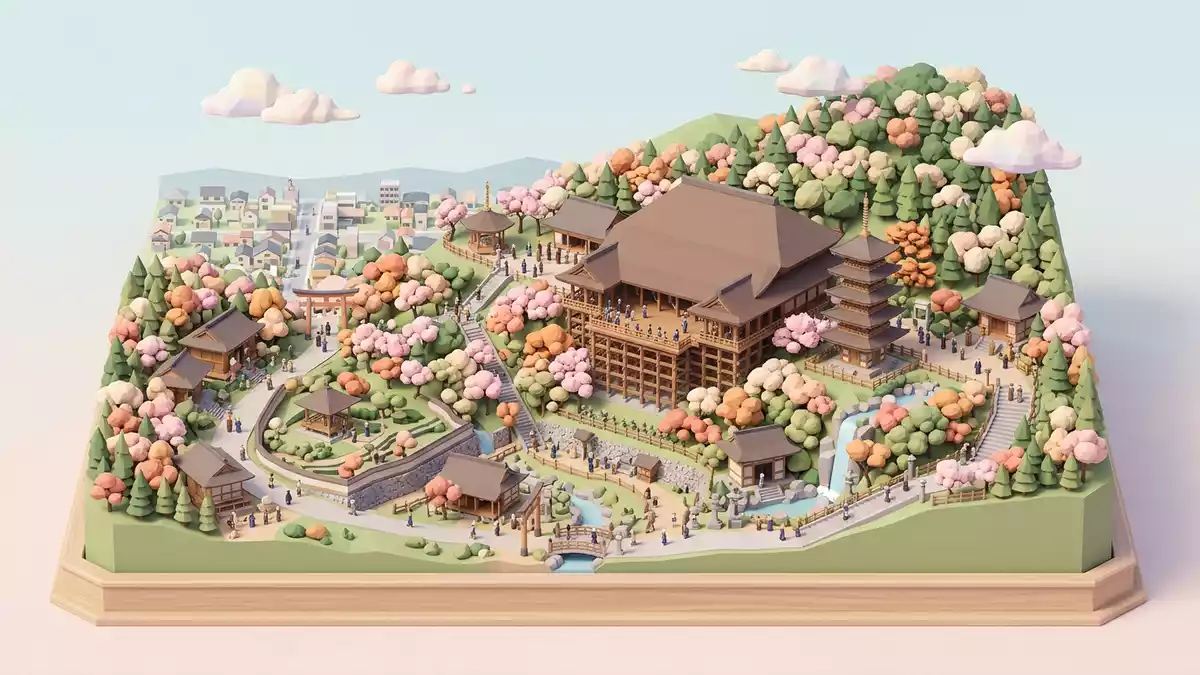
Kiyomizu-dera is a Buddhist temple in eastern Kyoto where a vast wooden terrace projects from the main hall above a steep, wooded hillside. Founded in the eighth century and later rebuilt in the seventeenth century, it forms part of the Historic Monuments of Ancient Kyoto, a UNESCO World Heritage Site.
A temple of pure water on Mount Otowa
The full name of Kiyomizu-dera is Otowa-san Kiyomizu-dera, a reference to Mount Otowa, the low mountain slope on which the temple complex stands. The site takes its identity from the Otowa Waterfall, a spring that gave the temple both its location and its name, which translates as “Pure Water Temple”.Pure Water Temple The waterfall lies at the lower edge of the complex, and its water is directed into three separate streams where visitors drink using metal cups on long poles.
The temple’s origins lie in the late Nara or early Heian period, when the monk Enchin is associated with a first place of worship at the waterfall around 778. Later in the eighth century the general Sakanoue no Tamuramaro is recorded as supporting the establishment of a hall here, linking the young capital at Heian-ky? with this hillside sanctuary.According to the city’s cultural property record Over the centuries Kiyomizu-dera became a major centre for devotion to Kannon, the bodhisattva of compassion.
The seventeenth-century main hall and wooden stage
The heart of Kiyomizu-dera is the Hondo, or main hall, which stands close to the edge of the slope and houses an image of the Eleven-Faced Thousand-Armed Kannon. The present main hall dates from the early Edo period and was rebuilt in 1633 under the Tokugawa shogunate.The Hondo, built in 1633 It is recognised as a National Treasure of Japan and exemplifies the heavy timber construction of seventeenth-century religious architecture in Kyoto.contains buildings from the seventeenth century
Extending from the south side of the main hall is the Kiyomizu Stage, a broad timber veranda that projects above the hillside. It is built in the kakezukuri style, with the floor carried on a lattice of tall wooden pillars and crossbeams anchored into the slope without the use of nails, relying instead on intricate joinery in Japanese zelkova and other hardwoods.built without the use of nails From this platform the city of Kyoto spreads out beyond the foreground of cherry and maple trees that cling to the valley below.
Pagodas, sub-shrines and the World Heritage landscape
Kiyomizu-dera is not a single building but a complex of halls, gates and pagodas arranged across terraces and slopes. A striking three-storied pagoda stands near the entrance, painted in bright vermilion and rising above the tiled roofs around it.the three-storied pagoda Within the same precinct lies Jishu Shrine, dedicated to a deity of love and matchmaking, marked by stone statues and small votive plaques.
In 1994 Kiyomizu-dera was inscribed as part of the Historic Monuments of Ancient Kyoto UNESCO World Heritage Site, an ensemble that recognises the city’s long record of wooden religious architecture and garden design.Historic Monuments of Ancient Kyoto The temple’s position on the hillside east of central Kyoto means that traditional buildings, temple roofs, forested slopes and the modern city skyline all fall within a single field of view from various points in the grounds.
Visiting Kiyomizu-dera: what travellers from Western Europe should know
- Kiyomizu-dera stands on Mount Otowa in Kyoto’s Higashiyama district, east of the Kamo River. It is reached on foot from nearby city streets and public transport stops.
- The temple complex occupies a steep hillside, with long flights of stone steps and sloping paths between the lower gate, main hall and pagoda terraces.
- Several structures, including the wooden stage beneath the main hall, rise high above the ground on exposed timber supports, and some viewpoints are edged by railings rather than solid walls.
- The official language is Japanese and the currency is the Japanese yen.
- Entry requirements depend on your nationality; UK travellers can check the FCDO travel advice at gov.uk/foreign-travel-advice, Irish travellers the Department of Foreign Affairs at ireland.ie.
Searching for Kiyomizu-dera on social platforms
These links open searches for Kiyomizu-dera on each platform.
Frequently asked questions about Kiyomizu-dera
Where is Kiyomizu-dera located in Kyoto?
Kiyomizu-dera stands on the slope of Mount Otowa in the Higashiyama area, east of central Kyoto and the Kamo River.
What should visitors expect when exploring Kiyomizu-dera?
Visitors encounter a large hillside temple complex with steep paths, multiple halls and a wooden stage overlooking trees, city roofs and the Otowa Waterfall.
What makes Kiyomizu-dera distinctive among Kyoto’s temples?
The projecting wooden terrace of the seventeenth-century main hall, its nail-free timber structure and the presence of the Otowa Waterfall together give Kiyomizu-dera its distinctive character.


